 Divisi
African armyworm
Spodoptera exempta · Insect
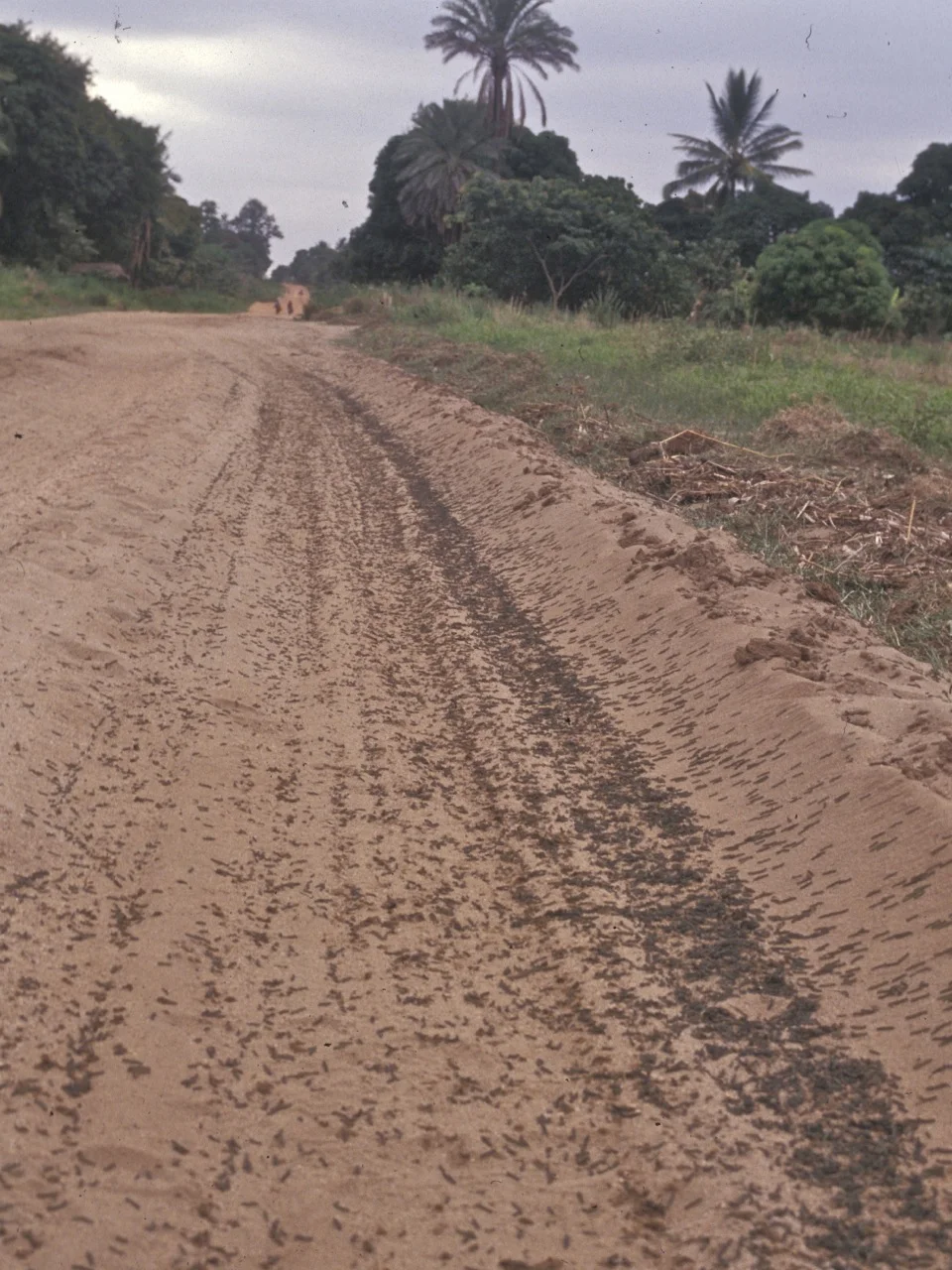
Photo: ChriKo · CC BY-SA 4.0
The African armyworm (Spodoptera exempta) is a migratory moth whose caterpillars erupt in sudden, dense outbreaks and march in "armies" across cereal and grass fields. Driven by rains following a dry spell, the young larvae feed together in huge numbers on the leaves of maize, sorghum, millet, wheat, rice and pasture grass, and can strip a young crop to bare ground within days before pupating in the soil and moving on.
Why it matters
African armyworm is a sudden-outbreak pest that can strip a young cereal or grass field to bare ground in just a few days — a bad attack can take your whole crop (up to 100% loss). It hits hardest at the seedling stage, arriving overnight in huge marching masses after the first rains, and the biggest caterpillars do the most damage in their final days before vanishing into the soil. Because the army marches in from surrounding fields and grassland, no one farmer can stop it alone — and by the time the damage is obvious the caterpillars are often large and hard to kill, so acting the moment they appear is everything.
When to act
Act immediately on reports of marching caterpillars or when young larvae are found feeding in numbers on seedlings and grass.
This guidance is general, compiled from published agronomic references including FAO and CABI. Thresholds and timing shift with your crop, your variety and the season.
In much of the region a spray is simply called mushonga — medicine. But a chemical group you cannot name is one you cannot rotate, and a product you did not write down has no pre-harvest interval you can observe. Mushonga, and other farming words →
The full African armyworm field guide
Identify it
The damage you see first
whole patches of young cereal and grass stripped astonishingly fast — leaves eaten to ragged shreds or right down to the midrib, and bare ground where a green field stood a day or two before.
Up close, the earliest sign
young caterpillars scrape one side of the leaf, leaving pale, papery "window" patches you can see through, before they grow big enough to eat right through the leaf.
The signature — the march:
masses of caterpillars, often in their hundreds or thousands, crawling together in a moving "front" across the ground and up the plants. When they eat one patch bare they march on to the next — seeing them march is the surest sign it is armyworm.
The caterpillar itself
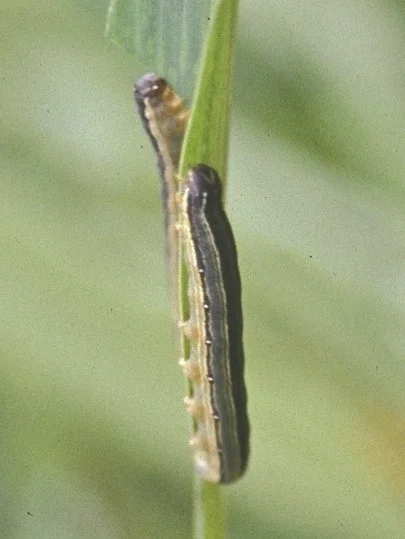
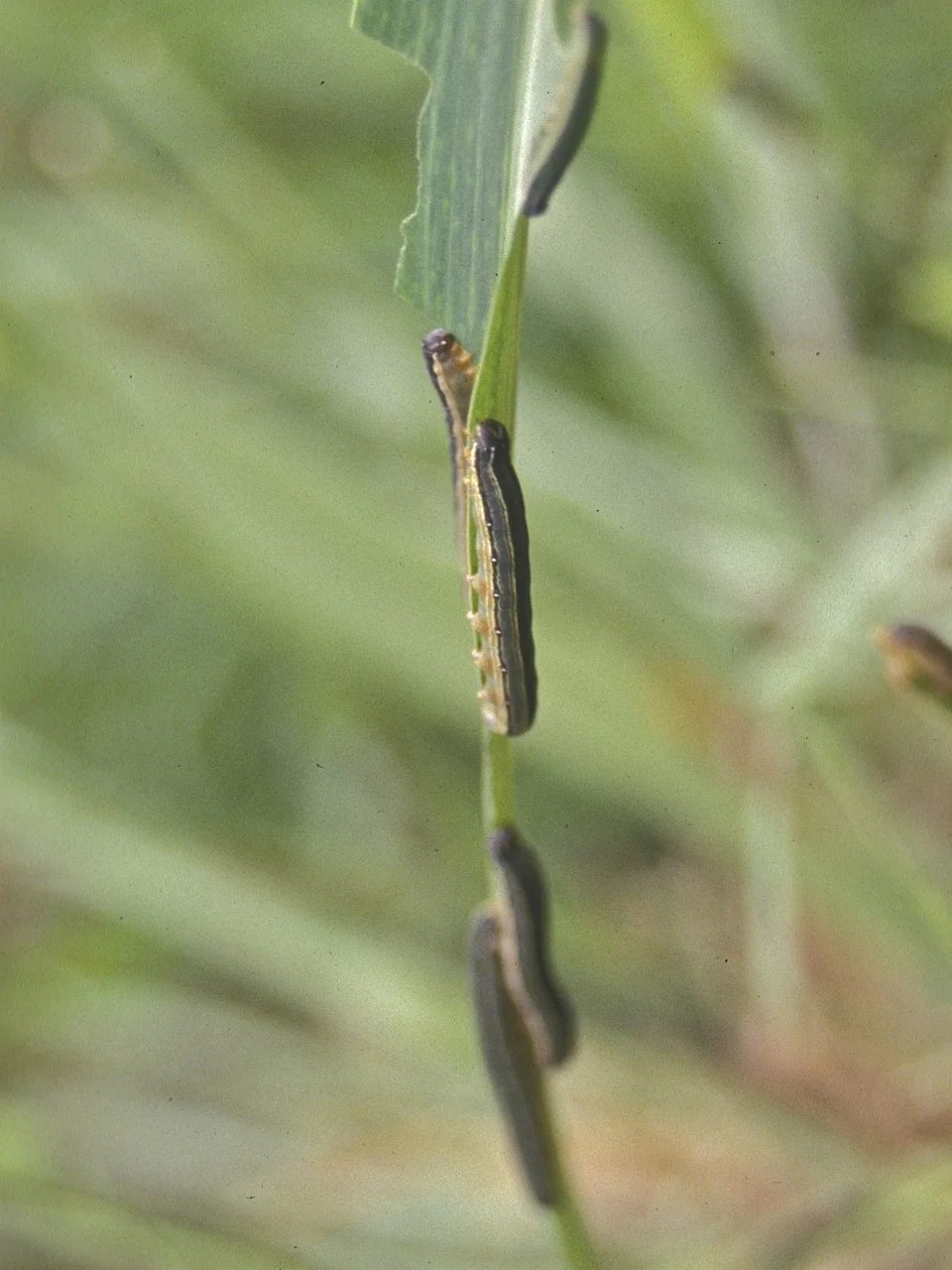
about matchstick length (3–4 cm), and in an outbreak velvety black with thin pale-yellow stripes down the back and along each side and a shiny black head; the belly is greenish and paler. (When few and scattered they can be dull green and easy to miss — the black colour comes with the crowd.)
Where they hide by day
in hot, bright sun they shelter at the base of the plants, under leaf litter, soil clods and in cracks in the ground — lift and look there. They come out to feed in the cool: at night, at dawn, at dusk and in dull, cloudy weather.
Don't confuse it
fall armyworm sits one or two deep in the whorl and never marches; the maize stalk borer makes neat rows of shot-holes and tunnels the stem; cutworms hide in the soil and cut single seedlings at night. African armyworm is the one that comes in swarming masses out on the leaves and marches across the field.
Scout for it
When to be on alert
from the first rains after a dry spell — especially when a flush of young green grass appears — and right through your crop's seedling and early-growth weeks, its most vulnerable stage. That is when the migrating moths pour in and lay their eggs.
Heed the warning network
take notice of regional armyworm forecasts, pheromone-trap catches (traps that lure and catch the moths) and word from up-wind neighbours. An outbreak sweeps a district as a wave, so a report from up-wind is your cue to start checking every day.
Walk a big "W"
cross the field in a "W" so you cover all four corners, the middle, and — above all — the edges next to grassland or pasture where the army marches in from. Make about 10 stops.
At each stop, check three places
the young leaves and whorls for scraping and small caterpillars; the grass and weeds in and around the crop; and the soil at the plant base (lift litter and clods) where they hide by day. Scout at dawn or dusk, when they are up feeding.
The trigger — act the same day:
with armyworm there is no safe "wait and see". Treat immediately if even a few of the plants you check each carry several small caterpillars, if you find a dense patch feeding together, or if you hear of caterpillars marching nearby — presence in numbers is the threshold.
Control it
Prevent
-
plant ahead of it:
follow the early-warning forecasts and plant early and all at once with your neighbours, so your crop grows past the tender seedling stage before moth numbers peak. This cultural first line is cheap and it protects the whole area at once.
-
trap the march:
because they travel along the ground, plough a steep-sided furrow or dig a ditch around the field. Marching caterpillars tumble in and cannot climb out — then bury, burn, crush or flood them. Report the outbreak to your community or extension network so the whole area acts together.
Act early — natural biological spray:
while the caterpillars are still small, spray a caterpillar-specific biological where you can get it — NPV (nucleopolyhedrovirus, a natural virus of armyworm) or Bt (Bacillus thuringiensis, a natural soil bacterium that kills only caterpillars). It is safe for you, bees, birds and the wasps and beetles that also eat armyworm, so avoid blanket poisons that kill those helpers. It only works on young larvae — spray as soon as you find them. For a small patch you can also knock caterpillars into a bucket of soapy water or sweep them into the trap furrow.
Last resort — chemical spray, used carefully:
if the outbreak is confirmed and numbers are high, a pyrethroid — a fast-acting contact insecticide (it kills on touch, so it need not be taken up inside the plant) — works well because armyworm feeds out in the open, not hidden in the whorl. Target the young larvae and the marching front or infested patches, not a blanket spray. Safety: cover your skin, eyes, nose and mouth; spray in the cool of morning or evening with the wind behind you; keep it off food, drinking water, children, livestock and bees; respect the pre-harvest interval (the set number of days you must wait between spraying and eating or selling the crop); and wash yourself and your clothes afterwards. Resistance: rotate to a different chemical group each time so the armyworm does not stop responding to the spray.
If it keeps spreading, or it's too late
if caterpillars keep marching in despite spraying, keep the trap furrow charged and push neighbours and the extension service to treat together — a migratory army is beaten area-wide, not field by field. If a seedling crop is stripped, don't despair: the army is only passing through and will soon move on, so once it has gone you can often replant and still make a season. If the crop is already mature, harvest what you can rather than spend more on spray.
Catch African armyworm before it costs you the harvest
This guide is the general answer. Divisi works out yours — the week to scout your own field for African armyworm, and what to do the day you find it.


Crops it affects
Plan the crops it attacks
-
 When to plant Maize in Mougalaba
 -
 When to plant Rice in Mbama
 -
 When to plant Sorghum in Maracha
 -
 When to plant Wheat in Hammedi
All planting calendars, country by country
Get Insights by email
A short digest of new Divisi articles. No email on quiet weeks.
Frequently asked questions
How do I identify African armyworm?
The damage you see first. whole patches of young cereal and grass stripped astonishingly fast — leaves eaten to ragged shreds or right down to the midrib, and bare ground where a green field stood a day or two before.
When should I take action against African armyworm?
Act immediately on reports of marching caterpillars or when young larvae are found feeding in numbers on seedlings and grass.
How do I control African armyworm?
Prevent — plant ahead of it:. follow the early-warning forecasts and plant early and all at once with your neighbours, so your crop grows past the tender seedling stage before moth numbers peak. This cultural first line is cheap and it protects the whole area at once.
Which crops are attacked by African armyworm?
Among the crops covered here: Maize, Rice, Sorghum, Wheat.