 Divisi
Bean fly
Ophiomyia phaseoli · Insect
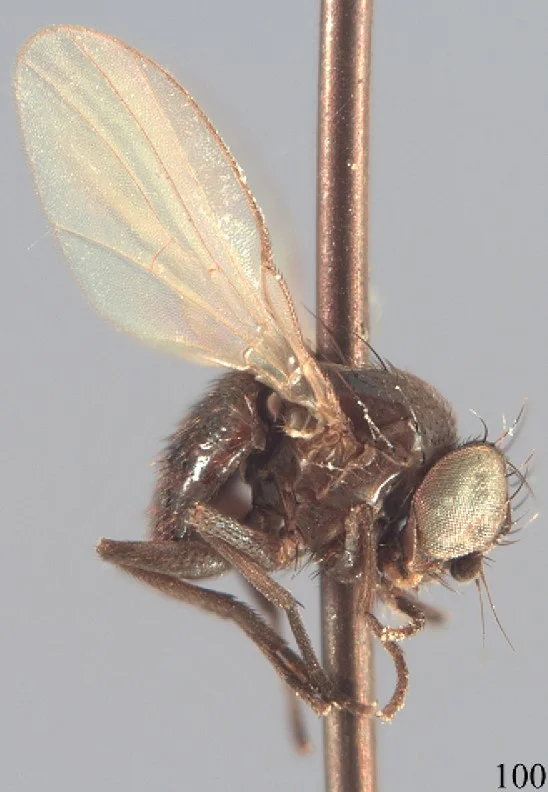
Photo: Lonsdale O, Murphy ST, Scheffer SJ · CC BY 4.0
Bean fly (also called bean stem maggot) is a tiny shiny-black fly whose maggots are the deadliest enemy of young beans, cowpeas and soybeans. The female pricks the first leaves to feed and lay eggs; the maggot that hatches tunnels down inside the leaf and into the stem, eating its way to the base at the soil line. Because it works hidden inside the stem of a seedling too young to withstand it, a single maggot can kill a plant — and a bad attack in warm, dry weather can take almost the whole stand.
Howard F. Schwartz, Colorado State University, Bugwood.org · CC BY 3.0 us 
Internet Archive Book Images · No restrictions
Why it matters
Bean fly is the number-one killer of young beans, cowpeas and soybeans. Its maggots tunnel down inside the stem of your seedlings and rot the base, and a bad attack can wipe out up to 9 in every 10 plants — often before the crop is three weeks old. The worst part is there is no cure once it is in: the maggot hides inside the stem where no spray can reach it, and by the time the leaves go yellow and wilt the plant is already dying. With bean fly, everything depends on stopping it before it starts — protect the seed and the seedling, because you cannot save a plant once it is mined.
When to act
Any yellowing or wilting of seedlings within three weeks of emergence, or larval mines seen when stems are split; act early because damage is fatal to young plants.
This guidance is general, compiled from published agronomic references including FAO and CABI. Thresholds and timing shift with your crop, your variety and the season.
In much of the region a spray is simply called mushonga — medicine. But a chemical group you cannot name is one you cannot rotate, and a product you did not write down has no pre-harvest interval you can observe. Mushonga, and other farming words →
The full Bean fly field guide
Identify it
The first sign is the seedlings themselves
within two to three weeks of coming up, the lower leaves turn yellow and the young plant wilts in the heat even though the soil is still moist. Look closely at the first leaves and you may spot tiny yellow or whitish dots near the base — the pinpricks where the fly fed and laid its eggs.
Hold a leaf up to the sunlight
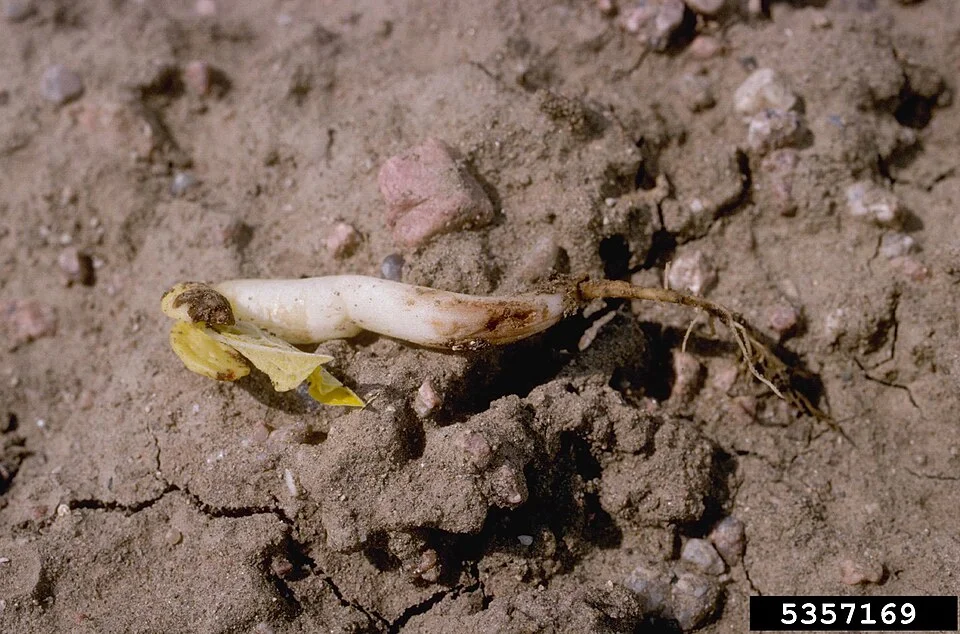
and look for a faint, pale winding line just under the skin of the leaf — this is the mine, the tunnel the maggot ate on its way down to the stem. Then follow the trouble to the base of the stem at the soil line: an attacked plant has a swollen, cracked stem base, often reddish-brown, with a mass of fine new roots bursting out above the crack — the plant's last effort to stay alive.
Slit that swollen stem base with your thumbnail or a knife
Inside you will find the culprit — a tiny white, legless maggot shorter than a grain of rice, or a small brown, grain-like pupa (its resting stage, before it turns into a fly). The adult is a shiny-black fly barely 2 mm long, smaller than a fruit fly and easy to miss; you rarely see the fly, you see its damage.
Don't confuse it with
drought — wilted plants perk up again after watering, but bean-fly plants never recover; damping-off disease — the stem base goes soft and rotten with no tunnel and no maggot inside, while bean fly leaves a firm, cracked, tunnelled stem with a maggot in it; cutworm — cuts the seedling clean off at the ground at night and leaves it lying, while bean fly leaves the plant standing but tunnelled; and simple hunger (poor soil) — an all-over pale yellowing with no stem cracking and no mine.
Scout for it
Scout every 2–3 days from the day the seedlings break the soil until the third trifoliate (three-part) leaf opens — about the first three weeks
This short window is the only time bean fly can kill your crop and the only time you can still act, so do not miss it. Watch hardest in warm, dry weather and after late or staggered planting, when the fly is at its worst.
Walk a big "W" across the field so you cover all four corners and the middle — not just the edge nearest the path. Make about 10 stops, and check 10 seedlings at each stop.
At every plant look for yellowing or wilting, check the first leaves for feeding dots, and hold a leaf to the light for a mine. At a few plants each stop, pull one up and split the stem base to look for the white maggot or brown pupa right at the soil line.
The trigger is almost zero — lead with this
Because just one maggot kills a seedling and you cannot cure a mined plant, do not wait for a big count: if you find yellowing, wilting, or a mine on even 1 seedling in 10 within three weeks of emergence — or a maggot when you split a stem — treat and protect the rest of the field now, and line up treated seed for your next planting.
Control it
Prevent it first — this is the whole battle
Plant early, as soon as the rains are steady, into a warm, well-prepared seedbed so your seedlings grow away fast and pass the tender three-week stage before the fly builds up. Sow a bit thicker (a higher seed rate) so that even if you lose some seedlings you still keep a full stand. Spread mulch and give the crop enough manure or fertiliser — a strong, fast-growing seedling shrugs off an attack that would kill a starved one.
Break the fly's cycle
Do not plant beans straight after a bean, cowpea or soybean crop that was hit — the fly carries over in the old stems; instead rotate to a non-legume such as maize and clear or bury the old crop residues. Where you can get them, plant tolerant or resistant varieties — beans that root strongly and re-root above damage survive far better.
Protect the seed — the one chemical that reaches this pest
Because the maggot feeds hidden inside the stem where no surface spray can touch it, use a systemic seed treatment: a chemical dressing you coat onto the seed before planting that is taken up into the plant's sap, so the growing seedling is poisonous to the maggot from the inside. (Systemic = the chemical travels inside the plant; a contact spray only kills what it lands on, which is useless against a maggot buried in the stem.)
Treated seed is poison — handle it with care
Wear gloves, keep the dust off your skin and out of your nose and mouth, and wash well afterwards. Never eat treated seed, never feed it to people or animals, and never mix it into grain for eating or selling — dress only as much seed as you will plant, keep the bag labelled and away from children, food and animals, and bury any spilled seed. If instead you apply a systemic drench or spray at emergence, spray in the cool of the day with the wind at your back, keep it off food, water, children and bees, and respect the pre-harvest interval — the number of days the label tells you to wait before harvest so no poison is left on the food.
Stop the fly building resistance
Use the treatment only at the vulnerable seedling stage, follow the label rate exactly, and rotate to a different chemical group each season so the fly never gets used to one poison and stops dying from it (that is what resistance means).
If seedlings are already wilting, work on the survivors — you cannot cure the mined ones
Earth up soil around the base of the standing plants so they push new roots above the damaged collar, and keep them fed and watered to grow through it. Gap-fill or replant the bare patches quickly while it is still early in the season. If too much of the stand is lost and it is too late to recover, cut your losses — replant that patch or switch it to another crop — and make treated seed, early planting, rotation and a tolerant variety your firm plan for next season.
Catch Bean fly before it costs you the harvest
This guide is the general answer. Divisi works out yours — the week to scout your own field for Bean fly, and what to do the day you find it.


Crops it affects
Plan the crops it attacks
-
 When to plant Common bean in Dilolo
 -
 When to plant Cowpea in Bangui-Rapides
 -
 When to plant Soybean in Dola
All planting calendars, country by country
Get Insights by email
A short digest of new Divisi articles. No email on quiet weeks.
Frequently asked questions
How do I identify Bean fly?
The first sign is the seedlings themselves. within two to three weeks of coming up, the lower leaves turn yellow and the young plant wilts in the heat even though the soil is still moist. Look closely at the first leaves and you may spot tiny yellow or whitish dots near the base — the pinpricks where the fly fed and laid its eggs.
When should I take action against Bean fly?
Any yellowing or wilting of seedlings within three weeks of emergence, or larval mines seen when stems are split; act early because damage is fatal to young plants.
How do I control Bean fly?
Prevent it first — this is the whole battle. Plant early, as soon as the rains are steady, into a warm, well-prepared seedbed so your seedlings grow away fast and pass the tender three-week stage before the fly builds up. Sow a bit thicker (a higher seed rate) so that even if you lose some seedlings you still keep a full stand. Spread mulch and give the crop enough manure or fertiliser — a strong, fast-growing seedling shrugs off an attack that would kill a starved one.
Which crops are attacked by Bean fly?
Among the crops covered here: Common bean, Cowpea, Soybean.