 Divisi
Bruchids (bean and cowpea weevils)
Callosobruchus maculatus · Storage
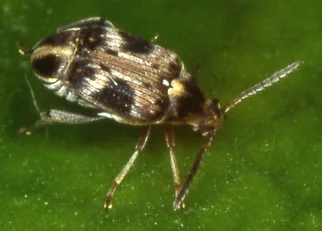
Photo: limbatus · CC BY 2.0
Bruchids — the bean and cowpea weevils — are small brown beetles whose grubs live and feed hidden inside stored bean, cowpea, groundnut and pigeon-pea seeds. It starts quietly: females glue tiny eggs onto the pods as they dry in the field, or onto the grain in the store, and each grub bores into a single seed and eats it hollow from the inside before chewing its way out as a new beetle through a neat round 'window' hole. In a warm, humid store they breed again and again every few weeks, so a handful of beetles at harvest can turn a full store into powder within months.
limbatus · CC BY 2.0 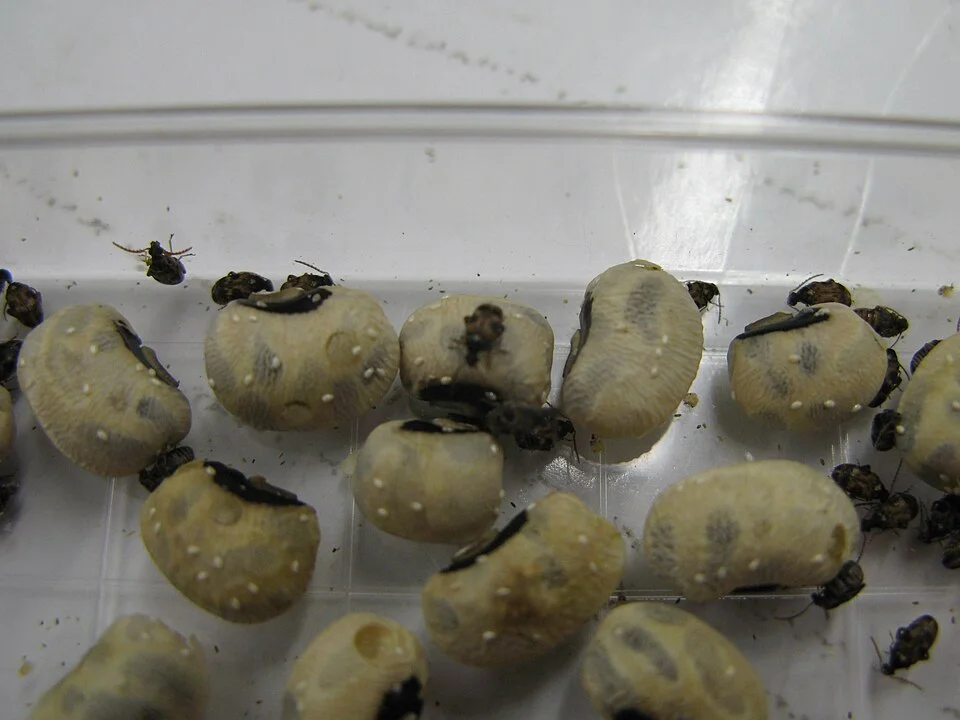
Originality1988 · CC BY-SA 3.0
Why it matters
Bruchids can wipe out your whole store — up to 100% of your beans — turning grain you meant to eat or sell into hollow shells full of powder, and spoiling seed so it won't even sprout. They do their damage hidden inside the seed, so by the time you spot the beetles and holes it is already done and multiplying. In a warm store their numbers double and double every few weeks, so a few beetles at harvest can eat out the whole stock in a single season. That is why keeping them out — clean, dry, airtight storage — matters far more than trying to kill them once they are in.
When to act
any adults, exit holes or eggs seen on stored grain
This guidance is general, compiled from published agronomic references including FAO and CABI. Thresholds and timing shift with your crop, your variety and the season.
In much of the region a spray is simply called mushonga — medicine. But a chemical group you cannot name is one you cannot rotate, and a product you did not write down has no pre-harvest interval you can observe. Mushonga, and other farming words →
The full Bruchids (bean and cowpea weevils) field guide
Identify it
The damage you'll see first
neat, round holes like tiny windows or portholes bored through the beans, and grain hollowed out and full of fine, whitish powder. Infested beans feel light and may rattle; scoop a handful and you'll see powder sifting to the bottom of the tin or sack. This grain fetches little at market, and if you plant it, it won't sprout.
The beetle itself
very small — about the size of a rice grain or smaller (2–3 mm) — reddish-brown and rounded, with no long snout or 'nose'. Its pointed tail-end sticks out past the wing covers, often marked with two dark spots. Look for them crawling over the grain and up the sacks in the warm part of the day; they love it hot and humid.
The early sign, before any holes appear
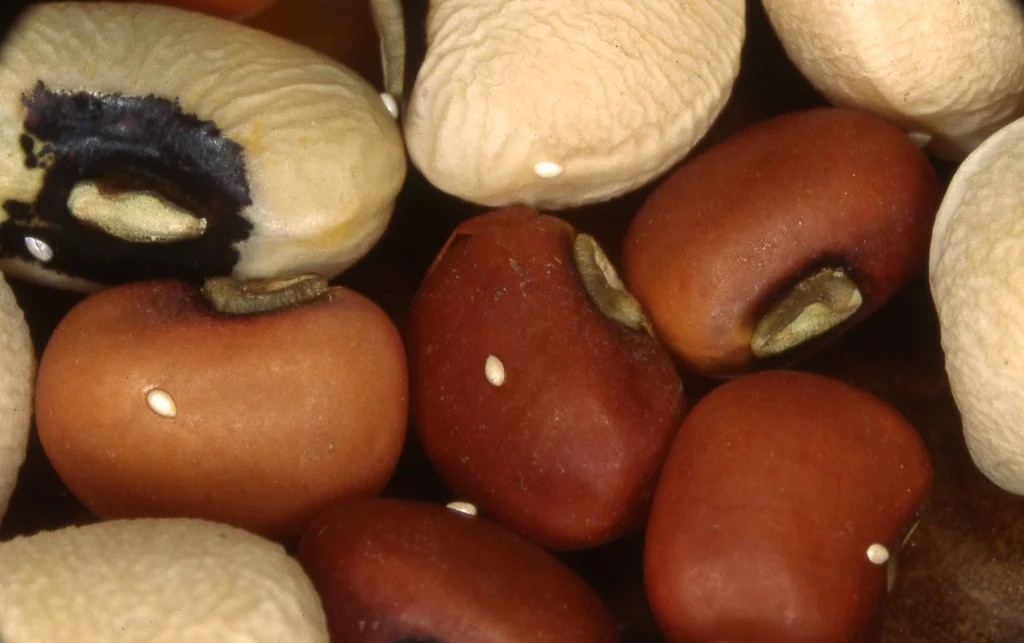
tiny clear, pearly domes glued flat onto the seed coat — like little dried water-drops stuck on the bean — and sometimes a faint pale round 'window' just under the skin, where the next beetle is about to chew its way out.
Don't confuse it
with the maize or rice weevil, which has an obvious long snout (nose) and attacks cereal grains like maize and rice. On beans and cowpea, a small, snout-less, rounded beetle leaving round window-holes is a bruchid.
Scout for it
Start early — the trouble begins in the field
Beetles fly in and lay eggs on the pods as they dry and ripen late in the season, before you even harvest, so check the crop at drying, harvest and shelling. Then check the store every 2–4 weeks right through storage — and more often in hot, humid weather (they breed fastest at about 25–35°C).
Take a proper sample — don't just glance at the top
Scoop grain from the top, middle and bottom of each drum or bag, and from several bags across the stack (walk a 'W' over your store, not one spot). Pour a cupful onto a plate or cloth in good light and spread it out thin.
Look — and listen — for:
live beetles crawling, round window exit-holes, light, hollow beans, whitish powder at the bottom, and tiny eggs stuck on the seed coats. Put your ear to a full tin: a faint rustling means a heavy load hidden inside. (Quick test: drop beans in water — badly bored, hollow ones tend to float.)
Act on the very first sign — there is no safe number
Even one live beetle, one exit-hole, or eggs on the grain means treat now. What shows on the surface is only a fraction of what is growing hidden inside the seeds, so never wait for 'a few more' — by then it has already multiplied.
Control it
Prevent it — start clean and dry
Harvest as soon as the pods are ripe; don't leave beans standing in the field to dry, where beetles fly in and lay their eggs. Dry the grain hard (a well-dried bean can't be dented with a fingernail or a tooth). Before storing, scrub out the store and containers and burn last season's leftover grain and pod trash where beetles hide. Never tip new grain onto old — store this season's crop on its own, and store only whole, unbroken beans.
Seal it away from air — the single best thing you can do
Pack the dry beans into an airtight (hermetic) container — a metal drum or plastic barrel with a tight, sealing lid, or triple-layer airtight storage bags (known as PICS bags). Fill it right up and close it tight: any beetles trapped inside use up the air and suffocate, and no new ones can get in. For a smallholder store this works better than any spray.
If beetles are already in the grain, treat without chemicals first
Mix the dry beans through with an inert dust — clean wood ash, or diatomaceous earth (a fine, chalk-like mineral powder that is safe on food) — coating every seed; the sharp, dry dust kills the beetles by scratching and drying them out. For seed you'll keep for planting, or small amounts to eat, you can instead rub the beans with a little cooking oil (about a spoonful per few kilos): the oil smothers the eggs so they never hatch.
Sun-heat (solarise) small lots
Spread infested grain in a thin layer inside a black plastic bag or sheet and leave it in full, hot sun for a few hours (an afternoon under clear plastic works too). The heat cooks the eggs, grubs and beetles hidden inside the seeds. Let it cool, then store it airtight so it can't be re-infested.
Chemical dust — only as a last resort
If you must keep a large amount for a long time and the steps above aren't enough, mix through a grain-protectant dust (a dust made and registered for stored grain), spread evenly at the rate on the label. It is a poison: cover your nose, mouth, skin and eyes, mix it outdoors with the wind behind you, and keep it away from food you're about to eat, from water, children, animals and bees; wash well afterwards. Respect the withholding period — the number of days the label says you must wait after treating before the grain is safe to eat or sell — so only treat grain going into long storage. And don't use the same dust every season: the beetles build resistance (the chemical stops working on them), so lean on airtight storage first and switch to a different chemical group if you ever treat again.
If beetles keep coming back — or it's too late
Still seeing them after you've sealed and treated? The seeds were already infested inside when you stored them — tip the grain out, sort out and throw away every holed, hollow or powdery bean, sun-heat or re-treat the good grain, clean the container, and re-seal. If a bag is mostly holes and powder, it's a write-off — don't keep it 'just in case', because it will re-infest your good store. Cut your losses: grind it for animal feed or destroy it straight away, and get the sound grain into airtight storage now.
Catch Bruchids (bean and cowpea weevils) before it costs you the harvest
This guide is the general answer. Divisi works out yours — the week to scout your own field for Bruchids (bean and cowpea weevils), and what to do the day you find it.


Crops it affects
Plan the crops it attacks
-
 When to plant Cowpea in Bangui-Rapides
 -
 When to plant Groundnut in Songo
 -
 When to plant Pigeon pea in Buganda
All planting calendars, country by country
Get Insights by email
A short digest of new Divisi articles. No email on quiet weeks.
Frequently asked questions
How do I identify Bruchids (bean and cowpea weevils)?
The damage you'll see first. neat, round holes like tiny windows or portholes bored through the beans, and grain hollowed out and full of fine, whitish powder. Infested beans feel light and may rattle; scoop a handful and you'll see powder sifting to the bottom of the tin or sack. This grain fetches little at market, and if you plant it, it won't sprout.
When should I take action against Bruchids (bean and cowpea weevils)?
any adults, exit holes or eggs seen on stored grain
How do I control Bruchids (bean and cowpea weevils)?
Prevent it — start clean and dry. Harvest as soon as the pods are ripe; don't leave beans standing in the field to dry, where beetles fly in and lay their eggs. Dry the grain hard (a well-dried bean can't be dented with a fingernail or a tooth). Before storing, scrub out the store and containers and burn last season's leftover grain and pod trash where beetles hide. Never tip new grain onto old — store this season's crop on its own, and store only whole, unbroken beans.
Which crops are attacked by Bruchids (bean and cowpea weevils)?
Among the crops covered here: Cowpea, Groundnut, Pigeon pea.