 Divisi
Cabbage aphid
Brevicoryne brassicae · Insect
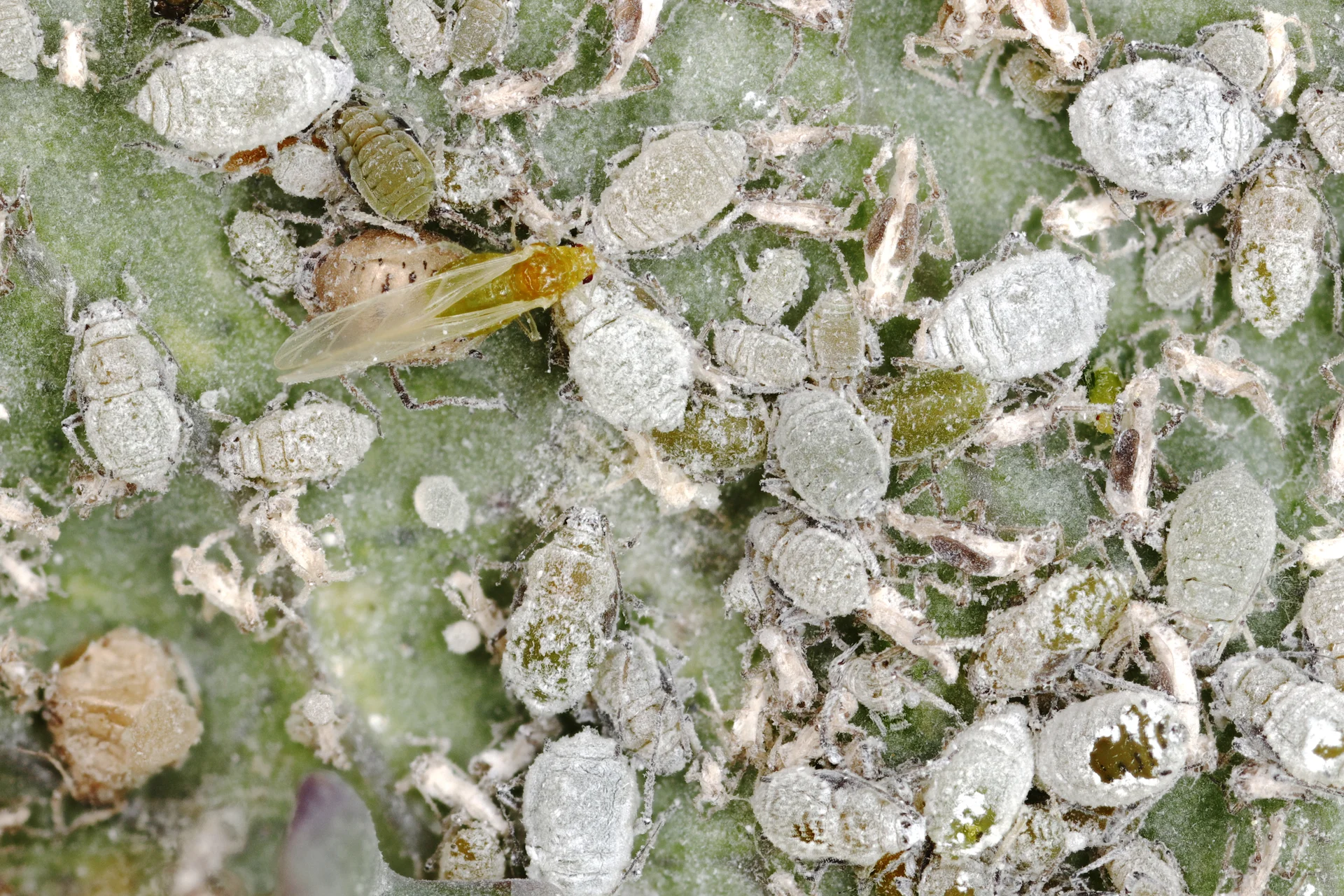
Photo: Sanjay Acharya · CC BY-SA 4.0
The cabbage aphid (Brevicoryne brassicae) is a small, soft-bodied, grey-green insect dusted with a fine white-grey mealy wax, so a colony looks like ash or flour on the plant. It attacks only the cabbage family — cabbage, kale, rape, broccoli and cauliflower — packing into dense colonies on the growing point (the heart) and the undersides of the youngest leaves. In cool, dry weather the females give birth to live young without mating, so colonies explode in days. As they suck sap they stunt and curl the leaves, coat the plant in sticky honeydew that turns black with sooty mould, and can pass on several brassica viruses.
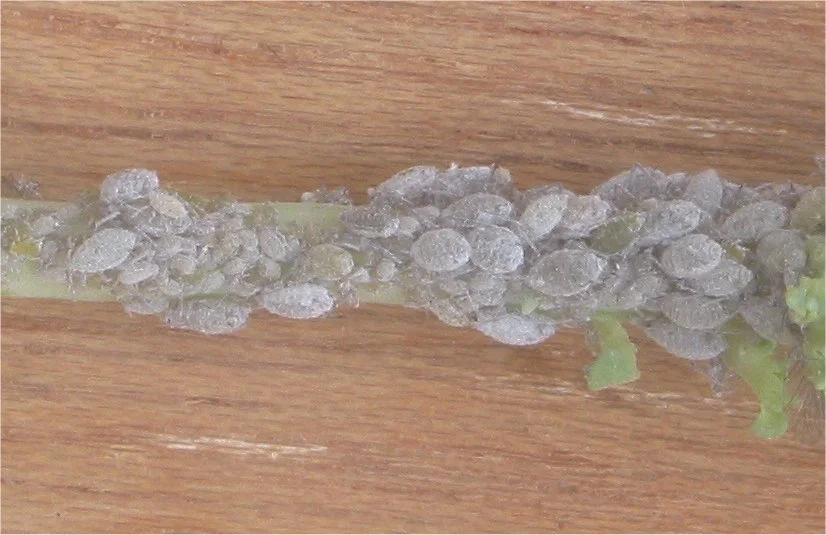
Rasbak · CC BY-SA 3.0 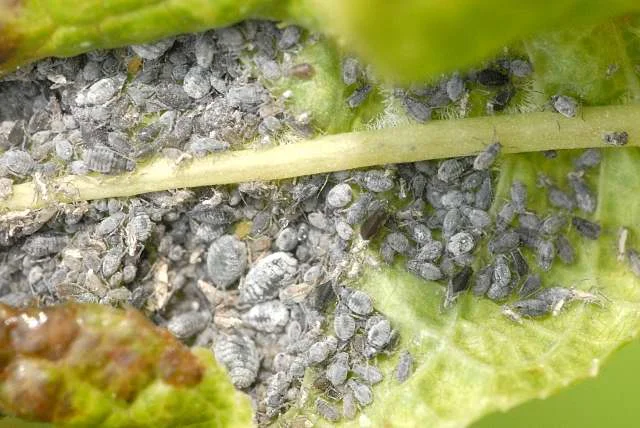
James K. Lindsey · CC BY-SA 3.0
Why it matters
Cabbage aphids can take up to 40% of your brassica crop — nearly half. They don't only weaken the plant by sucking its sap; they pack into the heart and foul it with sticky honeydew, black sooty mould and grey cast skins, so even lightly infested cabbages, kale or rape won't sell. Once a colony is set it is hard to stop: in cool, dry weather a few aphids become thousands within a week — each female births live young without mating — and they hide deep in the growing point and under the leaves where sprays struggle to reach. Catching them early, while colonies are few and near the surface, is everything.
When to act
colonies on the growing point or 5-10% of plants infested
This guidance is general, compiled from published agronomic references including FAO and CABI. Thresholds and timing shift with your crop, your variety and the season.
In much of the region a spray is simply called mushonga — medicine. But a chemical group you cannot name is one you cannot rotate, and a product you did not write down has no pre-harvest interval you can observe. Mushonga, and other farming words →
The full cabbage aphid field guide
Identify it
The damage first
the youngest inner leaves and the heart of the plant curl, pucker and yellow, and growth stalls. Look for a shiny, sticky coating (honeydew — the sugary waste the aphids drip) on the leaves that later turns into a black, dusty film (sooty mould), and heads, hearts or curds fouled with insects and white flecks that no buyer will take.
The pest itself
tiny soft-bodied aphids about 2 mm long — smaller than a rice grain, roughly a pinhead — packed shoulder-to-shoulder in dense grey colonies. Each is grey-green but coated in a fine white-grey mealy wax, so a cluster looks like the plant's heart has been dusted with grey ash or flour. They shelter on the undersides of leaves and deep in the growing point, mostly wingless and barely moving; cast white skins build up under them.
Tell it apart
the green peach aphid is shiny green, bare (no waxy powder) and scattered, not packed into grey mats. Whiteflies are tiny and fly up in a white cloud when you disturb the plant — aphids stay put. If it's a brassica and the colony is grey, mealy and jammed into the heart or under the young leaves with white cast skins, it is cabbage aphid.
Scout for it
When
check hardest through the leafy-growth stage and the heading stage (as plants build their frame and cabbages, curds or broccoli heads start to form) and all through the cool, dry season, when aphids multiply fastest. These are the stages where a fouled growing point ruins the very part you sell.
How often, and how to walk
walk the field twice a week right through the risk window — colonies multiply so fast that a once-a-week look can miss the jump from a few aphids to thousands. Each time, move through the field in a big "W" so you cover all four corners and the middle, not just the edge by the path. Make about 5 stops, and at each stop check 10 plants — around 50 plants in all.
What to check
at each plant, part the youngest leaves and look into the growing point (the heart) and at the undersides of the outer leaves — that is where colonies start. Also watch for ants running up the stems (ants farm aphids for their honeydew), curled or puckered leaves, and any sticky shine.
When to act
the moment you find aphids on about 1 in 20 to 1 in 10 plants (5–10%) — that is roughly 3 to 5 of your 50 plants — or even one colony sitting in a growing point, act now. Don't wait: a small colony becomes thousands within a week.
Control it
Prevent it
-
break the bridge:
as soon as a crop is finished, pull out and destroy (feed to livestock, bury or burn) all old brassica stalks, residues and self-sown volunteer brassicas. These are the green bridge the aphids survive on between crops. Don't plant brassicas in the same ground back-to-back — leave a host-free gap and rotate to a non-brassica like maize or beans so the aphids starve.
-
strong plants and helpers:
keep plants vigorous and well-watered, because dusty, water-stressed crops attract aphids and lose their natural enemies. A reflective mulch (silvery plastic or pale straw between the rows) confuses incoming winged aphids. Protect the aphids' enemies — ladybirds and their alligator-shaped larvae, hoverfly maggots crawling among the colony, and parasitic wasps that turn aphids into swollen brown "mummies" — and never spray broad, kill-everything poisons that wipe these helpers out.
Act early — soft first:
when only a few colonies show up, pinch off and destroy the infested outer leaves by hand while it is still small — but on cabbage, cauliflower and broccoli, leave the growing point (the heart) alone, because that heart becomes the very head or curd you sell, so cutting it out throws away the whole plant's yield rather than saving it. (Sacrificing a heart is a last-ditch move for plants already packed with aphids — see below — not an early fix.) Leafy kale and rape have no heart to lose, so an infested growing tip on those can be nipped off with little cost. For more than a few colonies, spray a soft insecticidal-soap (soap or a light oil). This is a contact spray — it kills only the aphids the liquid actually wets, not ones it misses — so you must soak the undersides of the leaves and right into the growing point, and repeat every few days as new aphids hatch. Even this soft spray, apply it in the cool of the day and keep it off open flowers where bees feed.
Chemical — last resort only:
if colonies keep growing past the threshold despite the steps above, use a selective aphicide — one made to hit aphids while sparing ladybirds, wasps and bees — never a broad-spectrum poison that destroys your helpers and makes the next outbreak worse. Safety: cover skin, eyes, nose and mouth; spray in the cool of morning or evening with the wind at your back; keep it off food, water, children and bees; respect the pre-harvest interval (the set number of days you must wait between the last spray and eating or selling the crop — read the label); and wash yourself and your clothes afterwards. Resistance: cabbage aphid grows immune fast, so rotate to a different chemical group each time — never spray the same product over and over.
If it keeps spreading
strip off and destroy the worst-fouled outer leaves and any plant whose heart is packed with aphids, to pull out the reservoir before it seeds the rest. When it's too late — heads or curds already grey with aphids, honeydew and mould near harvest won't sell — cut your losses: harvest whatever is still clean, then pull and destroy the crop residue immediately so it can't bridge to your next planting, and put the next crop on non-brassica ground.
Catch cabbage aphid before it costs you the harvest
This guide is the general answer. Divisi works out yours — the week to scout your own field for cabbage aphid, and what to do the day you find it.


Crops it affects
Plan the crops it attacks
-
 When to plant Rape / covo / kale in Ntoroko
 -
 When to plant Spider plant in Ibeno
 -
 When to plant Cabbage in Les Eucalyptus
All planting calendars, country by country
Get Insights by email
A short digest of new Divisi articles. No email on quiet weeks.
Frequently asked questions
How do I identify cabbage aphid?
The damage first. the youngest inner leaves and the heart of the plant curl, pucker and yellow, and growth stalls. Look for a shiny, sticky coating (honeydew — the sugary waste the aphids drip) on the leaves that later turns into a black, dusty film (sooty mould), and heads, hearts or curds fouled with insects and white flecks that no buyer will take.
When should I take action against cabbage aphid?
colonies on the growing point or 5-10% of plants infested
How do I control cabbage aphid?
Prevent it — break the bridge:. as soon as a crop is finished, pull out and destroy (feed to livestock, bury or burn) all old brassica stalks, residues and self-sown volunteer brassicas. These are the green bridge the aphids survive on between crops. Don't plant brassicas in the same ground back-to-back — leave a host-free gap and rotate to a non-brassica like maize or beans so the aphids starve.
Which crops are attacked by cabbage aphid?
Among the crops covered here: Cabbage, Rape / covo / kale, Spider plant.