 Divisi
Papaya mealybug
Paracoccus marginatus · Insect
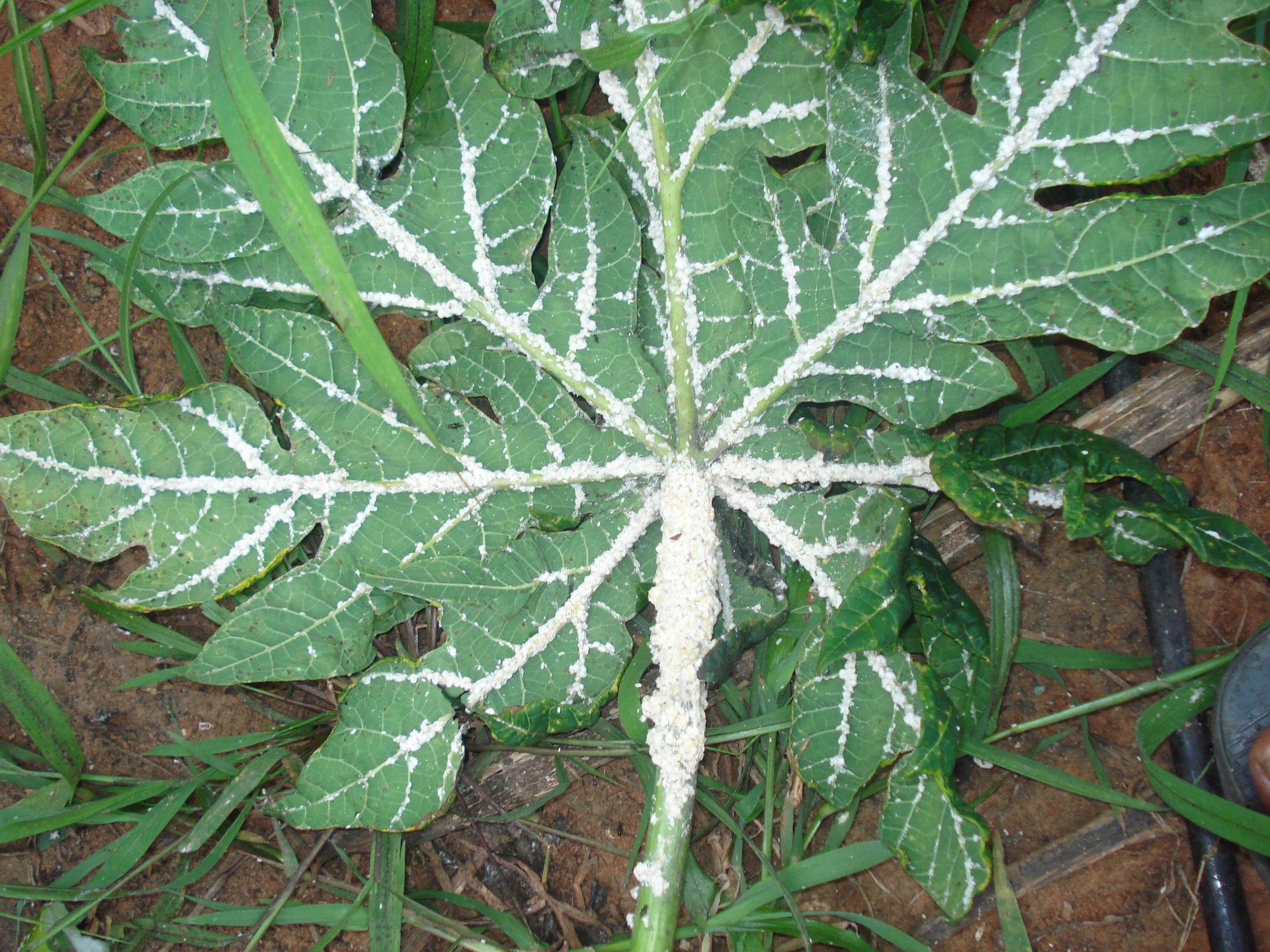
Photo: Basanagowda G · CC BY-SA 3.0
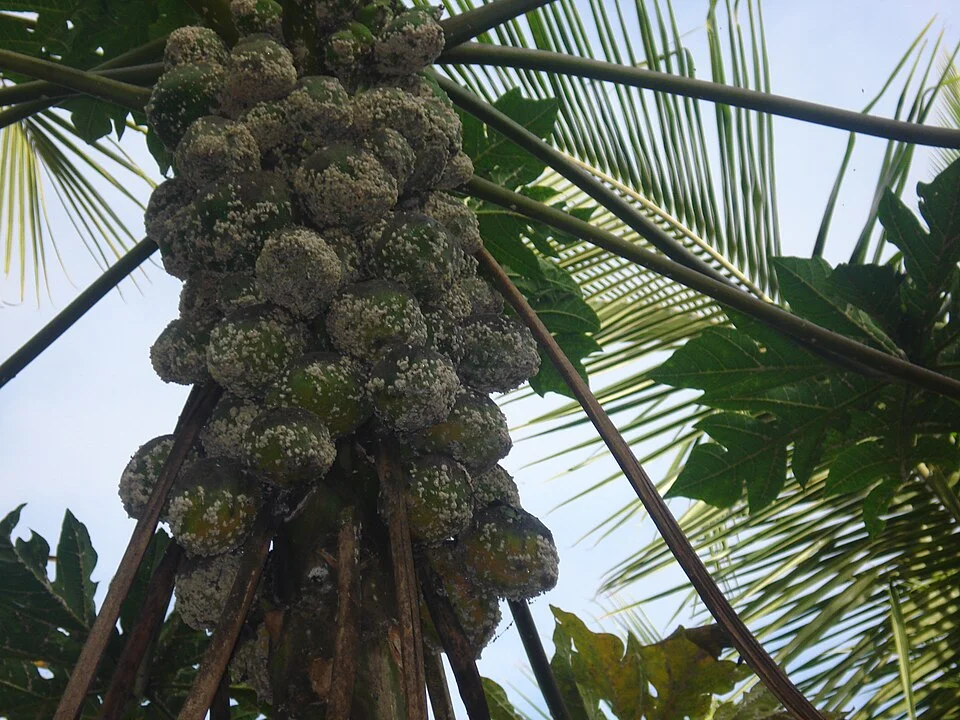
Papaya mealybug (Paracoccus marginatus) is a tiny sap-sucking insect that hides under a thick, cottony white wax. It packs into dense colonies on the growing tips, leaf undersides and fruit of papaya, cassava, tomato and many other plants, injecting a toxin that crinkles and stunts the new growth and coating the fruit in a sticky, mould-blackened wax that makes it unsellable. Its tiny mobile young ride out fast on planting material, wind, tools and ants, so a few colonies can take over a whole field in a matter of weeks.
Basanagowda G · CC BY-SA 3.0 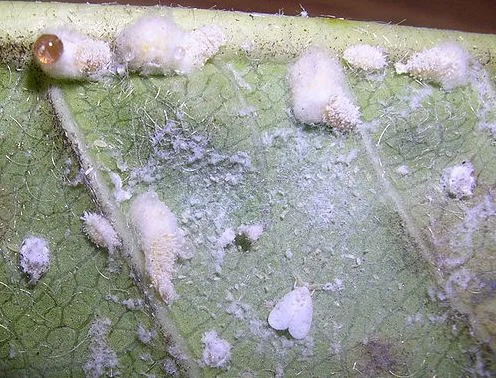
Starr_060721-9537_Plumeria_rubra.jpg: Forest & Kim Starr derivative work: Cwmhiraeth (talk) · CC BY 3.0
Why it matters
This little insect can cost you more than half your crop — up to 60%. It sucks the sap and injects a poison that crinkles and stunts your growing tips, and it smothers the fruit in sticky white wax and black mould so you cannot sell it. Once it takes hold it is very hard to shift: it shelters under a waxy coat that sprays struggle to wet, packs deep into the tight growing points, breeds fast in warm dry weather, and is ferried from plant to plant by ants and on planting material. That is why catching the very first colonies early matters so much — it is your cheapest and only easy chance.
When to act
Colonies with white waxy clusters and honeydew on growing points, leaves or fruit on more than 1 in 10 plants, or the first crinkling of new leaves.
This guidance is general, compiled from published agronomic references including FAO and CABI. Thresholds and timing shift with your crop, your variety and the season.
In much of the region a spray is simply called mushonga — medicine. But a chemical group you cannot name is one you cannot rotate, and a product you did not write down has no pre-harvest interval you can observe. Mushonga, and other farming words →
The full Papaya mealybug field guide
Identify it
What you see first
the newest leaves at the growing tip crinkle, curl and yellow, and the top of the plant goes bunched and stunted instead of pushing out healthy new growth. Where the pest feeds, a sticky, shiny honeydew (its sugary droppings) drips onto the leaves and fruit below and soon turns into a black, sooty mould — a dark grimy film that grows on the sugar.
The pest itself
part that mess and you'll find thick, cottony white clusters, like smears of cotton wool or a dusting of flour, on the leaf undersides, shoots and fruit. Inside the wax sit tiny soft yellowish, oval insects about the size of a pinhead (2 mm) — smaller than a rice grain — each dusted white, with a short, even fringe all around the edge and no long tails. Squash one and it smears yellow-orange, not red or pink. You'll often spot a fluffy cotton egg sac beside the colony and ants running over it.
Don't confuse it with look-alikes
Whitefly also makes honeydew and sooty mould, but its tiny white insects fly up in a cloud when you shake the leaf, while mealybugs sit dead still under their cottony wax. Plain sooty mould or powdery mildew rubs off dry with nothing living underneath and no stickiness — mealybug wax hides soft insects and leaves a sticky smear. Hard, dome-shaped scale bumps are stuck fast, have no loose cottony fluff, and don't wipe away.
Scout for it
When to look
start once your papaya is growing strongly and pushing out new leaves, and keep checking right through flowering, fruiting and up to harvest — this pest hits the growing and fruiting plant, not the tiny seedling. Look more often in warm, dry spells (around 22–33 °C), when it breeds fastest. On cassava and tomato, watch the same way from vigorous growth through to the crop maturing.
How to look
walk a big "W" across the block so you cover all four corners and the middle, not just the row beside the path. Stop at about 10 plants, and on each one check the growing tip and newest leaves (for crinkling), the undersides of the leaves, the shoots, and the fruit — especially where a fruit touches the stem, where colonies love to hide.
Follow the ants
a line of ants marching up a stem almost always leads to a mealybug colony they are guarding — trace it to the source. Check first the plants nearest where you brought in new seedlings, cuttings or suckers, and any plant standing right next to one already infested.
Act on the very first colonies. If even 1 in every 10 plants
carries white cottony clusters with sticky honeydew — or the newest leaves are just starting to crinkle — act now, don't wait. Because it spreads and hides so fast, those first few colonies are your best and cheapest chance to stop the whole field going.
Control it
Prevent it — start clean:
the pest rides in on infested planting material, so only plant papaya seedlings, cassava cuttings and tomato seedlings from a clean, pest-free source, and never carry plants, suckers or tools from an infested block into a clean one. Keep the plot weeded, because weeds and stray host plants shelter the pest between crops.
Cut out and burn the worst
the moment you spot colonies, cut off the heavily coated leaves, shoots and fruit and burn or bury them deep — never drop them on the ground or the rubbish heap, where the tiny mobile young (called crawlers) simply walk straight back onto the crop.
Break the ant trails
ants carry mealybugs from plant to plant and chase off the tiny wasp that would kill them, so cutting the ants off is one of your best moves. Smear a sticky band of grease or used oil around the trunk or stem so ants can't climb, and clear their nests from the base of the plant.
Let the natural enemies do the work — this is your strongest tool:
a tiny, harmless wasp called the Acerophagus papayae parasitoid (a parasitoid is a small wasp that lays its egg inside the mealybug, and its grub eats the pest from within) gives excellent, lasting, free control once it settles in. You can tell it is working when mealybugs turn brown and swollen ("mummified"), with tiny round exit holes. Ladybird beetles and lacewings feed on them too. Your job is simply to protect these helpers — control the ants and do not blanket-spray broad poisons that kill them.
Knock down small outbreaks by hand
on just a few plants, wipe or scrub the cottony clusters off with a rag, or blast them off the leaves and fruit with a strong jet of water. Done early, this alone can hold a light attack.
Spray only as a last resort — horticultural oil:
if colonies keep spreading, spot-spray only the colonies with a horticultural oil — a light plant or mineral oil that works by smothering the insect and dissolving its waxy coat on contact. It is a contact spray, not a systemic one (a systemic poison travels inside the plant's sap; a contact spray only kills what it directly wets). Add a little soap as a wetter to help it spread and cut through the wax, and wet each colony thoroughly, then spray again about a week later, because the wax sheds water and the young keep hatching. Never blanket-spray a broad-spectrum insecticide — it wipes out your free wasp and the pest comes back worse. Safety: cover your skin, eyes, nose and mouth; spray in the cool of the day with the wind at your back; keep the spray off food, off drinking water, and away from children and bees; respect the pre-harvest interval (the number of days you must wait between spraying and picking fruit to eat or sell, so no residue is left on it); and wash yourself and your clothes afterwards. If you ever step up to a stronger product, rotate to a different chemical group each time so the pest can't build up resistance (survive the spray).
If it keeps spreading
stop any blanket spraying (it is killing your ally, the wasp), remove and burn the worst-hit plants to cut off the source, hit the ants hard, and give the parasitoid time — it can take a season to catch up, then it holds the pest down for good. When a plant is completely coated, bunched and stunted and its fruit is already spoilt, cut your losses: uproot or cut it down and burn it so it stops seeding the whole field, then replant with clean material.
Catch Papaya mealybug before it costs you the harvest
This guide is the general answer. Divisi works out yours — the week to scout your own field for Papaya mealybug, and what to do the day you find it.


Crops it affects
Plan the crops it attacks
-
 When to plant Cassava in Banalia
 -
 When to plant Papaya in Hamahamet-Mboinkou
 -
 When to plant Tomato in Goma
All planting calendars, country by country
Get Insights by email
A short digest of new Divisi articles. No email on quiet weeks.
Frequently asked questions
How do I identify Papaya mealybug?
What you see first. the newest leaves at the growing tip crinkle, curl and yellow, and the top of the plant goes bunched and stunted instead of pushing out healthy new growth. Where the pest feeds, a sticky, shiny honeydew (its sugary droppings) drips onto the leaves and fruit below and soon turns into a black, sooty mould — a dark grimy film that grows on the sugar.
When should I take action against Papaya mealybug?
Colonies with white waxy clusters and honeydew on growing points, leaves or fruit on more than 1 in 10 plants, or the first crinkling of new leaves.
How do I control Papaya mealybug?
Prevent it — start clean:. the pest rides in on infested planting material, so only plant papaya seedlings, cassava cuttings and tomato seedlings from a clean, pest-free source, and never carry plants, suckers or tools from an infested block into a clean one. Keep the plot weeded, because weeds and stray host plants shelter the pest between crops.
Which crops are attacked by Papaya mealybug?
Among the crops covered here: Cassava, Papaya, Tomato.