 Divisi
How to grow cashew
Anacardium occidentale · Anacardiaceae
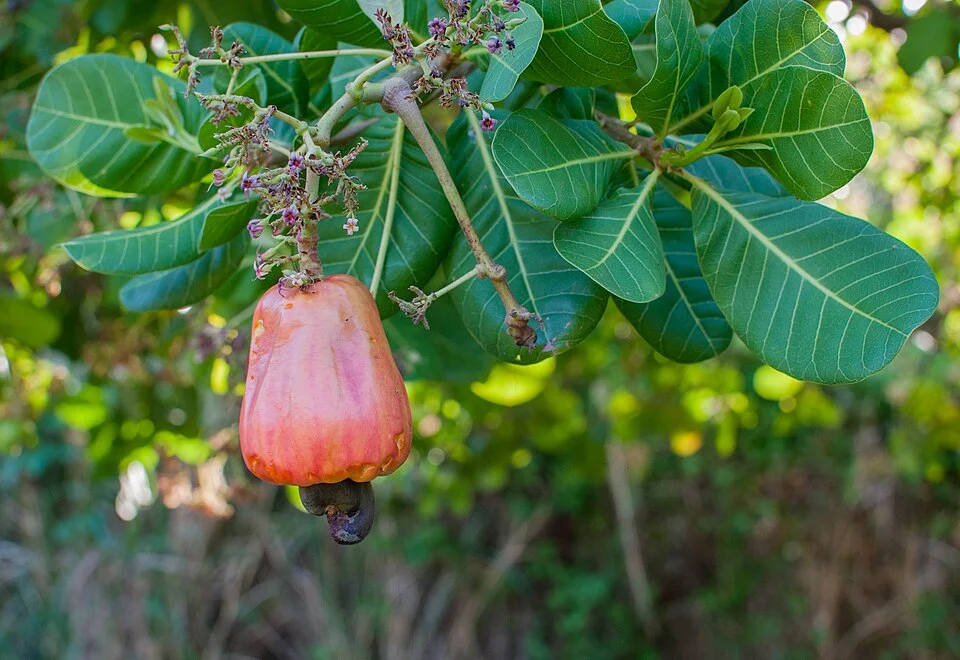
Photo: Wilfredor · CC0
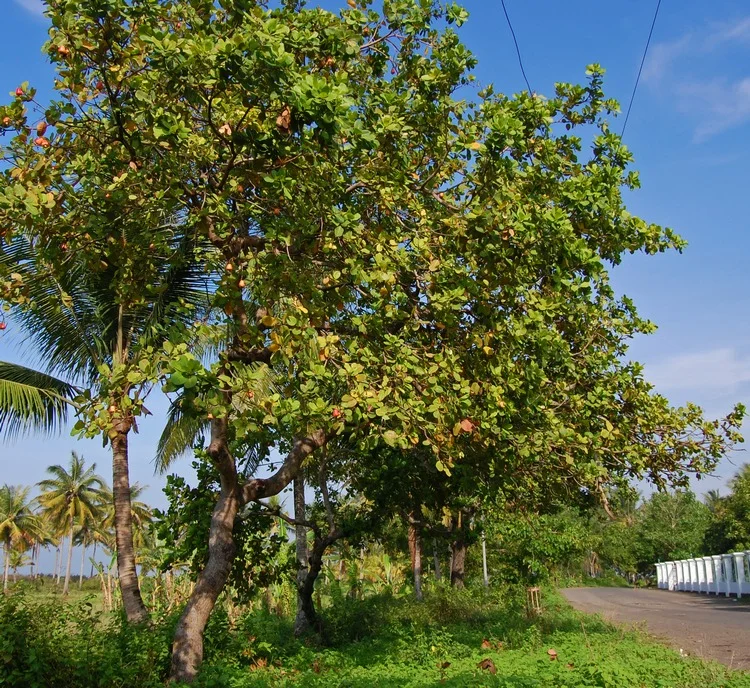
Cashew is a tough evergreen tree that lives and bears nuts for 20 years or more. It thrives where most crops fail — on poor, sandy, dry land — driving a deep taproot down to find its own water. Its fruit grows upside down: one kidney-shaped nut, sealed in a hard shell, hangs below a swollen, juicy cashew apple. Plant a grafted tree and it starts bearing in about 3 years; a tree grown from seed takes 5 years or more, and its nuts are a gamble. You do not pick cashew — you gather the nuts as they fall. Two dangers run through the whole crop: the flowers are fragile, and powdery mildew and the mosquito bug can wipe them out in the dry-season flowering weeks; and the shell holds a caustic (burning) oil (CNSL) that harms skin, so the nuts are handled and shelled with care.
Wibowo Djatmiko (Wie146) · CC BY-SA 3.0 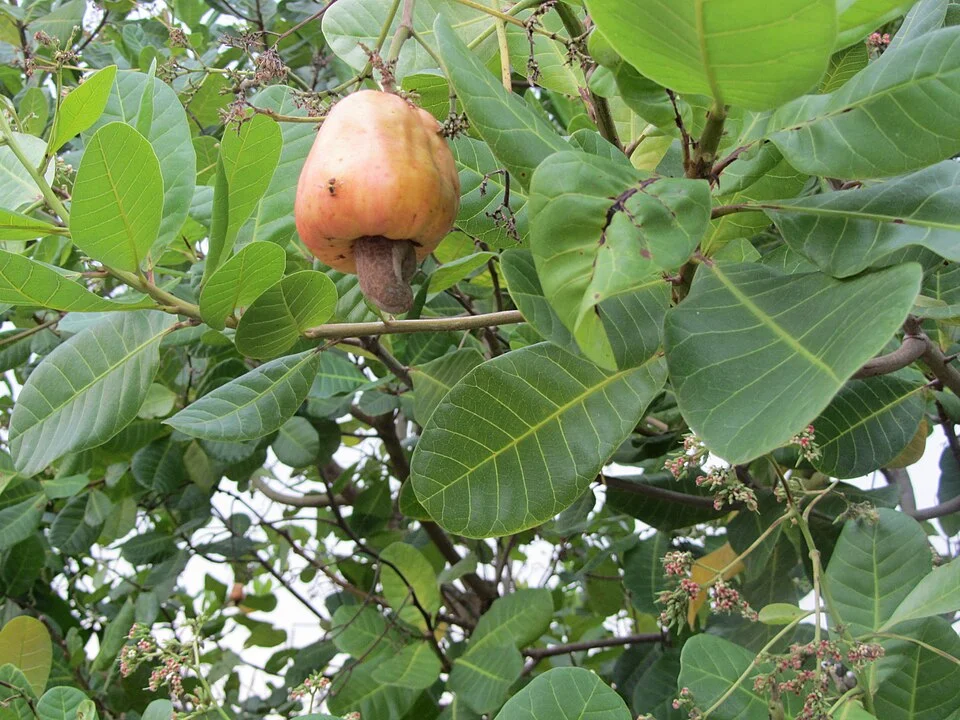
Strobilomyces · CC BY-SA 3.0
- Days to maturity
- 60–90 days
- Row spacing
- 800 cm
- Plant spacing in the row
- 800 cm
These are general figures for the crop, compiled from published agronomic references including FAO and CABI. The right choice for your field depends on your soil, rainfall and the yield you are aiming for.
Will cashew actually do well on your field? Check your own field against every crop in the catalogue — no signup. Run the crop check →
Also known as
Cashew is also called cashew nut and cashew apple.
- English
- cashew nut, cashew apple
- French
- anacardier, noix de cajou, pomme cajou
- Portuguese
- cajueiro, caju
- Swahili
- mkorosho, korosho
Working in buckets, bags or paces? The farming glossary turns the measures growers actually use into kilograms and hectares — what a 20 litre bucket of each crop really weighs, and how to size a field by walking it — alongside the Shona, Swahili, Ndebele and Yoruba words used in the field. Open the glossary →
Growing cashew, stage by stage
Your cashew orchard, year by year: raise a grafted young tree through its first risky dry seasons, shape it into a strong, open tree, then — every dry season it flowers — guard the flowers from powdery mildew and the mosquito bug so the nuts set, and gather, dry and store the fallen nuts before they spoil.
Pick the spot and plant your young trees
Cashew is a tree you plant once and keep for 20 years or more — you cannot move it later, so the choices you make now last a lifetime. Pick warm, sandy, well-drained ground with no frost; dig big pits with well-rotted manure at wide 8 m (8 strides) spacing; and set out grafted young trees at the very start of the rains, so their roots go down deep before the first dry season tests them.
Choose a sandy, drained, warm site Recommended
Cashew is one of the few trees that thrives on poor, sandy, dry land where other crops starve — but it will not forgive two things: cold and wet feet. Frost kills it outright, and roots left sitting in water rot and die. You cannot move a tree once it is planted, so choosing the right spot now is a decision you live with for decades.
Pick warm, low-lying ground (below about 500 m) that never gets frost. Cashew dies at freezing point — if your nights turn cold and frosty, this is the wrong crop for that spot.
Choose deep, sandy or sandy-loam soil that drains fast. Cashew loves light, poor land, and its deep taproot digs down to find its own water — but it drowns where the soil stays wet.
Walk the land after heavy rain: if water pools and sits, that spot is a red flag — pick somewhere higher. Avoid low spots, hollows and hardpans (a hard buried layer that traps water).
Give each tree full sun and room. A grown cashew is a big, wide, spreading tree — keep it well clear of buildings, shade and other large trees.
Keep pasture, cotton and sweet potato out of the orchard — they feed the mosquito bug (Helopeltis) that will later attack your flowers and young nuts.
Choose land you can watch over and reach easily — you will be visiting these trees for many years, protecting and harvesting them.
- Tip:
Interplanting with pasture, cotton or sweet potato — they host the mosquito bug (Helopeltis) that later blights your flowers and nuts.
- Watch out:
Water that pools after heavy rain is a red flag — cashew roots rot in wet ground. Pick higher, free-draining land.
- Do:
Choose a site you can protect and reach easily — you will be visiting these trees for many years.
Dig pits + add manure Recommended
A big pit filled with soft, rich topsoil gives the young roots an easy place to grow down fast in their first year — the year that decides whether the tree lives through its first dry season. Well-rotted manure holds water in thirsty sandy soil and feeds the young tree slowly while it settles in.
Mark your planting spots at the wide spacing a cashew needs: about 8 strides (8 m) apart every way. A full-grown cashew fills all that space — crowded trees shade and starve each other and trap the damp, still air that breeds disease.
At each spot dig a big pit — about three hand-spans wide and three hand-spans deep (60 x 60 cm). Keep the dark, rich topsoil in one heap and the pale, poor subsoil from lower down in a separate heap.
Mix a bucket or two of well-rotted manure or compost into the topsoil heap. Use only well-rotted manure — dark, crumbly, no strong smell — because fresh manure burns and kills young roots.
Refill the pit with that topsoil-and-manure mix, putting the poor subsoil aside or spreading it on top — the young roots should meet the good soil first.
Do this in the month before you plant, so the soil settles and the manure is ready and cool the moment the tree goes in.
- Do:
Dig the pits in the dry season before the rains, so they are ready the moment the first planting rains fall.
- Tip:
Fresh, raw manure in the pit — it scorches the young roots and can kill the tree. Only well-rotted manure or compost goes in.
- Watch out:
Wash your hands after handling manure, and keep it away from drinking water.
Plant grafted stock Critical
Use a grafted tree, not a seed. A grafted tree carries a known, good variety and starts bearing nuts in about 3 years; a tree grown from seed can take 5 years or more, and its nuts are a gamble. The graft union — the swollen knuckle low on the stem where the good variety was joined onto the rootstock (the wild base that grows the roots) — is the tree's weak point, and it must be kept above the soil at planting.
Plant at the start of the rains, within about two weeks of your first good, soaking rain — so the young tree gets a full wet season to root down before it ever meets a dry spell.
Buy grafted young trees from a trusted nursery. Look for the graft union — a swollen knuckle low on the stem — and pick sturdy plants with healthy green leaves, not tall, thin or pot-bound ones.
Dig a hole in the middle of your prepared pit. Slip the tree out of its bag without breaking the ball of soil around the roots — hold it by the soil-ball or pot, never by the stem.
Set the tree so the top of the root-ball sits level with the ground, and the graft union (the knuckle) stays well above the soil — never bury it.
Firm the soil around the roots with your hands and heel, then water it in well so the soil settles snugly against the roots with no air pockets.
Push in a stake to hold the young stem straight, and shade it for the first few weeks with grass or palm fronds so the hot sun does not scorch the young leaves.
- Do:
Handle the tree by the pot or soil-ball, never by the stem, and keep the root-ball whole.
- Tip:
Burying the graft union — if soil covers that knuckle the join rots, or the wild rootstock takes over and you lose your good variety.
- Watch out:
If a newly planted tree wilts in its first weeks, add more shade and water — the first dry season is the biggest killer of young cashew.
Keep the young tree alive
A cashew earns nothing for its first few years — this whole stage is about keeping the young tree alive through its first one or two dry seasons, when most losses happen. Protect it from browsing animals, water it through the dry months, keep a bare, weed-free ring around it, and check it every month for the stem borer and the mosquito bug.
Protect the young tree Critical
A young cashew is a single, small stem — one goat, one browsing cow, or a rodent gnawing the bark can kill it in a night, and with it die the years and money you have already put in. Until the tree is big and woody (about its first 1-2 years), it must be physically protected.
From planting day, put a guard around every young tree — a ring of thorny branches, a wooden cage, or a fence of stakes — tall and wide enough that goats and cattle cannot reach in and bite the leaves.
Protect the bark at the base from rodents and hares that gnaw young stems. Clear the grass right up against the stem so these pests have nowhere to hide and nest.
Check the guards after wind, storms and passing herds, and mend any gap or gnawed spot at once — a broken guard is an open door.
Keep the guards up for the first one to two years, until the tree is tall and woody and animals can no longer harm it.
- Do:
Walk your young trees often in the first months — a broken guard found today saves a tree tomorrow.
- Watch out:
Animals push hardest at fences in the dry season, when other feed is scarce — check the guards more often then.
Water through the first dry seasons Critical
The first one or two dry seasons kill more young cashew trees than anything else. The roots have not yet reached deep water, so a long dry spell can finish them. Watering through these dry months is the single thing that carries the tree to the point where its deep taproot can fend for itself — after that, a mature cashew is drought-hardy and needs no watering at all.
From about a month after planting, water each young tree every 1-2 weeks right through the dry season — more often on very hot days and on pure sand that dries out fast.
Give a deep soaking each time — a few buckets poured slowly at the base so the water sinks down to the roots — not a light daily sprinkle that only wets the surface and pulls the roots upward.
Spread a mulch of dry grass or leaves over the soil around the tree — kept a hand-span clear of the stem — to hold the moisture in and keep the ground cool.
Keep this up until the tree is established — growing strongly on its own through the dry season, usually after the first year or two — then you can stop.
- Do:
Water in the cool of early morning or evening, so less is lost to the sun.
- Watch out:
Drooping, wilting leaves in the dry season mean the young tree is thirsty — water it now; one missed dry-season watering can kill it.
Keep a weed-free ring Recommended
Grass and weeds crowding the young tree steal the water and food you are giving it, and a thick weedy collar hides the rodents and borers that attack the stem. A clean, bare ring puts everything you water and feed straight into the tree, and lets you spot trouble early.
From about a month after planting, keep a bare, weed-free ring around each young tree, clearing it every 1-2 months while the weeds are growing.
Make the ring wide — about one-and-a-half times as wide as the leafy top (canopy) of the tree — clearing out past the drip line (the circle on the ground under the outer leaves), because the feeding roots reach at least that far.
Weed by hoeing shallowly or hand-pulling, especially near the stem — the feeding roots run close to the surface, so deep digging cuts them.
Leave the pulled weeds, or a layer of grass mulch, on the ring (but a hand-span clear of the stem) to hold moisture and slow the next flush of weeds.
- Do:
Widen the cleared ring each year as the canopy spreads outward.
- Tip:
Hoeing deep close to the trunk — cashew feeder roots run shallow and wide and are easily cut.
Scout Recommended
Two pests can quietly kill a young tree. The stem borer — a grub that tunnels into the trunk base — can ring a tree from the inside before you ever notice. The mosquito bug (Helopeltis) blackens the soft new shoots. A slow, careful monthly walk catches both while you can still act.
Once a month, walk to every tree and look it over slowly, from the base upward — young trees are few, so check each one.
At the trunk base and collar (where the stem meets the ground), look for gum oozing out, reddish sawdust-like droppings (frass), and small holes in the bark — signs of the stem borer grub tunnelling inside. Tap the base: a hollow sound is a bad sign.
On the soft new red-brown leaves and shoot tips (the flush), look for dark, sunken black spots and blackened, dying tips — that is the mosquito bug feeding.
Note which trees show damage, and how much, so you can act on those trees (see the pest guides). Flag any borer-hit tree at once — a single grub can kill even a grown tree if it is left.
- Watch out:
A tree that suddenly yellows and wilts with no drought often has a stem borer inside — check the base for gum and reddish frass.
- Do:
Keep trees healthy and unstressed — the borer goes for weak, neglected trees first.
Grow the frame and shape the tree
Now the tree builds the frame that will carry every future crop. Shape it early — one strong main stem cleared at the base, and an open, airy top — so it grows sturdy, lets light and wind through, and is easy to spray and harvest under later. Keep checking the trunk base for the stem borer, the main danger in these building years.
Formative pruning Recommended
The shape you build in the first three years is the shape the tree keeps for life. A single strong trunk cleared near the ground, carrying an open top, makes a tree that stands up to wind, dries fast after rain (so less disease), lets light onto the flowers, and lets you walk under it to gather nuts. A crowded, low, tangled tree fights disease all its life and hides its crop in the grass.
In the first 1-3 years after planting, train the tree to a single main stem (one leader) — if two stems compete, cut the weaker one out.
Cut off the low side branches and any suckers (shoots from the base) so the clear trunk reaches about knee-to-hip height (60-90 cm) before the branches begin — this lifts the canopy off the ground so you can work under it.
Thin out crowded, crossing and inward-growing branches to leave an open, airy top that light and wind pass through. Open growth dries the leaves fast and starves off powdery mildew and the mosquito bug.
Use a clean, sharp tool, cut close to the branch base (leave no stump), and prune in dry weather so the cuts dry and heal without infection.
- Do:
Prune a little each year while the branches are still small — small cuts heal fast.
- Tip:
Leaving big stumps or torn bark — they let in the borer and rot. Cut clean and close.
- Watch out:
Remove and burn any dead wood — it is where the stem borer breeds.
Scout Recommended
Through these building years the stem borer is the main danger. Its grub tunnels into the trunk base and rings the tree from the inside (girdles it) — cutting the pipes that carry food and water, so the tree slowly dies. Caught early you can dig the grub out; caught late, you lose the whole tree.
Once a month, check every tree, looking closely at the trunk base and collar.
Look for gum oozing out, reddish sawdust-like frass, and small bore holes in the bark — signs the borer grub is tunnelling inside.
Tap the trunk base and listen for a hollow sound, and watch for branches that yellow, wilt or die back for no clear reason.
Flag any affected tree straight away. On an early attack you can hook or dig the grub out of its hole with a stiff wire; cut out and burn any dead or badly infested tree so the beetles cannot breed and spread to your other trees.
- Watch out:
Reddish frass like fine sawdust at the base is the clearest early sign — look for it on every visit.
- Do:
Keep trees vigorous and their trunks unwounded — the borer attacks stressed, injured trees first.
Flowering — protect the flowers to get nuts
Once a year, in the dry season, the tree pushes out its flower heads — and this short window makes or breaks the crop. Powdery mildew alone can take 50-100% of your nuts, and the mosquito bug blights the flowers and young nuts. This is the one stage you must act: feed the new flush with zinc and boron before flowering, scout the flower heads every few days, and dust sulphur from the first flowers through nut set.
Foliar zinc + boron before flowering Optional
A quick spray of zinc and boron on the new flush just before flowering helps the tree flower well and set more nuts — boron especially helps the flowers turn into nuts instead of dropping off. Cashew responds well to these two, and they cost little. Treat it as a helper, not a rescue.
Spray in the month before the flower heads (panicles) come out, while the tree is pushing its new flush of leaves.
Mix zinc and boron (for example zinc sulphate and borax) at the rate on the label in clean water, and spray to wet the new leaves and shoot tips until they glisten.
Spray in the cool of morning or evening, out of strong sun, so the leaves take it up without scorching.
This is a helper, not a rescue — in a year you cannot manage it, skip it; but never skip the sulphur mildew sprays that follow, which matter far more.
- Do:
Cover skin, eyes and nose when mixing and spraying, keep it off food, and wash well afterwards.
- Tip:
Overdoing the boron — a little helps, too much harms. Stick to the label rate.
- Watch out:
Rain or high humidity at flowering brings powdery mildew and anthracnose and drops the nut set — be ready to spray sulphur.
Scout the panicles Critical
The flower heads decide this year's whole crop, and they are attacked fast. Powdery mildew can coat and kill the flowers in a matter of days, and the mosquito bug blackens them — either one can wipe out your nuts. Checking every 5-7 days is what tells you when to spray in time, before the damage is done.
From the day the flower heads (panicles) first show, check them closely every 5-7 days right through flowering and early nut set.
Look for powdery mildew: white or greyish powder, like flour dusted over the flower heads, shoot tips and young nuts. It is the top killer — and it spreads even in dry weather, on humid nights.
Look for the mosquito bug (Helopeltis): dark, sunken black spots on the flower stalks and young nuts, and blackened flower heads that fail to set. Early in the morning you may catch the slender, long-legged bugs themselves.
If the weather turns wet, look also for anthracnose: dark, sunken spots, some with pink or orange specks in the middle, on shoots and young nuts.
Act on what you find — keep up the sulphur for mildew, and spray for the mosquito bug at the first damage (see the spray tasks and the pest guides). If you already see white powder, you are behind — spray today.
- Watch out:
White powder on the flowers is an emergency — it can cost half your crop or more. Do not wait for the next round.
- Do:
Scout in the early morning, when the bugs are slow and easy to see.
Sulphur dust / fungicide for powdery mildew Critical
Powdery mildew is the number-one destroyer of the cashew crop — left untreated it can take 50-100% of your nuts. Sulphur is a protectant: it coats the flowers and shields them, so it only works if it is on the flowers before and during the attack, never after. Dusting sulphur from the first flowers through nut set is the most important thing you do all year.
Start at the first flower heads and repeat every 10-14 days through flowering and nut set — always keep a fresh protective coat on the growing flowers.
Dust sulphur (or spray the fungicide your recommendation gives, at the amount it sets) early in the morning when the air is still, so the fine powder settles evenly over the flower heads and young nuts.
Remember sulphur is a protectant, not a cure — it shields healthy flowers but cannot clear mildew already dug in — so keep the cover going and never let it lapse during the flowering weeks.
You may skip a round in a fully dry, mildew-free spell, but check again in 5-7 days — humid nights bring it back fast.
If the flowers are already white and coated when you look, the spray is too late for those heads: cut off and destroy the worst ones, protect the rest at once, and start earlier next year.
- Do:
Cover your nose and mouth when dusting sulphur, work with the wind behind you, and wash afterwards.
- Tip:
Dusting sulphur in the hottest part of a very hot day — it can scorch the leaves. Dust in the cool.
- Watch out:
Respect the pre-harvest interval — the days-to-harvest wait on the label, the gap you must leave between your last spray and gathering the nuts.
Helopeltis spray at first damage Recommended
The mosquito bug (Helopeltis) pierces the soft flush, flowers and young nuts, and each bite kills a small patch of tissue. A heavy attack blackens the flower heads, deforms and drops the young nuts, and kills back the shoots. Spraying at the first real damage during flowering protects the nuts that are forming right then.
Watch for the mosquito bug's damage as the tree flushes and flowers — dark, sunken spots on shoots, flower heads and young nuts, blackened tips, and the slender, long-legged bugs themselves.
At the first real damage, spray a registered insecticide, repeating every 10-21 days only while the bug is active — target the tender flush, flowers and young nuts where it feeds.
Spray in the cool hours (early morning or late afternoon), with the wind behind you, covering skin, eyes and nose, and keeping the spray off food crops.
Where you have weaver ants (the fierce ants that build leaf-nests up in the tree), leave them alone — they hunt the mosquito bug for free and can hold it down with no spray at all.
- Do:
Spray only when you see the bug or its fresh damage — not on a fixed calendar. That saves money and spares the helpful insects.
- Tip:
Spraying in wind or heat, or letting the spray drift onto food crops. Respect the label's pre-harvest wait.
- Watch out:
Open, well-pruned trees suffer less — the bug loves dense, shady growth and a steady supply of soft new flush.
Nuts fill and the apple swells
The nuts now fill out and the fleshy cashew apple swells beneath each one, over about 2-3 months. There is little to do but watch — mainly for anthracnose and nut scab if the rains come — and get everything ready to collect the nuts the moment they start to drop.
Scout (anthracnose, nut scab) Recommended
If rain falls while the nuts are filling, anthracnose can spot and rot the shoots and nuts, and nut scab can scar the young nuts. Spotting either early lets you protect the rest of the crop before it spreads.
Every 7-10 days while the nuts and apples are growing, check a sample of nut-bearing shoots across the orchard — especially after rain.
Look for anthracnose: dark, sunken spots, some with pink or orange specks in the middle, on nuts, stalks and leaves — worst in warm, wet spells.
Look for nut scab: rough, scabby, corky patches on the skin of the young nuts.
If disease is spreading in wet weather, protect the crop with a fungicide, and remove badly spotted or shrivelled (mummified) nuts and shoots — they carry the disease over to next season.
- Watch out:
Anthracnose needs wet leaves to spread — dry spells are safe, wet spells are the danger. Scout hardest after rain.
- Do:
Clear fallen, rotting nuts and old shrivelled nuts from under and in the tree — they harbour the fungus for next time.
Prepare for harvest Recommended
Cashew does not ripen all at once — the nuts drop to the ground a few at a time over many weeks, and a fallen nut left lying will spoil, mould or sprout. A little planning now means you collect them clean and fast the moment they start falling.
About two months after flowering started — a couple of weeks before the first nuts drop — get ready to harvest.
Clear and smooth the ground under and around each tree — cut the weeds and rake it clean — so fallen nuts are easy to see and pick up and do not hide in the grass.
Line up your helpers, baskets or open bags, and drying space for a long harvest — the drop runs about 6-10 weeks, with visits every few days.
Plan to collect often — weekly, and daily in wet weather — because a nut left on damp ground quickly spoils or sprouts.
- Do:
A clean, weed-free floor under the tree is the biggest time-saver of the whole harvest — do it before the drop starts.
- Watch out:
Keep animals off the orchard floor once nuts start dropping — they trample and foul the crop.
Collect the fallen nuts
You do not pick cashew — you let it fall and gather it. When the cashew apple is fully coloured and the whole thing drops, the nut below is ripe. Collect the fallen nuts often — every few days, daily in wet weather — over a drop of about 6-10 weeks, before they spoil or sprout on the ground.
Collect fallen nuts Critical
The nut only reaches full quality when it falls on its own. And every nut left lying on damp ground quickly rots, moulds or sprouts — turning a good nut into a worthless one. Frequent collecting is the difference between a full harvest and one lost on the ground.
Let the fruit ripen and fall by itself — never pull nuts off the tree. The sign of ripeness: the cashew apple is fully coloured (red or yellow) and the whole apple-and-nut drops, and the nut is grey-brown and hard.
Walk the cleared orchard floor and gather the fallen nuts every 3-7 days — daily in wet weather — before they spoil.
Twist the nut off the apple. Keep the nuts; the fleshy apple spoils within hours, so eat, use or discard it the same day.
Put the nuts in baskets or open bags — not sealed sacks, which make them sweat and mould — and take them to dry that same day.
If an apple is still green, firm and clinging to the branch, it is not ready — leave it. Only gather what has fallen; nuts taken early are poorly filled and worth little.
- Do:
Collect after wind or rain, when many nuts drop at once.
- Tip:
Leaving nuts on wet ground overnight — they spoil and sprout fast.
- Watch out:
The shell holds a caustic (burning) oil (CNSL) — handle large amounts with care, and read the drying task before you ever try to shell them.
Separate the nut from the apple Recommended
The nut is the crop that stores and sells; the cashew apple is tasty but rots within hours and cannot be kept. Separating them at once lets you save the nut to dry and use the apple fresh before it spoils.
As you collect, twist or snap the nut off the bottom of the apple — when ripe, they part easily.
Put the nuts in one basket, to go for drying, and the apples in another, for use the same day.
Use the apples within hours — eat them fresh, or make juice, jam or a dried snack — because they spoil the same day and cannot be stored.
Keep both baskets out of the sun while you work, so neither the nuts nor the apples cook and spoil.
- Watch out:
The cashew apple is highly perishable — use it within hours or it spoils the same day.
- Do:
If you have no use for the apples, compost them rather than leave them to rot under the tree and draw pests and animals.
Dry and store the nuts
The crop is grown — now don't lose it. A well-dried nut keeps for months; a damp one moulds and is rejected at the market. Sun-dry the raw nuts hard until they rattle, then store them dry and cool. Remember the shell holds a caustic oil (CNSL) — never shell them bare-handed.
Sun-dry the raw nuts Recommended
Raw cashew nuts store safely only when they are dried hard (about 8-12% moisture). Dried well, they keep for months and pass at the market; left damp, they mould, rot and are rejected, and the hidden moisture ruins the kernel inside the shell. Drying is the last step that protects everything you grew.
As you collect each batch, spread the raw nuts in a single layer on a mat, rack or clean hard surface — never on bare, damp ground, which pushes damp back in and adds mould, grit and dirt.
Sun-dry them for about 2 hours a day over 1-3 days, turning them so they dry evenly, and bring them in or cover them if rain threatens.
Test for dryness: a well-dried nut rattles when you shake it (the kernel has shrunk away from the shell), and the kernel inside is hard, not soft or bendy — that is about 8-12% moisture.
Store the dry nuts in clean, dry bags in a cool, dry, airy place — off the floor and away from the wall — and check them now and then for damp or mould.
If a nut does not rattle, or the kernel is still soft, it is not dry enough — dry it more before storing, or it will mould in the bag.
- Tip:
Bare-handed shelling — the shell liquid (CNSL, cashew nut shell liquid) is a caustic oil that burns skin. Wear gloves, and keep it away from children.
- Do:
Dry on a raised rack or mat, never on bare ground, which pushes damp back in and adds mould, grit and dirt.
- Watch out:
Never bag the nuts away while any are still damp — one wet nut can mould a whole sack.
Pests and diseases that attack cashew


Grow cashew with a plan, not a guess
This guide is the general answer. Divisi works out yours — the week to plant cashew on your soil and your rainfall, and each job dated for your field.


When to plant cashew, country by country
- When to plant cashew in Algeria
- When to plant cashew in Angola
- When to plant cashew in Benin
- When to plant cashew in Botswana
- When to plant cashew in Burkina Faso
- When to plant cashew in Burundi
- When to plant cashew in Cabo Verde
- When to plant cashew in Cameroon
- When to plant cashew in Comores
- When to plant cashew in Congo
- When to plant cashew in Côte d'Ivoire
- When to plant cashew in Egypt
- When to plant cashew in Eritrea
- When to plant cashew in Eswatini
- When to plant cashew in Ethiopia
- When to plant cashew in Gabon
- When to plant cashew in Gambia
- When to plant cashew in Ghana
- When to plant cashew in Guinea Ecuatorial
- When to plant cashew in Guinea-Bissau
- When to plant cashew in Guinée
- When to plant cashew in Kenya
- When to plant cashew in Liberia
- When to plant cashew in Libya
- When to plant cashew in Madagascar
- When to plant cashew in Malawi
- When to plant cashew in Mali
- When to plant cashew in Mauritanie
- When to plant cashew in Mauritius
- When to plant cashew in Moçambique
- When to plant cashew in Namibia
- When to plant cashew in Niger
- When to plant cashew in Nigeria
- When to plant cashew in Rwanda
- When to plant cashew in République centrafricaine
- When to plant cashew in République démocratique du Congo
- When to plant cashew in Sao Tome and Principe
- When to plant cashew in Seychelles
- When to plant cashew in Sierra Leone
- When to plant cashew in Somalia
- When to plant cashew in South Africa
- When to plant cashew in South Sudan
- When to plant cashew in Sudan
- When to plant cashew in Sénégal
- When to plant cashew in Tchad
- When to plant cashew in Togo
- When to plant cashew in Uganda
- When to plant cashew in United Republic of Tanzania
- When to plant cashew in Zambia
- When to plant cashew in Zimbabwe
Where cashew scores best
Districts where Divisi's engine currently rates this crop highest, ranked by fit.


Get Insights by email
A short digest of new Divisi articles. No email on quiet weeks.
Frequently asked questions
How do I grow cashew?
How to grow cashew: 60–90 days to maturity, 800 cm rows. Also called cashew nut, anacardier, cajueiro, mkorosho.
What is anacardier in English?
Anacardier (also noix de cajou and pomme cajou) is the French name for cashew.
What is cajueiro in English?
Cajueiro (also caju) is the Portuguese name for cashew.
What is mkorosho in English?
Mkorosho (also korosho) is the Swahili name for cashew.
How long does cashew take to grow?
Cashew takes about 60–90 days from sowing to maturity, though the exact length varies with variety, temperature and how the season runs.
What spacing should I use for cashew?
Space cashew rows about 800 cm apart, with roughly 800 cm between plants within the row.
What pests and diseases attack cashew?
The ones covered in this guide are Capsids (mirid bugs), Cashew stem and root borer, False codling moth. Each has its own page explaining how to identify, check for and control it.