 Divisi
Collar rot
Sclerotium rolfsii · Fungal
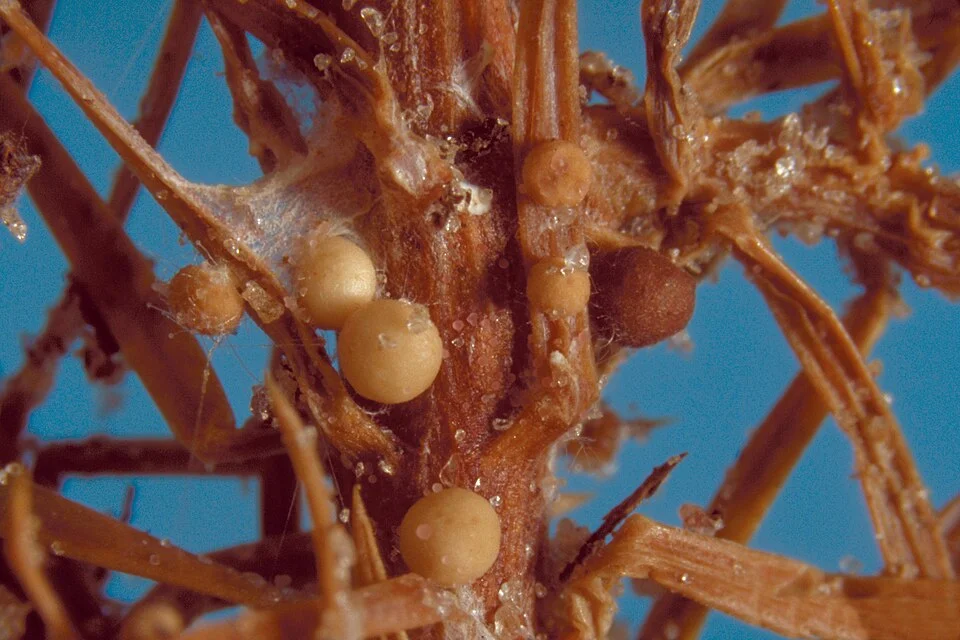
Photo: Edward L. Barnard - Florida Department of Agriculture and Consumer Services · CC BY 3.0 us
Collar rot is a soil-borne fungal disease (Sclerotium rolfsii) that attacks the stem base — the 'collar' — of seedlings and young plants right at the soil line. It grows out of old crop residue lying on warm, moist soil, wrapping the stem in a white cottony mould that rings and chokes it until the plant wilts and dies. It survives between crops as tiny hard beads (sclerotia) that last for years in the soil, and it strikes a wide range of smallholder crops including groundnut, beans, tomato, chickpea and soybean.
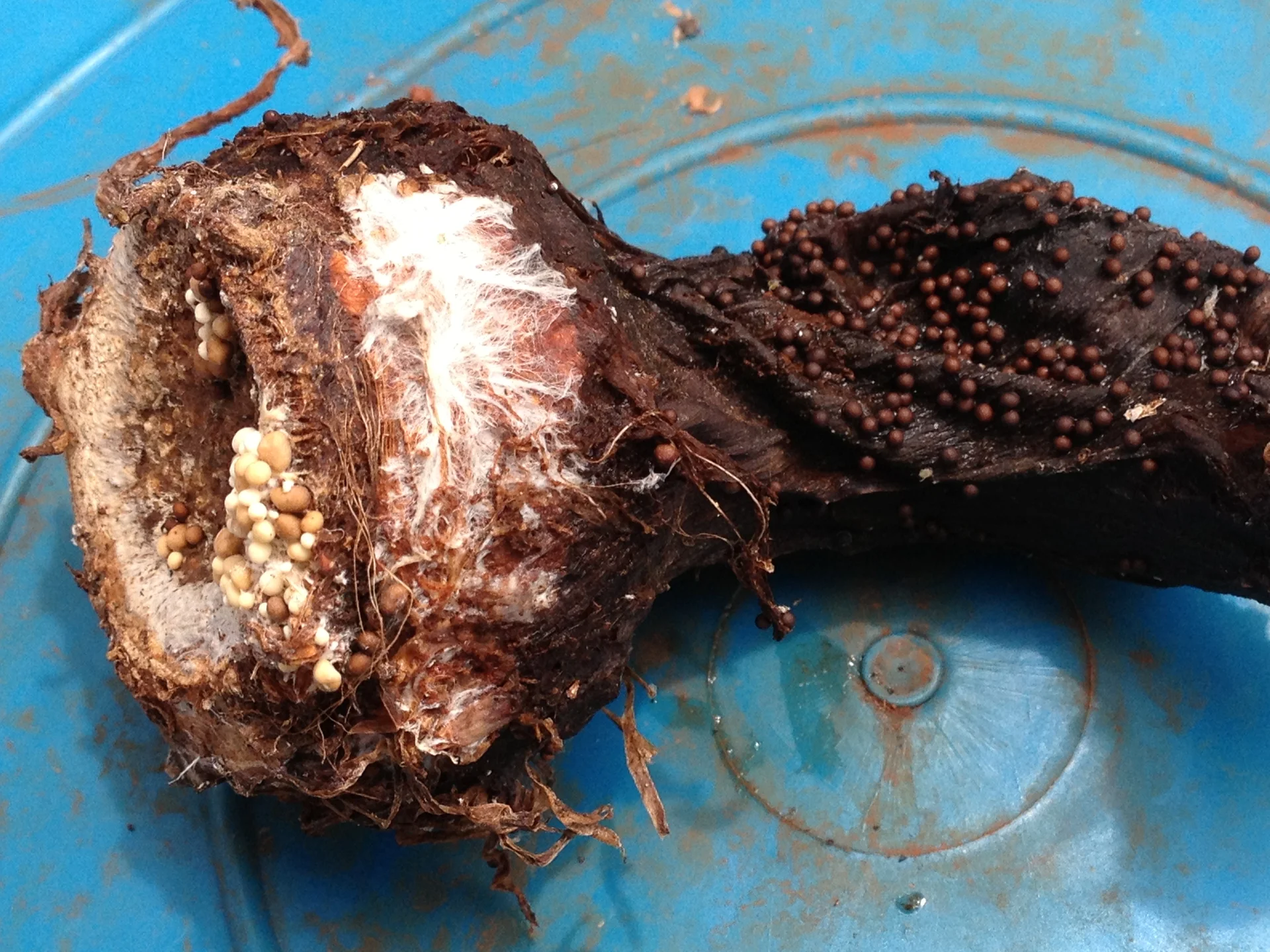
Glenn Teves (Molokai) · CC0 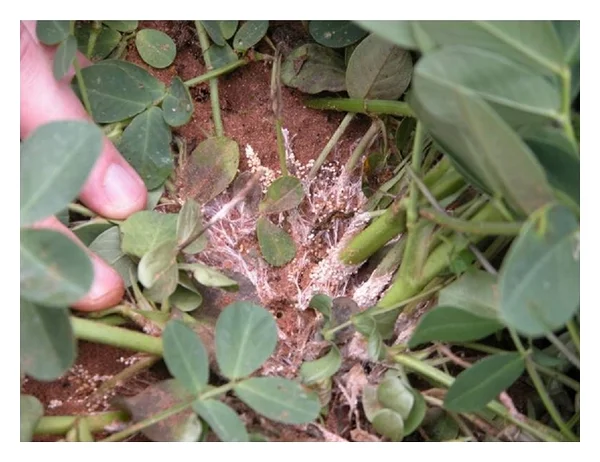
Lindsey D. Thiessen, Jason E. Woodward · CC BY 4.0
Why it matters
Collar rot rings the stem right at the soil line and chokes the plant, so a healthy young groundnut, bean or tomato can wilt and die in just a few days — and a bad outbreak can cost you up to 40%, nearly half your crop. The cruel part is that a plant already choked (girdled) at the collar is dead: no medicine brings it back, so you can only save the plants around it. And once it takes hold it leaves behind thousands of tiny hard 'seeds' (sclerotia) that survive in your soil for years, ready to attack your next crop — which is why it is so hard to be rid of once it is established.
When to act
Scattered seedlings or young plants wilting and collapsing at the soil line, especially in warm wet patches with residue.
This guidance is general, compiled from published agronomic references including FAO and CABI. Thresholds and timing shift with your crop, your variety and the season.
In much of the region a spray is simply called mushonga — medicine. But a chemical group you cannot name is one you cannot rotate, and a product you did not write down has no pre-harvest interval you can observe. Mushonga, and other farming words →
The full Collar rot field guide
Identify it
The first thing you see
a healthy young plant — groundnut, beans, tomato, chickpea or soybean — suddenly wilts, yellows and flops over as if it is dying of thirst, usually one plant here and there in the warm, wet, shaded patches. But the soil is moist and watering does not revive it, while the plants right next to it stay green.
At the stem base — the 'collar', where the stem meets the soil:
scratch away a little soil and you find a soft, brown, water-soaked rot ringing right around the stem. The rot has choked the stem through, so the plant snaps off or lifts out easily — the base has rotted away.
The give-away sign
a white, cottony, fan-shaped mould spreads over the rotted collar and out onto the soil around it. Scattered in that mould are tiny round beads the size of mustard seeds — white and soft at first, then hardening to tan and dark brown. These beads are the fungus's long-lasting 'seeds' (called sclerotia); no other seedling problem leaves them, so finding them confirms collar rot.
Favoured by: warm soil (25-35°C), high moisture, plenty of old crop trash lying on the surface, and crowded plants with little air movement at the base — so it flares up worst in warm, wet weather.
Don't confuse it with look-alikes
ordinary damping-off also kills seedlings at the soil line, but leaves a thin, dark, pinched stem with no white fan and no mustard-seed beads. A cutworm cuts the stem clean through and topples the plant — you'll find a chewed cut and a grey worm in the soil, but no rot and no mould. Plain heat or drought wilt perks back up in the cool of the evening; collar rot never recovers. And an inside-the-plant wilt disease like Fusarium wilts the plant but shows no white cottony fan and no beads at the base.
Scout for it
When to look
collar rot hits seedlings and young plants — from the day they come up until they are well established (roughly the first few weeks of growth). Check at least twice a week through this tender stage, and look extra hard in warm, humid weather and after rain, when the warm wet soil lets the fungus race along the surface.
How to walk the field
cross it in a big 'W' shape so you cover all four corners and the middle — about 10 stops — not just the edge by the path. At each stop, pay special attention to the low, wet, shaded patches and any spots thick with old crop trash, because that is where the rot starts.
What to check at each stop
look for any plant that is wilting, yellow or collapsed. Go to those plants and check the stem base at the soil line — scratch away a little soil and look for the soft brown rot, the white cottony fan, and the mustard-seed beads on the stem and in the soil around it.
Is it still active?
Fresh white fans of mould mean the fungus is alive and spreading right now — act. A dead plant with only dry, dark-brown beads and no fresh white growth is a past attack; note the spot, but you cannot undo that plant.
When to act — even 1 plant in 20
This is not a wait-for-a-big-percentage pest. Because each rotted plant drops hundreds of long-lasting beads into your soil, you act on the first confirmed find: even 1 plant in 20 showing the white fan and mustard-seed beads means the fungus is active in your field — remove that plant and start protecting the rest now. If you find these collapsed plants scattered across several of your W-stops, treat the whole field as infected.
Control it
Prevent it first — starve the fungus with rotation (your strongest tool)
The rot feeds on groundnut, beans, tomato, chickpea and soybean. Plant a cereal — maize, sorghum or millet — on that land for 2-3 seasons; with no host to feed on, the fungus in the soil slowly dies down. Never plant one susceptible crop straight after another on land that has rotted.
Bury the trash and keep the collar clear
The fungus lives on old crop residue lying on the surface, so deep-plough to bury last season's stalks, leaves and weeds well under the soil, away from your new seedlings. When you weed, do not heap soil or trash against the stem base — a buried, damp collar is exactly what the rot wants. Give plants good spacing so air moves and the base dries.
Drain the wet spots and start with clean seed
On land that stays wet, plant on raised beds or ridges so water drains away from the stem base — the fungus needs warm, wet soil. And treat your seed before planting (with the biocontrol or fungicide below) so seedlings get safely through the tender stage.
Act early — pull out and remove (rogue out) every infected plant
The moment you find a collapsed plant with the white fan and beads, lift it out together with a scoop of the soil around its roots and carry it right out of the field. Burn it or bury it deep, far away — never leave it on the field edge and never put it in compost, because each plant carries hundreds of beads that survive for years. This single act does the most to stop it spreading.
Bring in a 'good' fungus — Trichoderma
Trichoderma is a beneficial fungus that attacks the rot fungus in the soil. Apply a Trichoderma-based biofungicide as a seed treatment before planting, or mix it with water and drench (pour) it around the stem bases of the healthy plants. It is safe for you, your animals and bees.
Chemical is a last resort — an approved fungicide
Only if the rot keeps spreading despite the steps above, and mainly on high-value crops like tomato, use an approved fungicide (a medicine that kills fungus): treat the seed before planting and drench the collar zone — pour the mixed solution around the stem bases at the soil line — as the plants establish. Remember it only protects healthy plants; a plant already girdled is dead and cannot be saved. Safety: cover your skin, eyes, nose and mouth; mix and apply in the cool of morning or evening with the wind behind you; keep it off food, off water, and away from children, animals and bees; and respect the pre-harvest interval — the set number of days you must wait after the last treatment before it is safe to harvest and eat. Wash yourself and your clothes afterwards. To stop the fungus getting used to the medicine (resistance), rotate to a different chemical group each time rather than using the same one over and over.
If it keeps spreading — cut your losses and reset the land
A plant girdled at the collar is already dead, so once whole patches keep collapsing, stop pouring inputs into this crop. Remove all the infected plants, then take that land out of susceptible crops: put it under a cereal for 2-3 seasons, deep-plough the trash, and fix the drainage before you ever plant groundnut, beans, tomato, chickpea or soybean there again. Because the beads survive in the soil for years, next season is won by prevention, not by rescue.
Catch Collar rot before it costs you the harvest
This guide is the general answer. Divisi works out yours — the week to scout your own field for Collar rot, and what to do the day you find it.


Crops it affects
Plan the crops it attacks
-
 When to plant Chickpea in Nyaribari Chache
 -
 When to plant Groundnut in Songo
 -
 When to plant Soybean in Dola
 -
 When to plant Tomato in Goma
All planting calendars, country by country
Get Insights by email
A short digest of new Divisi articles. No email on quiet weeks.
Frequently asked questions
How do I identify Collar rot?
The first thing you see. a healthy young plant — groundnut, beans, tomato, chickpea or soybean — suddenly wilts, yellows and flops over as if it is dying of thirst, usually one plant here and there in the warm, wet, shaded patches. But the soil is moist and watering does not revive it, while the plants right next to it stay green.
When should I take action against Collar rot?
Scattered seedlings or young plants wilting and collapsing at the soil line, especially in warm wet patches with residue.
How do I control Collar rot?
Prevent it first — starve the fungus with rotation (your strongest tool). The rot feeds on groundnut, beans, tomato, chickpea and soybean. Plant a cereal — maize, sorghum or millet — on that land for 2-3 seasons; with no host to feed on, the fungus in the soil slowly dies down. Never plant one susceptible crop straight after another on land that has rotted.
Which crops are attacked by Collar rot?
Among the crops covered here: Chickpea, Groundnut, Soybean, Tomato.