 Divisi
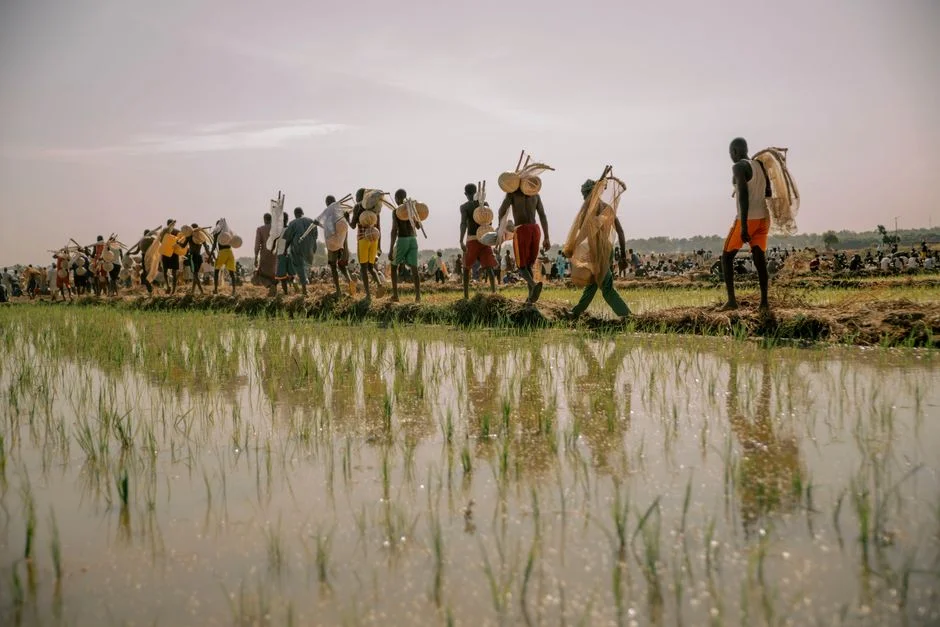
A wet El Niño year is a rice year. The same rain that stresses maize can fill your inland valley and hand you a strong paddy harvest, if you hold the water, space the crop right, and split your nitrogen.
This Crop Clinic is your field plan: lowland versus upland, seed and spacing, water depth, and how to beat the four problems that steal rice yield.
Is a wet El Niño year good or bad for rice?
Good, and here is why. Rice is the one staple that turns standing water into grain, so a season that drowns other crops can be your best rice year yet.
In East Africa, El Niño tends to push the short rains wetter (more on the East Africa floods picture). Across West Africa the monsoon can arrive stronger (protect your main-season crop). An inland valley (the low, flat ground that floods; called fadama in Nigeria and bas-fonds in francophone West Africa) will hold water longer this year, which is exactly what rice wants.
One caution: rice loves standing water but not full submergence for days. Watch for flash floods that bury young seedlings, and keep an outlet in your bund so a downpour can drain off the top.
Should I grow lowland (paddy) or upland NERICA rice?
Match the rice to your land and water.

Photo: Léonide Mahajanjy / Pexels
| Your land | Best rice type | Why |
|---|---|---|
| Flat, floods or holds water (inland valley, fadama, bas-fonds; e.g. Nigeria, Mali's Office du Niger, Ghana, Tanzania's Kilombero) | Rainfed lowland (bunded, puddled) | Standing water feeds yield and smothers weeds |
| Gentle rain-fed slope, no standing water (forest and derived savanna; e.g. Uganda, western Tanzania) | Upland / NERICA | Bred to grow on rainfall alone |
NERICA (New Rice for Africa) are AfricaRice crosses of African rice (O. glaberrima) and Asian rice (O. sativa). Early types like FARO 55 (NERICA 1) and FARO 56 (NERICA 2) mature in under 90-100 days, and their African-rice blood gives better resistance to yellow mottle virus. Rainfed upland averages about 1.7 t/ha; a well-managed bunded lowland field does more. Pick a named variety with your extension officer (how to choose seed).
How much seed and what spacing do I use for rice?
Use this table instead of guessing (a 50 kg paddy bag is the standard; 90 kg in Zambia and Zimbabwe).

Photo: Petr Ganaj / Pexels
| Method | Seed rate | Spacing |
|---|---|---|
| Transplanting (lowland) | 80-100 kg/ha in the nursery (~2 bags) | 20x20 cm on fertile soil, 30x30 cm for late varieties; 2-3 seedlings a hill, 3-4 cm deep |
| Dibbling (upland) | 50-60 kg/ha (~1 bag) | 20x20 or 30x30 cm; 5-8 seeds a hole, thin to 2-4 |
| Drilling in rows (upland) | 75-80 kg/ha | 25-30 cm rows, 5 cm within |
| Broadcasting | 80-100 kg/ha | even scatter |
For lowland, about 1000 m2 of nursery raises enough seedlings for 1 ha. Transplant at 14-21 days after sowing; older seedlings tiller poorly.
Level and bund first. A field flat to within a hand-width holds an even sheet of water, which starves weeds and spreads fertiliser evenly. Build low earth walls (bunds) of about 20-30 cm around the plot to trap and hold the rain. Feed the soil that holds it (compost, manure and mulch).
How deep should the water be, and when do I drain the field?
Hold a thin sheet of about 5 cm from a week after transplanting until the grain fills, then drain 7-10 days before harvest.

Photo: IAN / Pexels
- Start at about 3 cm and build to 5-10 cm as the plants grow. No-tool test: 5 cm is about a matchbox stood on its end, or water up to your first thumb knuckle.
- Never let it dry at flowering. Rice is most sensitive to water shortage then; the soil must stay glassy-wet with water on it.
- Short of water? Use AWD (alternate wetting and drying). Sink a bottomless tin as a field water tube, 30 cm long with 15 cm above the soil, and re-flood to 5 cm when the water drops about 15 cm below the surface (roughly a hand-span down). Keep it flooded right through flowering.
- Drain 7-10 days before harvest so the field firms up and the grain ripens evenly.
How do I stop rice blast, yellow mottle and birds?
Resistant varieties, clean fields and the right nitrogen beat most of it; spray only as a last resort.
Rice blast (Magnaporthe oryzae, a fungus). Worst in cool, humid uplands and the forest zone. ID: diamond or eye-shaped leaf spots with grey centres and brown borders. IPM order:
1. Sanitation — plough under old rice stubble and volunteer plants.
2. Cultural — plant a resistant variety; split nitrogen and keep the field flooded, because excess N feeds blast.
3. Botanical — spread rice-straw ash (silicon) on poor soils.
4. Chemical, last — a triazole or strobilurin at heading, used judiciously; wear gloves, mask and long sleeves, and observe the pre-harvest interval on the label.
Rice yellow mottle virus (RYMV, a Sobemovirus). ID: yellow-orange streaks and mottling on young leaves, stunting and few tillers; worst when plants are hit 20-50 days after transplanting. It spreads by leaf beetles, grazing animals, irrigation water and handling. IPM: grow NERICA and AfricaRice lines with African-rice resistance; weed during and after the crop; plough in infected stubble and ratoons; and plant with your neighbours in one window.
Birds (quelea and others). They hit from the milk to dough stage, when the grain goes from soft to hardening, in the 2-3 weeks before harvest. Plant in one community window so no single field is the only ripe target, scare actively at dawn and dusk, and net small plots.
Weeds. In lowland, a steady 5 cm of water is your cheapest herbicide. In upland, weed at 2-3 weeks and again at 6-7 weeks after emergence — the two weedings that protect yield most.
Your next step this week
Walk your lowest, wettest plot. If it holds a sheet of water, mark out a bunded lowland field and book a nursery bed (about 1000 m2 per hectare); if it only catches rain, order early NERICA seed instead. Then set your nitrogen: three splits — at transplanting, mid-tillering (3-5 weeks after transplanting) and panicle initiation (8-9 weeks), never more than 1½ bags of urea (35 kg N/ha) at once.