 Divisi
Broad mite
Polyphagotarsonemus latus · Mite
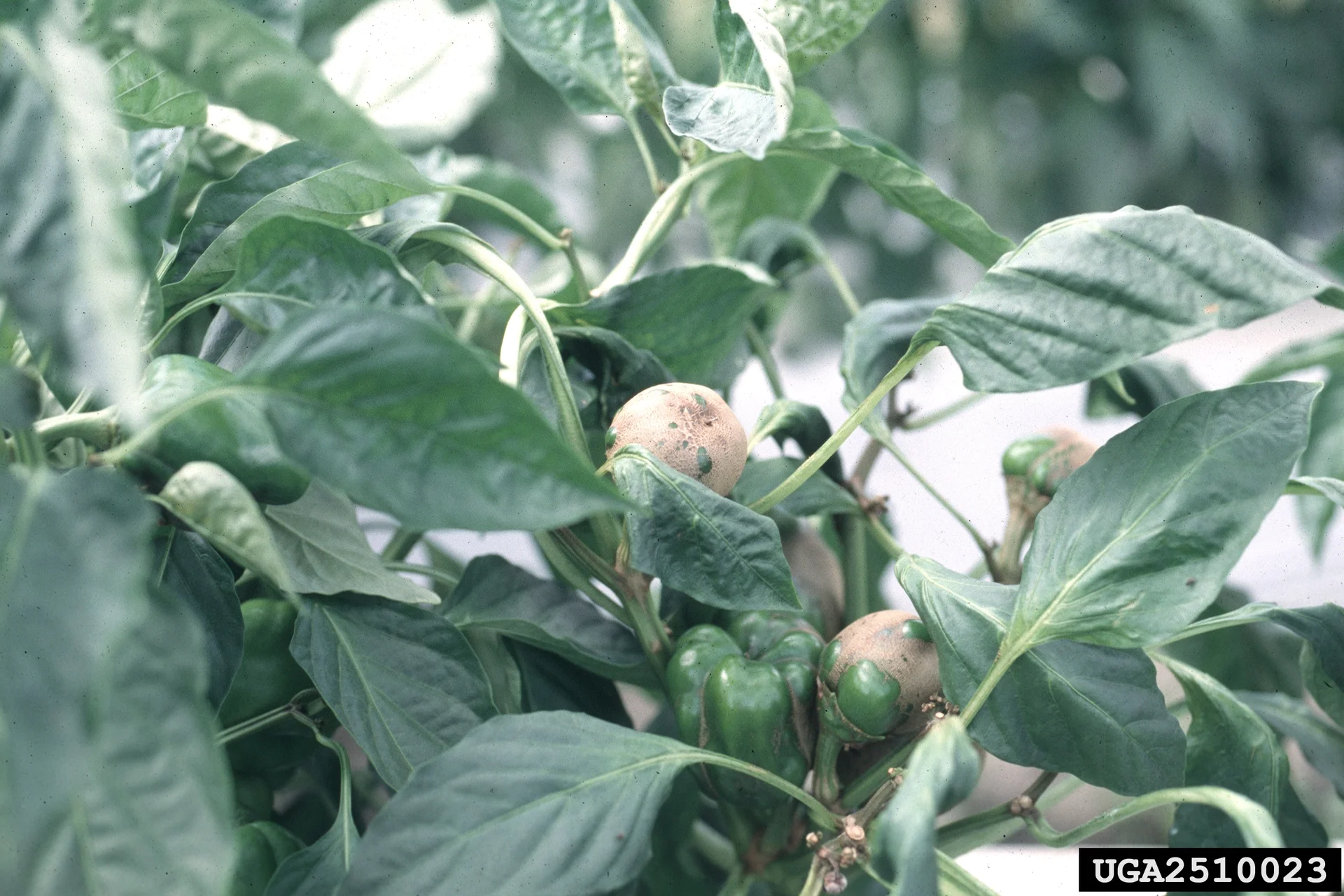
Photo: David Riley, University of Georgia, Bugwood.org · CC BY 3.0
Broad mite (Polyphagotarsonemus latus) is a mite so tiny you cannot see it with your eyes — far smaller than a grain of sugar. It lives on the youngest leaves and growing tips of pepper, chilli, tomato, cotton and citrus, and as it feeds it injects a poison in its spit that twists and hardens new growth. It breeds explosively in warm, humid weather and rides from plant to plant on your hands, your tools, the wind, and on whiteflies.
Merle Shepard, Gerald R.Carner, and P.A.C Ooi, Insects and their Natural Enemies Associated with Vegetables and Soybean in Southeast Asia, Bugwood.org · CC BY 3.0 US 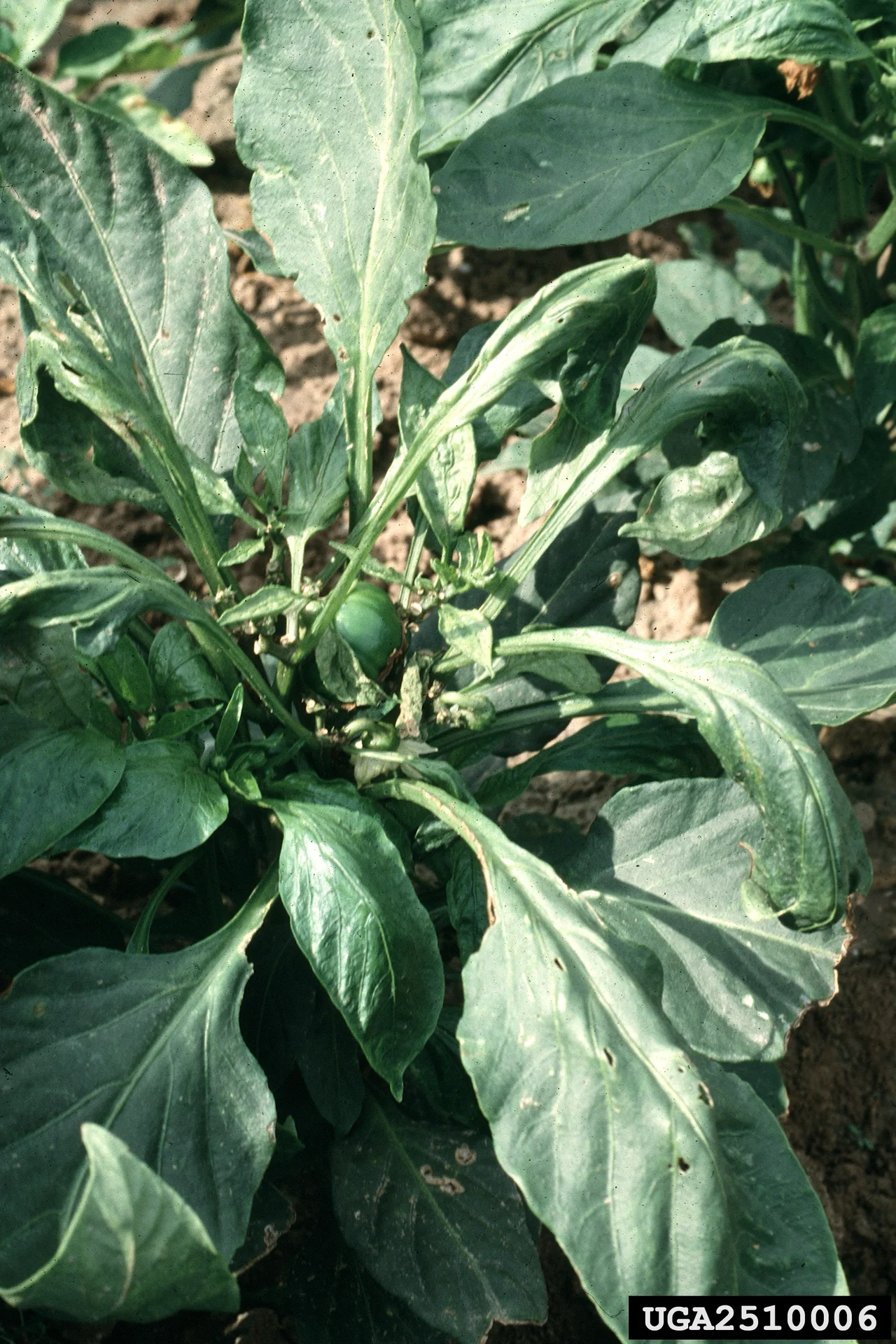
David Riley, University of Georgia, Bugwood.org · CC BY 3.0
Why it matters
Broad mite can take up to half your crop (50%) on peppers, chillies and tomatoes, because it kills the growing point where all your new leaves, flowers and fruit come from. The hardest part is that you never see the mite — it is far too small — and by the time the leaves look wrong, the mites have already moved on to the next fresh shoot. Left alone, it stops the plant setting fruit and scars the fruit it does set, so catching the first curled, bronzed leaf is everything.
When to act
Treat at the first sign of downward-curled, bronzed young leaves or distorted growing tips, since the mites are too small to see and symptoms appear before damage is obvious.
This guidance is general, compiled from published agronomic references including FAO and CABI. Thresholds and timing shift with your crop, your variety and the season.
In much of the region a spray is simply called mushonga — medicine. But a chemical group you cannot name is one you cannot rotate, and a product you did not write down has no pre-harvest interval you can observe. Mushonga, and other farming words →
The full Broad mite field guide
Identify it
The damage comes first — that's what you'll actually see
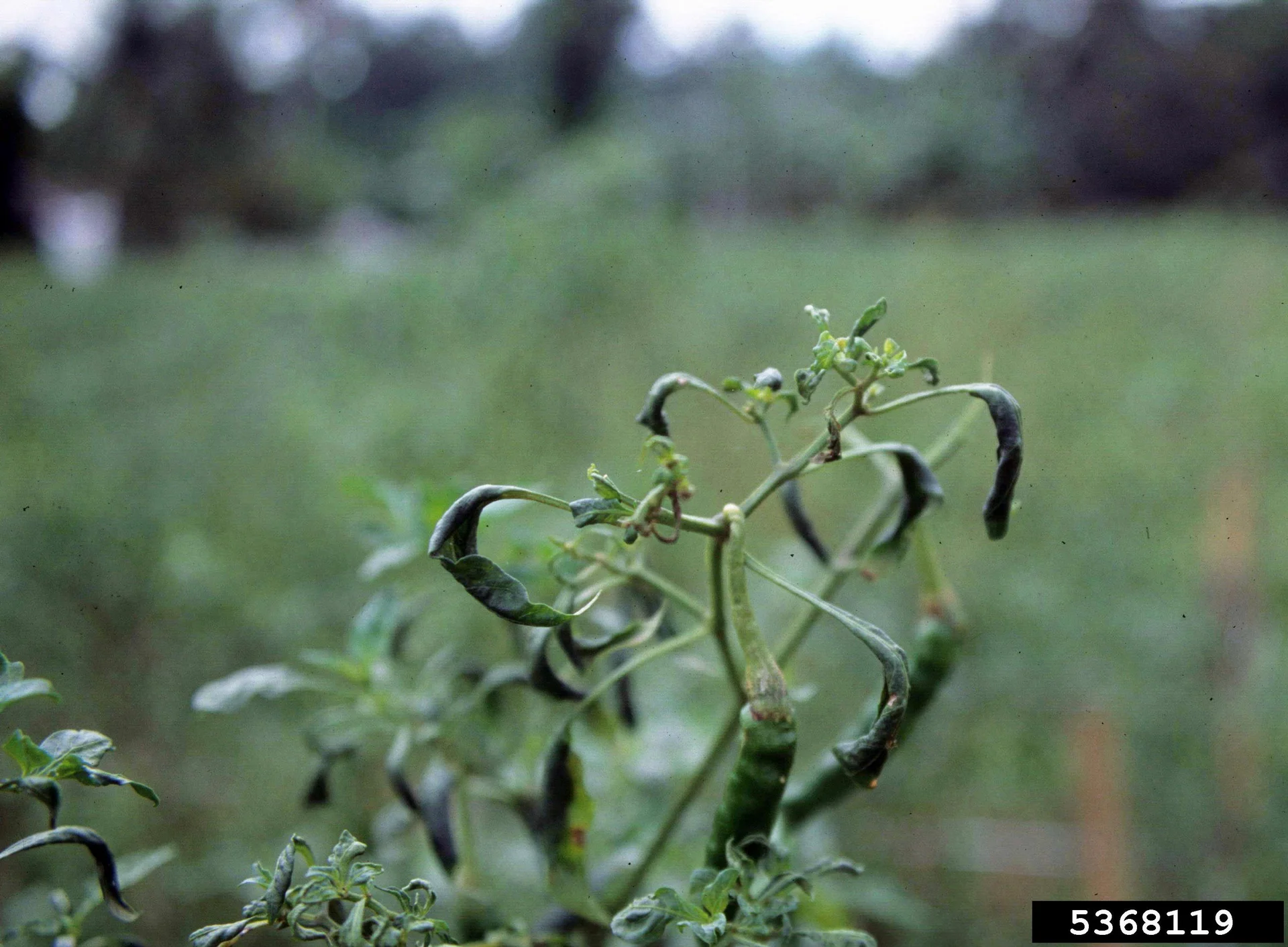
The youngest leaves at the growing tip curl downward, go stiff and brittle, and the underside turns a shiny bronze or copper colour, as if lightly scorched or oiled. The growing tip bunches up tight and stops growing — like a little witches' broom of stunted, deformed leaves.
On the fruit
peppers, chillies and tomatoes get a rough, corky, grey-brown skin (russeting), often silvery cracks on the shoulders — the fruit looks scarred and won't sell.
The mite itself is invisible to the naked eye
— about 0.2 mm, far smaller than a grain of sugar, clear to pale amber and shiny. Even with a strong hand lens you'll struggle; you are hunting the damage, not the animal. It hides on the underside of the very youngest leaves and deep in the growing tip, where it's shaded and humid.
Don't confuse it with look-alikes
Unlike red spider mite, broad mite makes no webbing and the leaves bronze rather than show pale speckles. Unlike leaf-curl virus (spread by whitefly), broad-mite curling is on the newest growth with that oily bronze underside and hard, brittle feel — virus curl is usually yellower, blotchy and puckered. It can also look like hormone weedkiller drift or boron shortage; the giveaway for broad mite is the shiny bronzed underside on the youngest leaves plus corky, russeted fruit.
Scout for it
When to look hardest
from the fast-growing (development) stage through the fruiting (mid-season) stage — whenever the plant is pushing lush new tips. Warm, sticky weather (about 21–30°C with humid, still air) and shaded, sheltered or greenhouse corners are where it explodes, so check those spots first.
Walk a big "W" across the field
so you cover all four corners and the middle — not just the row nearest the path, where you always end up looking.
At about 10 stops, bend down and inspect the youngest 2–3 leaves and the growing tip of each plant. Turn the young leaves over and tilt them to the light: you're checking for a shiny bronze underside, downward-curled brittle edges, and bunched, distorted tips.
Act on the very first plants you find
Because the mite is too small to see and the damage shows up before it becomes obvious, treat as soon as you find even a few plants with curled, bronzed young leaves or twisted growing tips — don't wait for a big count. If you see it on 1 plant, check the neighbours; a cluster of affected tips means it's spreading and you should treat now.
Watch whiteflies at the same time — they ferry broad mite between plants, so lots of whitefly means the mite will travel fast.
Control it
Prevent it — start clean
Plant only clean, healthy transplants (inspect the growing tips before you buy or move seedlings) — this is the single most important step, since most outbreaks arrive on infested seedlings. Keep your hands and tools clean when moving between plants, and control whiteflies, which carry the mite from plant to plant.
Rogue the worst plants
As soon as you spot badly curled, bronzed, witches-broomed plants, pull them out and destroy them (burn or bury away from the field) so they stop feeding the outbreak — don't just drop them between the rows.
Protect the natural enemies (your free help)
Tiny predatory mites (such as Amblyseius / Neoseiulus types) hunt and eat broad mite and can hold it down on their own. Protect them by not blanket-spraying broad, harsh insecticides — those poisons kill the good mites faster than the pest and make the problem far worse.
Act early, aim at the tips
Broad mite lives only on the newest growth, so any spray must soak the undersides of the young leaves and the growing tips — that's where the mites are. Spray thoroughly and repeat as the plant keeps pushing new growth, because fresh shoots are unprotected.
Chemical — last resort (abamectin)
If it keeps spreading despite the steps above, use a targeted miticide of the abamectin class (or sulphur), directed straight at the young leaf undersides and growing tips. Abamectin is a contact/translaminar miticide — it kills mites it touches or that feed on the sprayed leaf, so thorough coverage is everything. Safety: cover your skin, eyes, nose and mouth, spray in the cool of the day with the wind at your back, keep it off food, water, children and bees, wash yourself and your clothes afterwards, and respect the pre-harvest interval (the minimum days you must wait between spraying and picking — read the label). To stop the mite building resistance (surviving the poison), rotate to a different chemical group each time rather than using abamectin over and over.
If it keeps spreading → change tactics; if it's too late → cut your losses
Re-treat the young growth every few days and keep roguing the worst plants. If new tips keep coming out curled and bronzed after repeated treatment, switch to a different chemical group and lean harder on clean material and whitefly control. When a plant is fully stunted with a dead, broomed growing tip and russeted fruit, it will not recover — pull it, destroy it, and protect the healthy plants around it instead of spending more spray on a lost one.
Catch Broad mite before it costs you the harvest
This guide is the general answer. Divisi works out yours — the week to scout your own field for Broad mite, and what to do the day you find it.


Crops it affects
Plan the crops it attacks
-
 When to plant Cotton in Kalemie
 -
 When to plant Hot pepper in Dekese
 -
 When to plant Sweet pepper in Manono
 -
 When to plant Tomato in Goma
All planting calendars, country by country
Get Insights by email
A short digest of new Divisi articles. No email on quiet weeks.
Frequently asked questions
How do I identify Broad mite?
The damage comes first — that's what you'll actually see. The youngest leaves at the growing tip curl downward, go stiff and brittle, and the underside turns a shiny bronze or copper colour, as if lightly scorched or oiled. The growing tip bunches up tight and stops growing — like a little witches' broom of stunted, deformed leaves.
When should I take action against Broad mite?
Treat at the first sign of downward-curled, bronzed young leaves or distorted growing tips, since the mites are too small to see and symptoms appear before damage is obvious.
How do I control Broad mite?
Prevent it — start clean. Plant only clean, healthy transplants (inspect the growing tips before you buy or move seedlings) — this is the single most important step, since most outbreaks arrive on infested seedlings. Keep your hands and tools clean when moving between plants, and control whiteflies, which carry the mite from plant to plant.
Which crops are attacked by Broad mite?
Among the crops covered here: Cotton, Hot pepper, Sweet pepper, Tomato.