 Divisi
Broomrape
Orobanche · Parasitic Weed
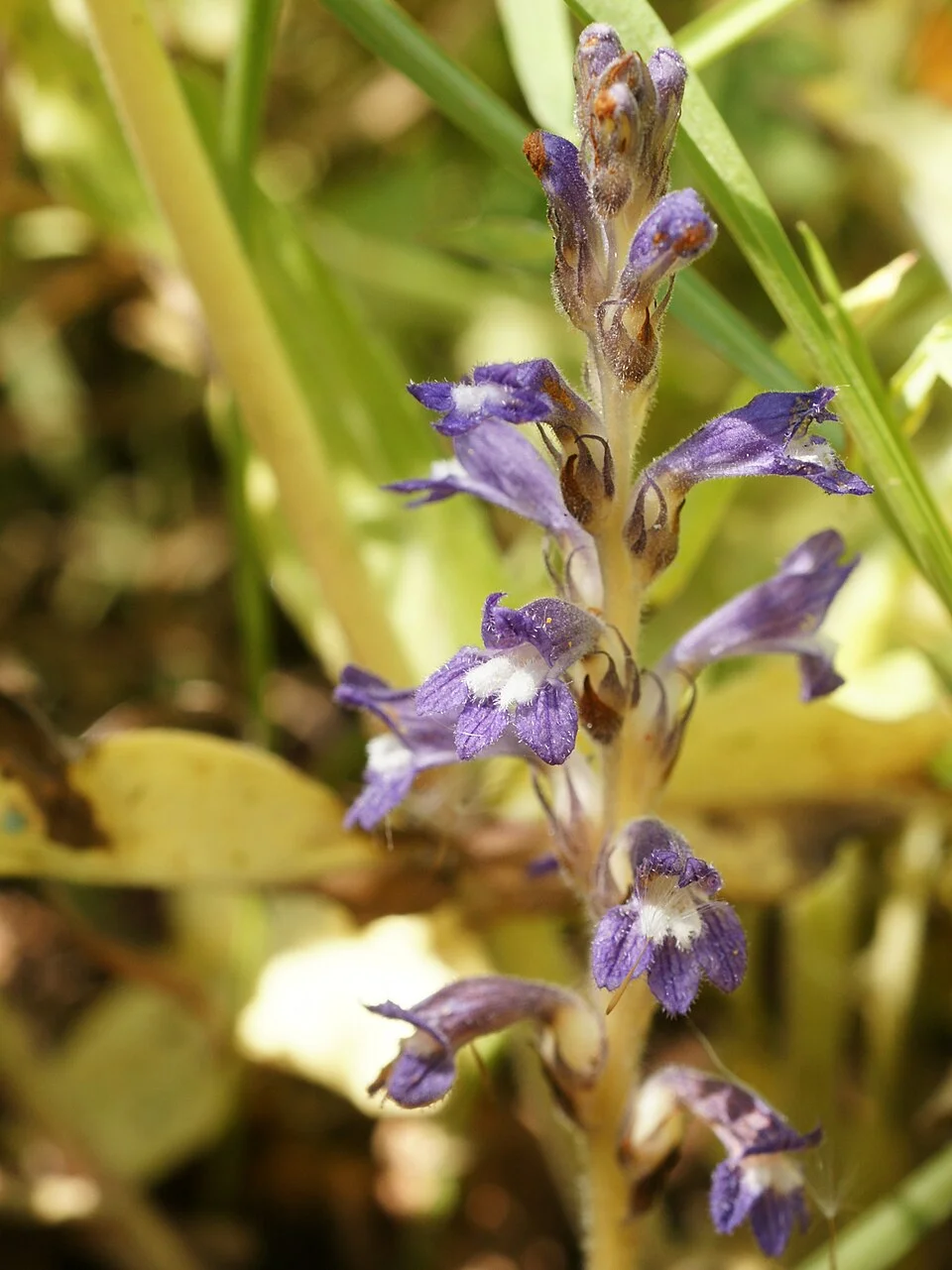
Photo: Hans Hillewaert · CC BY-SA 3.0
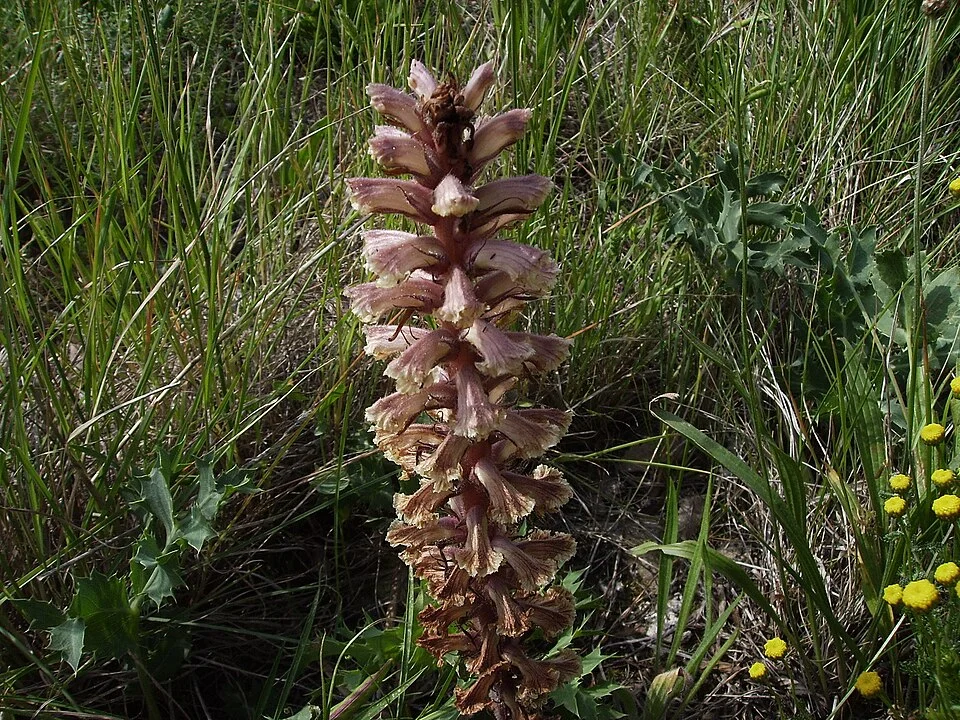
Broomrape (Orobanche) is a parasite plant — it has no roots and no green leaves of its own, and it makes no food from sunlight the way normal plants do. Instead it drives a sucker into the roots of your crop underground and lives entirely off the water and food it steals, showing above ground only as clusters of leafless, scaly spikes at the base of the crop stem. A single plant can shed tens of thousands of dust-fine seeds that lie in wait in the soil for more than ten years and wake up only when they sense the roots of a crop they can feed on.
Victor M. Vicente Selvas · Public domain 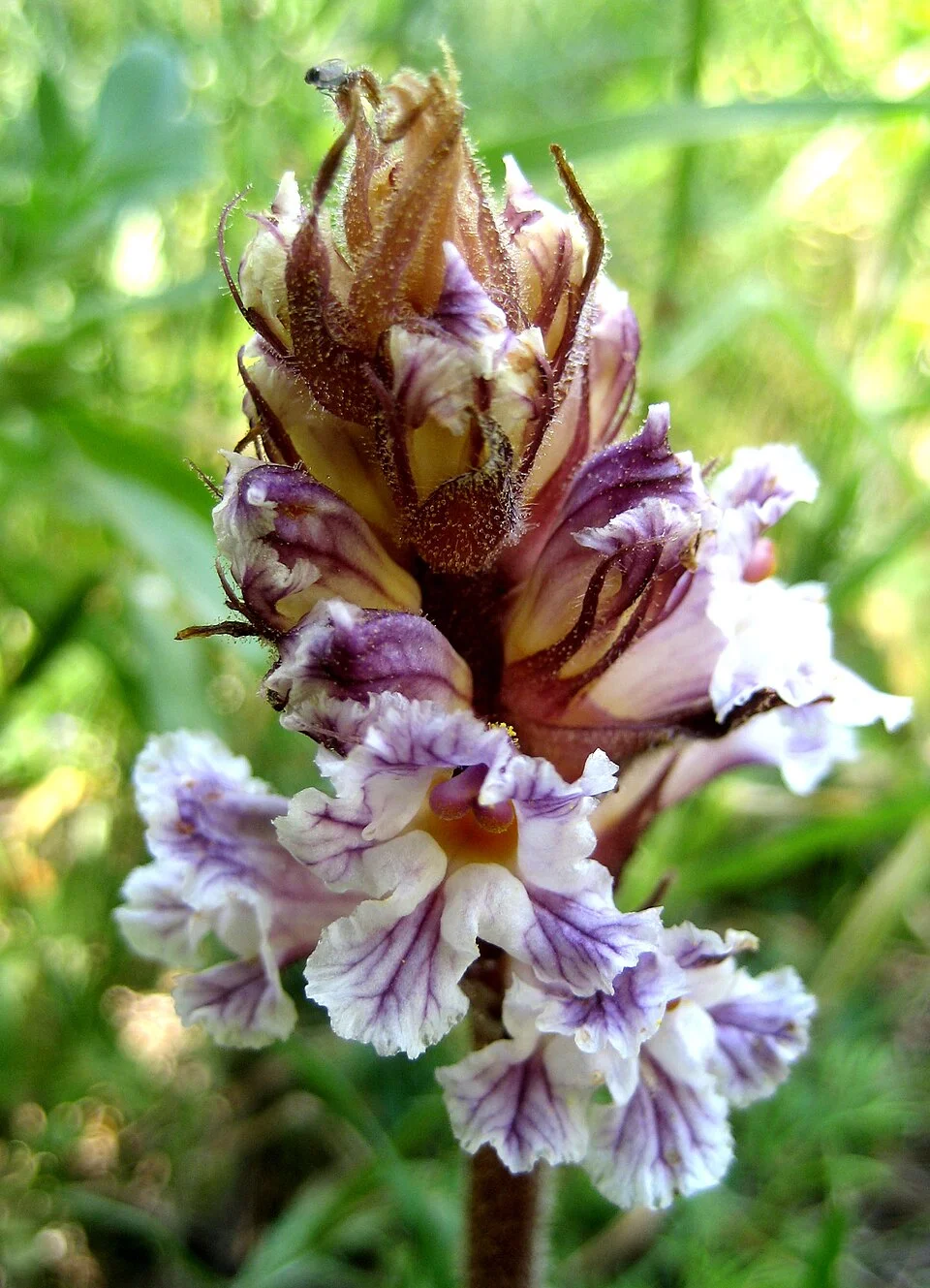
Maarten Sepp · CC BY-SA 4.0
Why it matters
Broomrape is a parasite plant (one that lives off another plant and gives nothing back) — it has no roots or green leaves of its own, so it latches onto your crop's roots underground and drinks its water and food, and your plants starve from below while they still look like they are only growing badly. A heavy attack can take up to 80% of your crop — as much as four of every five plants' worth of harvest. The cruel part is that most of the damage is done underground before you ever see the parasite, and a single broomrape plant that is allowed to flower drops tens of thousands of dust-fine seeds that stay alive in your soil for more than ten years, waking up every time you plant a crop it can feed on. That is why you must never, ever let even one shoot flower — once the soil is seeded, that field is cursed for a decade.
When to act
Any emerged broomrape shoots must be pulled and destroyed before they flower and seed; even a few plants seed the soil for years.
This guidance is general, compiled from published agronomic references including FAO and CABI. Thresholds and timing shift with your crop, your variety and the season.
In much of the region a spray is simply called mushonga — medicine. But a chemical group you cannot name is one you cannot rotate, and a product you did not write down has no pre-harvest interval you can observe. Mushonga, and other farming words →
The full Broomrape field guide
Identify it
The first warning, before you see the parasite
a patch of crop that is stunted, yellowing and wilting in the afternoon heat even though the soil is still moist. The parasite is drinking the plant's water from below, so your crop shows a thirst it should not have. Mark these weak patches — broomrape is at work underground right there.
The unmistakable sign — the parasite itself:
clusters of fat, leafless spikes pushing up right against the crop's stem, low to the soil — like a little bunch of pale asparagus fingers or wax candles. They are straw-yellow, honey-brown or purple-blue — never green (the plant has no green colour anywhere), and are covered in small overlapping scales instead of leaves. As they grow, snapdragon-like flowers open along the spike. A young shoot may be only a finger's length, but a mature one can reach knee-high or taller — so don't rule out a big spike; the tall, flowering ones are the most urgent to pull.
Don't confuse it
it is not a mushroom (a mushroom is a soft cap; broomrape is a firm, scaly flowering spike) and not a new shoot of your own crop (your crop's shoots are green — broomrape never is, and it joins to the ROOT, not the stem). It is a different parasite from dodder, which is an orange-yellow thread that twines over the TOP of the plant around stems and leaves; broomrape instead sits as a stubby spike at the base. And plain hunger or drought yellows the whole field fairly evenly — broomrape damage comes in spreading patches tied to those spikes at the stem base.
Favoured by: warm, dry weather (soil around 15–25°C), and above all by growing a host crop on the same land season after season — tomato, faba bean, sunflower, common bean or tobacco — on soil that already carries broomrape seed.
Scout for it
When
begin watching from the development stage, as soon as the crop is growing strongly and rooting down, and look hardest through mid-season and flowering — this is when the spikes break the surface. It presses hardest in the warm, dry part of the season (soil about 15–25°C).
First, hunt the weak patches
even before any spike appears, walk the field for patches of stunted, yellow, afternoon-wilting plants and mark them — that is where broomrape is feeding underground, and where spikes will show first.
Walk a big "W"
across the field so you cover all four corners and the middle, not just the edge by the path. Make about 10 stops — and add extra stops inside every weak patch you marked.
At each stop, look low
Part the crop's bottom leaves and look right at the soil against the stem base, where the spikes push up short and half-hidden. They are easy to miss under the canopy, so get your eyes right down to ground level.
Even ONE emerged shoot is too many
Broomrape has no safe number the way a few caterpillars might be tolerable — a single plant that flowers seeds the soil for a decade. The moment you find one spike, act now — pull it before its flowers open. If you can already see open flowers or drying seed pods, seeding may have started, so remove and bag those first.
Map the patches
each time so you know where broomrape lives — that tells you where to scout first next season, and which part of the field to work and harvest last so you don't carry seed onto clean ground.
Control it
Best defence — plant a resistant variety
Where you can get it, sow a crop variety bred to resist broomrape — these exist for sunflower and faba bean. The parasite's sucker cannot grip a resistant plant well, so far fewer ever attach. Ask your seed supplier or extension officer what resistant or tolerant seed is available for your crop.
Keep the seed out — clean everything
Broomrape seed is as fine as dust and rides in on dirty tools, boots, animals, machinery, irrigation water and unclean crop seed. Plant clean, certified seed; knock off and wash tools and boots when you leave an infested field; work your clean fields first and the infested field LAST; and never carry soil, manure or crop trash from an infested field onto a clean one.
Starve it out with rotation
(changing which crop grows on the field each season). Broomrape can only live on host crops — tomato, faba bean, sunflower, common bean, tobacco. Move the field for several seasons onto a crop it cannot feed on — a non-host such as maize, sorghum or another cereal grass — so the waiting seeds find no host and slowly die. The longer the break from host crops, the more the buried seed falls.
Trick the seeds into dying (trap crop)
A trap (catch) crop makes broomrape seeds sprout — they sense its roots — but then gives them nothing to latch onto, so they die; this is called suicidal germination and it drains the seed out of the soil. Ask your extension officer which trap crop suits your area. On a small plot you can also try solarisation — cover damp soil with clear plastic through the hottest weeks so the trapped heat cooks the seeds near the surface.
Pull every shoot before it flowers — this is the key action
The instant you spot a spike, pull or dig it out and carry it off the field in a bag. Do not drop it on the ground or throw it on the compost — it can still open its flowers and set seed. Getting them out before the flowers open is everything; after seed set you have gained nothing. Keep coming back every week through mid-season, because new spikes keep pushing up.
Chemical — last resort, and risky
Because the parasite is joined to your crop's own sap, the only chemical route is a very low, carefully-timed dose of a systemic weed-killer of the glyphosate group — systemic means it is taken in through the crop's leaves and carried down inside the sap to reach the parasite hidden on the roots, where a surface spray can never reach. The catch: the dose that kills broomrape is dangerously close to the dose that kills your crop. So use it only on a crop known to tolerate it, and only with exact guidance from your extension officer. It is the weakest option here, so let prevention do most of the work. Safety: cover your skin, eyes, nose and mouth; spray in the cool of morning or evening with the wind at your back; keep it off food, drinking water, children, animals and bees; wash yourself and your clothes after; and wait the full pre-harvest interval (the number of days the label tells you to leave between the last spray and harvest so the food is safe to eat). This glyphosate-group spray is the only weed-killer that reaches broomrape — there is no back-up product to switch to — so do not lean on it season after season; keep it a rare last resort and let clean fields, rotation and hand-pulling carry the real load.
If it keeps coming back — save the next ten years
If broomrape has already flowered and seeded, or patches return year after year, accept that this field's soil is now loaded with seed that lasts ten years or more. Take that field out of host crops (no tomato, faba bean, sunflower, common bean or tobacco), put it under non-host cereals or grasses for several seasons, keep pulling any shoots before they seed, and always work and harvest that field last with cleaned tools. If this season's crop is already ruined, still pull the broomrape before it seeds — you may lose this harvest, but you protect the next decade of them.
Catch Broomrape before it costs you the harvest
This guide is the general answer. Divisi works out yours — the week to scout your own field for Broomrape, and what to do the day you find it.


Crops it affects
Plan the crops it attacks
-
 When to plant Common bean in Dilolo
 -
 When to plant Niger seed (noug) in Ngoma
 -
 When to plant Sunflower in Nakasongola
 -
 When to plant Tobacco in Opobo/Nkoro
 -
 When to plant Tomato in Goma
All planting calendars, country by country
Get Insights by email
A short digest of new Divisi articles. No email on quiet weeks.
Frequently asked questions
How do I identify Broomrape?
The first warning, before you see the parasite. a patch of crop that is stunted, yellowing and wilting in the afternoon heat even though the soil is still moist. The parasite is drinking the plant's water from below, so your crop shows a thirst it should not have. Mark these weak patches — broomrape is at work underground right there.
When should I take action against Broomrape?
Any emerged broomrape shoots must be pulled and destroyed before they flower and seed; even a few plants seed the soil for years.
How do I control Broomrape?
Best defence — plant a resistant variety. Where you can get it, sow a crop variety bred to resist broomrape — these exist for sunflower and faba bean. The parasite's sucker cannot grip a resistant plant well, so far fewer ever attach. Ask your seed supplier or extension officer what resistant or tolerant seed is available for your crop.
Which crops are attacked by Broomrape?
Among the crops covered here: Common bean, Niger seed (noug), Sunflower, Tobacco, Tomato.