 Divisi
Cutworms
Agrotis ipsilon · Insect
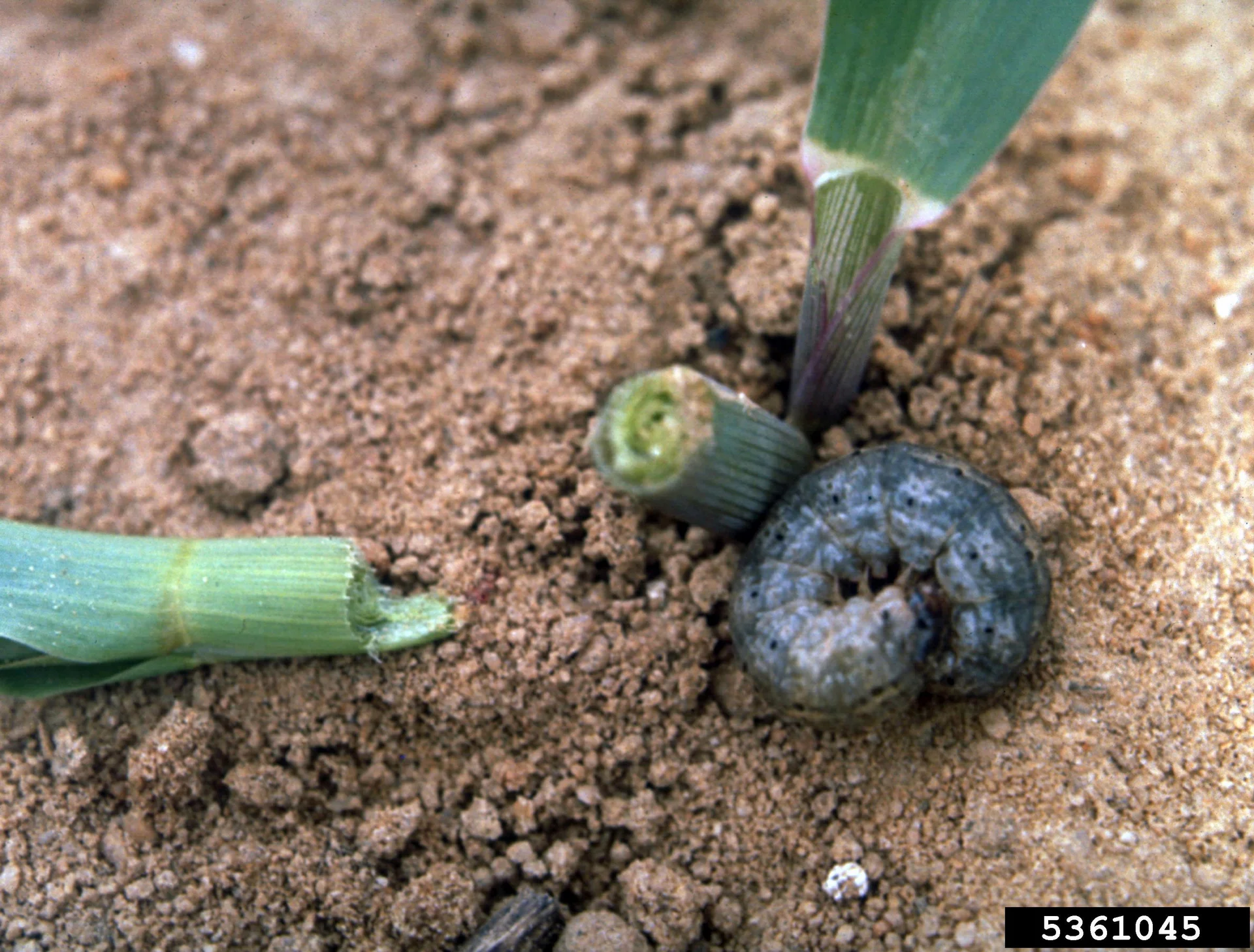
Photo: USGS Bee Inventory and Monitoring Lab from Beltsville, Maryland, USA · Public domain
Cutworms are the fat, night-feeding caterpillars of several drab brown moths, most commonly the black cutworm (Agrotis ipsilon). They spend the day curled up in the soil and come out after dark to chew young leaves and — most damagingly — to sever seedlings clean off at ground level, felling them one by one. They attack a wide range of young crops including maize, tomato, cabbage, beans, tobacco and other vegetables, and are worst on land freshly cleared of grass or weeds, which carry their eggs and small larvae straight into the new crop.
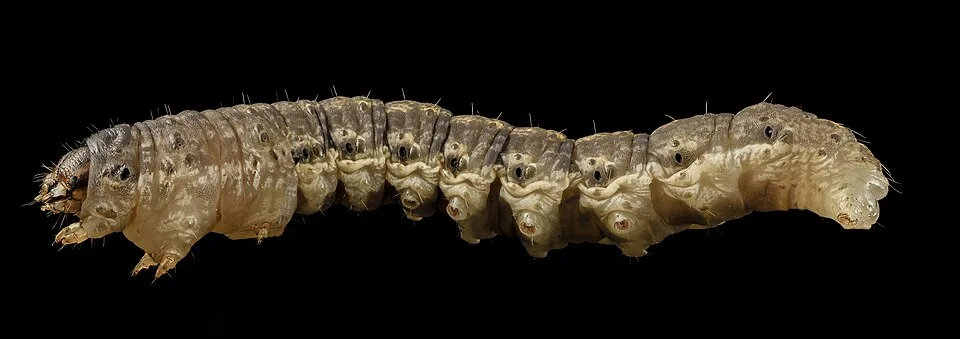
USGS Bee Inventory and Monitoring Lab from Beltsville, Maryland, USA · Public domain 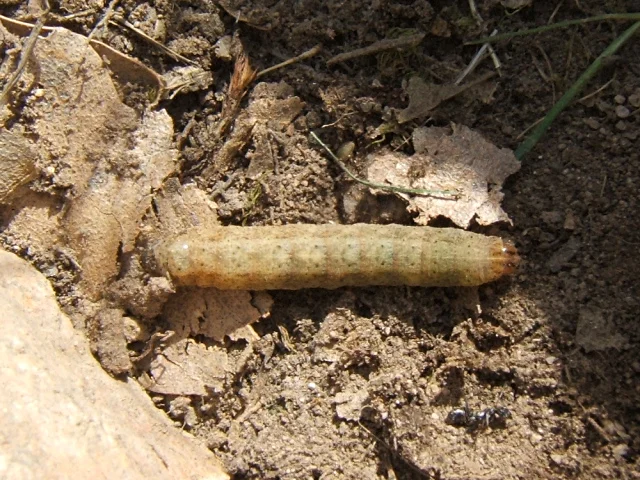
USGS Bee Inventory and Monitoring Lab from Beltsville, Maryland, USA · Public domain
Why it matters
Cutworms are seedling killers. They come out at night and slice young plants off clean at ground level, so you wake to toppled seedlings and bare gaps in the row — and a cut seedling never grows back. A bad attack on a young field can cost you up to a third of your crop (30%) before it is even properly established. They are hard to stop once they start because the fat grey caterpillars hide in the soil by day, out of reach of any leaf spray, and each one goes on killing a fresh plant every night — so a clean, weed-free seedbed beats any cure.
When to act
Treat when 5 percent or more of seedlings are cut, or 2 to 3 larvae per square metre are found.
This guidance is general, compiled from published agronomic references including FAO and CABI. Thresholds and timing shift with your crop, your variety and the season.
In much of the region a spray is simply called mushonga — medicine. But a chemical group you cannot name is one you cannot rotate, and a product you did not write down has no pre-harvest interval you can observe. Mushonga, and other farming words →
The full Cutworms field guide
Identify it
The damage shows first
You will find young seedlings cut clean through at ground level, as if someone snipped them with scissors — the toppled plant often lies wilting right beside its own little stump, or it disappears altogether, leaving bare gaps and missing plants in patches along the row (usually several in a run, not one lonely plant here and there). Before they are big enough to fell a stem, the smaller caterpillars chew ragged notches and holes in the young leaves.
The caterpillar itself
Scratch a few centimetres into the soil right beside a freshly cut plant and you will uncover the culprit: a fat, soft, greasy-looking caterpillar, grey to grey-brown, up to about 4 cm long — a full-grown one is about as long and as thick as your little finger. The give-away: when you disturb it, it curls up tight into the shape of the letter 'C' and lies still. It hides in the soil, under clods or under leaf litter by day, and only feeds at night.
Tell it apart from look-alikes
White grubs (the larvae of chafer beetles) also curl into a C, but they are creamy-white with a hard brown head and clear legs, and they chew roots below ground — they do not cut the stem at the surface. Termites can topple a seedling too, but they leave mud tunnels or soil plastered up the stem and a hollowed, ragged base, not one clean cut with a grey caterpillar lying beside it. Damping-off (a seedling rot disease) makes plants flop over as well, but there the stem is pinched, darkened and water-soaked (rotten) at the base, not cleanly severed — and there is no caterpillar to be found.
Scout for it
Watch the seedling stage — that is the whole danger window
Cutworms can only cut a plant while its stem is still soft, so the risk runs from the day your crop first emerges through its first three to four weeks, then fades as the stems toughen. Be on highest alert if you planted into land that was recently grassy, weedy or newly cleared, and during mild, moist weather — that is when the moths lay and the young larvae thrive.
Look every morning, and walk a big letter 'W'
across the whole field so you cover the four corners and the middle, not just the edge nearest the path. Scan the rows for freshly cut or wilting seedlings and new gaps. Because cutworms feed at night and hide by day, the best times to catch them in the act are early morning, on the fresh overnight cutting, or after dark with a torch, when they climb up to feed.
At about five stops along your 'W', check a stretch of row and scratch the top few centimetres of soil within a hand's width of any cut plant — the curled grey caterpillar is nearly always hiding right there, or under a nearby clod or leaf. At a couple of the stops, also mark out a square metre (about one big stride each way), dig it over, and count the larvae you turn up.
Act now if 1 in 20 seedlings has been cut (that is 5%), or if you dig up 2 to 3 caterpillars in a square metre
Below that, keep checking every single day — but because each larva kills another plant every night it survives, do not sit and wait once you are close to the threshold.
Control it
Prevent it first — a clean, weed-free seedbed is your strongest and cheapest weapon
Cutworms ride into your field on the grass and weeds that grew before your crop. Plough your land and keep it completely weed-free for two to three weeks before you plant, so the larvae already in the soil are left with nothing to eat and starve or get picked off before your seedlings even come up. Never plant straight into freshly cleared grassland or a weedy field — that brings the worst attacks.
Turn the soil and clean the field edges
Plough well at land preparation so the turning soil throws hidden caterpillars up to the sun and to hungry birds, and clear grassy weeds and volunteer plants (crop plants that sprout on their own from last season's spilled seed) from the edges, where the night-flying moths shelter and lay their eggs. Where you have water, a flood irrigation before planting drowns the larvae or drives them up to the surface for predators to take.
Act early, while numbers are still small — and let nature help
Protect the natural enemies that eat cutworms — birds, ground beetles and tiny parasitic wasps — by not reaching for broad poisons that kill them too. In moist soil you can water in beneficial nematodes (tiny soil-dwelling worms, sold to hunt insect pests and harmless to your crop and family), which seek out and kill the larvae underground.
Hand-pick them by torchlight
On a small plot the surest early action costs nothing: dig out the curled caterpillar hiding beside each cut plant and crush it. Go out at dusk or after dark with a torch, when the caterpillars climb up to feed and are easiest to catch, and collect every one you find.
Use chemicals only as a last resort, and only once you reach the threshold
When cutting hits 1 in 20 seedlings (5%) or 2–3 larvae per square metre, apply an approved insecticide as a poison bait, or as a drench aimed at the soil and stem base — not sprayed over the leaves, which the soil-hiding caterpillars never touch. Put it out in the late afternoon so it is fresh when they surface to feed that night. Safety: cover your skin, eyes, nose and mouth; work in the cool of the day with the wind at your back; keep it well away from food, drinking water, children and bees; do not harvest until the pre-harvest interval (the waiting time printed on the label between spraying and eating) has passed; and wash yourself and your clothes well afterwards.
Guard against resistance
If you have to treat more than once, switch to a different chemical group each time instead of using the same product over and over. Otherwise the few caterpillars that live through one poison pass their toughness on to their young — this is called resistance — and in time the poison stops working at all.
If the cutting keeps spreading
keep checking every morning, dig out the larva from each new gap, and repeat the evening bait wherever the threshold is still being crossed. Replant or gap-fill the bare patches quickly to hold a full stand — the danger ends once the stems toughen at about a month old, so any replacements are only at risk for a short while. If a whole block has been felled and those seedlings are too far gone to save, cut your losses there, replant that patch into clean soil, and put your effort into protecting the rest of the field.
Catch Cutworms before it costs you the harvest
This guide is the general answer. Divisi works out yours — the week to scout your own field for Cutworms, and what to do the day you find it.


Crops it affects
Plan the crops it attacks
-
 When to plant Maize in Mougalaba
 -
 When to plant Tobacco in Opobo/Nkoro
 -
 When to plant Tomato in Goma
 -
 When to plant Cabbage in Les Eucalyptus
All planting calendars, country by country
Get Insights by email
A short digest of new Divisi articles. No email on quiet weeks.
Frequently asked questions
How do I identify Cutworms?
The damage shows first. You will find young seedlings cut clean through at ground level, as if someone snipped them with scissors — the toppled plant often lies wilting right beside its own little stump, or it disappears altogether, leaving bare gaps and missing plants in patches along the row (usually several in a run, not one lonely plant here and there). Before they are big enough to fell a stem, the smaller caterpillars chew ragged notches and holes in the young leaves.
When should I take action against Cutworms?
Treat when 5 percent or more of seedlings are cut, or 2 to 3 larvae per square metre are found.
How do I control Cutworms?
Prevent it first — a clean, weed-free seedbed is your strongest and cheapest weapon. Cutworms ride into your field on the grass and weeds that grew before your crop. Plough your land and keep it completely weed-free for two to three weeks before you plant, so the larvae already in the soil are left with nothing to eat and starve or get picked off before your seedlings even come up. Never plant straight into freshly cleared grassland or a weedy field — that brings the worst attacks.
Which crops are attacked by Cutworms?
Among the crops covered here: Cabbage, Maize, Tobacco, Tomato.