 Divisi
Leaf miners
Liriomyza spp. · Insect
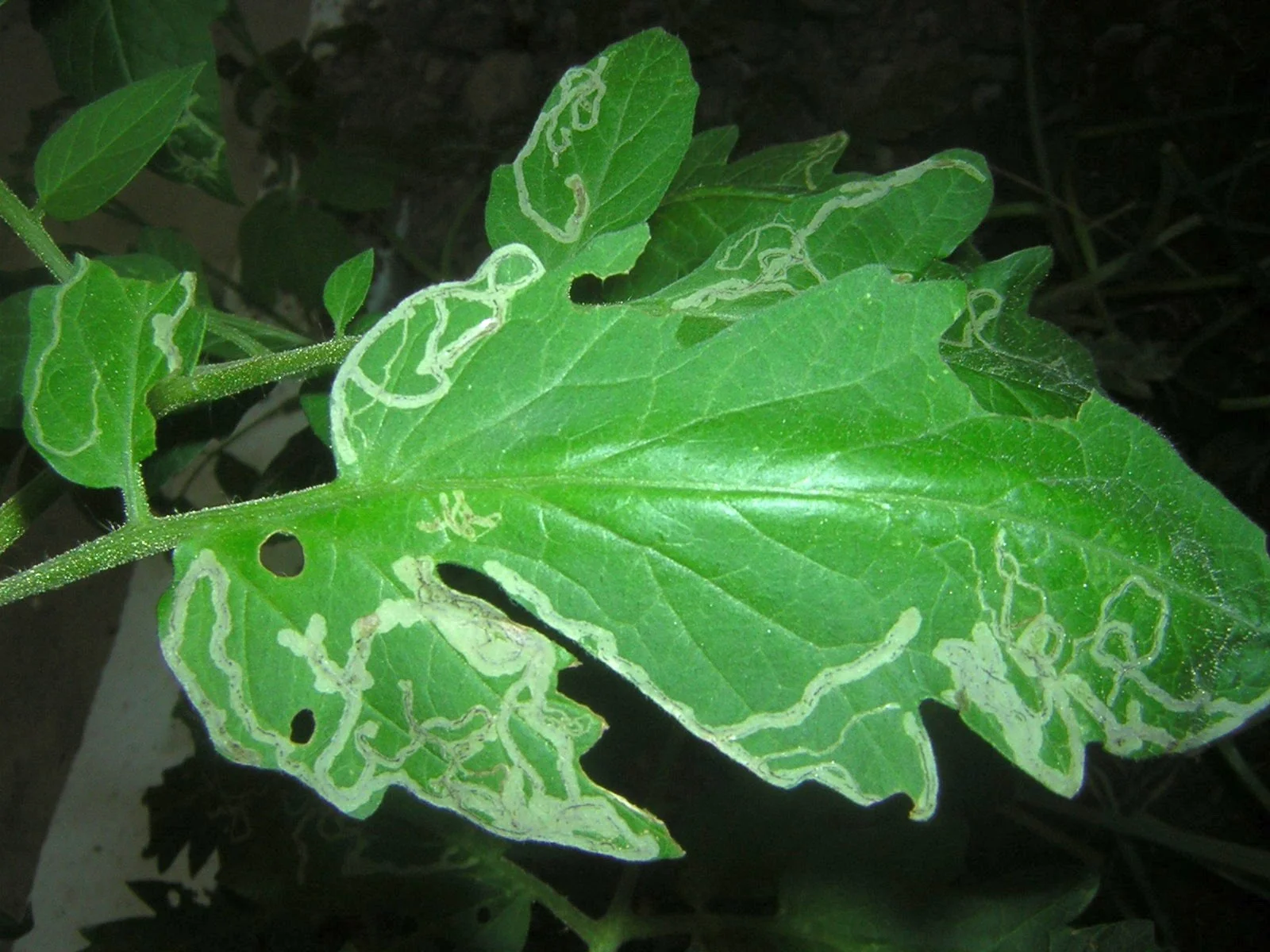
Photo: Flowersabc · CC BY-SA 2.0
Leaf miners (Liriomyza flies) are tiny black-and-yellow flies whose pale, legless maggots tunnel inside the leaves of tomato, beans, onion and cucumber, leaving winding white trails. The adult flies also punch little white holes in the leaf to feed and lay their eggs. Heavy mining dries and disfigures the leaves and starves the plant of light — and because the maggots hide inside the leaf where surface sprays cannot reach, the biggest outbreaks are usually triggered by broad poisons that kill off the tiny wasps that normally keep miners in check.
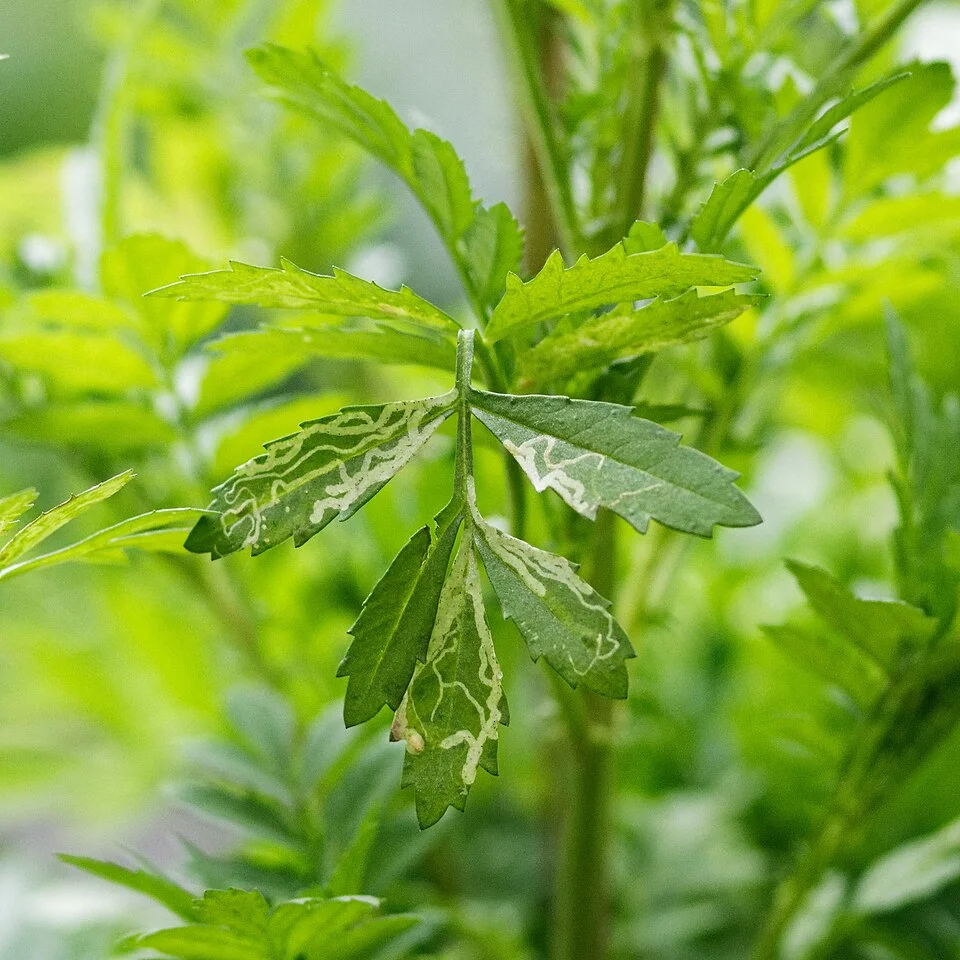
Retired electrician · CC0 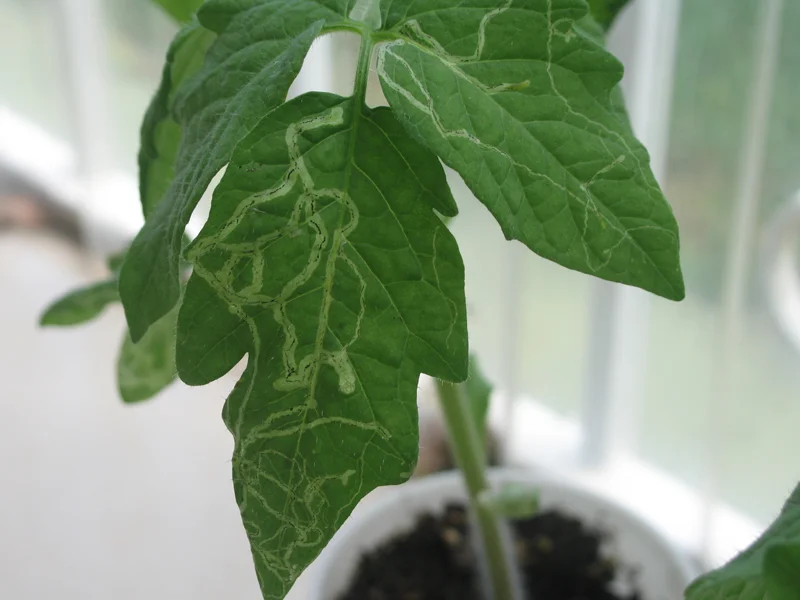
N3v3rl4nd · Public domain
Why it matters
Leaf miners can cost you up to a third of your crop (30%) on tomato, beans, onion and cucumber — and they hit hardest on young seedlings and fresh transplants, which have too few leaves to spare any. The damage is done by tiny maggots tunnelling inside the leaf, where an ordinary spray on the surface can never reach them. Worst of all, a bad outbreak is usually something you bring on yourself: broad poisons meant for other pests kill the tiny wasps that keep miners down, and once that free, natural control is broken the flies breed back fast and become very hard to stop. So the whole game is protecting those helper wasps and catching mines early, while your plants are still young.
When to act
several fresh serpentine mines per leaf on a majority of plants, especially on seedlings and young transplants
This guidance is general, compiled from published agronomic references including FAO and CABI. Thresholds and timing shift with your crop, your variety and the season.
In much of the region a spray is simply called mushonga — medicine. But a chemical group you cannot name is one you cannot rotate, and a product you did not write down has no pre-harvest interval you can observe. Mushonga, and other farming words →
The full Leaf miners field guide
Identify it
The damage (first and clearest sign)
pale, winding tunnels in the leaf — like a snake's trail or a scribble of white thread across the leaf. Each mine starts thin and grows wider as it goes, and if you look closely a fine dark line runs down the middle (that dark line is the maggot's droppings, called frass). Badly mined leaves turn papery, dry from the edges, and drop early.
The white speckles
on the upper side of the leaf, look for tiny white pin-prick spots where the adult flies have stabbed the leaf to feed and lay eggs. A fresh rash of these white specks means the flies are active and laying eggs right now — new mines will follow within a few days.
The pest itself
the tunnels are cut by a tiny pale maggot (a small legless grub) no longer than this comma, living inside the leaf — hold the leaf up to the sunlight and you'll see it as a little cream speck moving along the mine. The adult is a tiny black-and-yellow fly, smaller than a grain of rice, easy to miss as it rests on the leaf.
Don't confuse it
a mine is inside the leaf, so you cannot rub or wipe it off. A silvery slug or snail trail sits on top of the leaf and smears when you rub it; leaf-spot diseases make round patches or blotches, not winding tunnels; mite or thrips damage is a fine, even silvery speckling with no tunnel and no maggot. If it winds like a trail and you can't rub it off, it's a miner.
Scout for it
When to look
start in the nursery and again at transplanting, then keep checking every week right through the young and growing stages — from seedling, through leaf-and-stem growth, up to flowering and fruit-set (the stages when miners do their real harm). Young plants suffer most, so inspect new transplants before you plant them and never carry mined seedlings into a clean field.
How to walk the field
walk a big "W" shape so you cover all four corners and the middle — not just the row beside the path where you always look. Make about 10 stops along the way.
What to check at each stop
pick a couple of plants and turn the leaves over. Look for fresh pale mines (bright and moist, not old and brown), the white feeding speckles, and hold a leaf up to the light to spot the maggot still inside. A fresh mine with a live maggot is an active attack; old brown, empty mines are a past attack — don't act on those.
Hang traps for early warning
peg a few yellow sticky traps just above the crop — the adult flies are drawn to the yellow and stick fast. A rising catch of tiny flies warns you that egg-laying is starting, often before any mines even show.
Act on this number
treat when more than half the plants you check — about 6 in every 10 — each carry several fresh mines per leaf. On seedlings and young transplants, act sooner: even a few fresh mines per leaf on most young plants is enough, because they have so little leaf to lose.
Control it
Prevent it — start clean and stay clean:
plant only mine-free seedlings (check them and throw out any with tunnels), pick off and bury or burn the worst-mined leaves as you find them, and after harvest plough or dig in all crop residues so the pupae (the resting stage the maggot turns into before it becomes a fly) hidden in old leaves can't carry over to your next crop. Where you can, rotate to an unrelated crop so miners don't build up in the same spot season after season.
Protect your free helpers — the single most important step:
tiny parasitoid wasps (harmless little wasps that lay their eggs inside the leafminer maggot and kill it from within) normally keep miners down for you at no cost. Broad-spectrum sprays — poisons that kill every insect they touch — wipe out these wasps and are the usual cause of a leafminer outbreak. Spray as little and as narrowly as you possibly can so the wasps survive to do their work.
Act early, by hand
squash the maggots by pinching the end of each fresh mine between your fingers, keep removing the worst-mined leaves, and let the yellow sticky traps pull down the egg-laying flies. Done while numbers are still low, this — together with the wasps — often keeps you below the spraying threshold.
Spray only as a last resort, and only at threshold
because the maggots sit inside the leaf, an ordinary contact spray (one that only wets the leaf surface) cannot reach them — you need a translaminar insecticide, meaning one that soaks through the leaf to the maggot in its tunnel. Spot-spray only the affected patches, never the whole field, so you spare the wasps instead of wiping them out and making things worse. Safety: cover your skin, eyes, nose and mouth, spray in the cool of early morning or evening with the wind at your back, keep the spray off food, water, children and bees, wash yourself and your clothes afterwards, and respect the pre-harvest interval — the set number of days you must wait between spraying and picking so the crop is safe to eat. And rotate to a different chemical group each time you spray: leaf miners build resistance (stop dying to a spray you lean on too often) very quickly, so no single product should be used twice in a row.
If it keeps spreading → change tack
if mines keep spreading after you spray, stop spraying — you are most likely killing the wasps and feeding the outbreak. Fall back on sticky traps, removing mined leaves, and giving the wasps time to recover. If a seedling bed or young transplants are overwhelmed, pull out and destroy the worst plants to protect the rest. And when a leafy crop is close to harvest and badly mined, cut your losses: pick what is still usable now (once the pre-harvest interval has passed), then dig in every leaf and residue so your next crop starts clean.
Catch Leaf miners before it costs you the harvest
This guide is the general answer. Divisi works out yours — the week to scout your own field for Leaf miners, and what to do the day you find it.


Crops it affects
Plan the crops it attacks
-
 When to plant Cucumber in Jorquelleh
 -
 When to plant Onion in Sandoa
 -
 When to plant Tomato in Goma
 -
 When to plant Cabbage in Les Eucalyptus
All planting calendars, country by country
Get Insights by email
A short digest of new Divisi articles. No email on quiet weeks.
Frequently asked questions
How do I identify Leaf miners?
The damage (first and clearest sign). pale, winding tunnels in the leaf — like a snake's trail or a scribble of white thread across the leaf. Each mine starts thin and grows wider as it goes, and if you look closely a fine dark line runs down the middle (that dark line is the maggot's droppings, called frass). Badly mined leaves turn papery, dry from the edges, and drop early.
When should I take action against Leaf miners?
several fresh serpentine mines per leaf on a majority of plants, especially on seedlings and young transplants
How do I control Leaf miners?
Prevent it — start clean and stay clean:. plant only mine-free seedlings (check them and throw out any with tunnels), pick off and bury or burn the worst-mined leaves as you find them, and after harvest plough or dig in all crop residues so the pupae (the resting stage the maggot turns into before it becomes a fly) hidden in old leaves can't carry over to your next crop. Where you can, rotate to an unrelated crop so miners don't build up in the same spot season after season.
Which crops are attacked by Leaf miners?
Among the crops covered here: Cabbage, Cucumber, Onion, Tomato.