 Divisi
Legume pod borer
Maruca vitrata · Insect
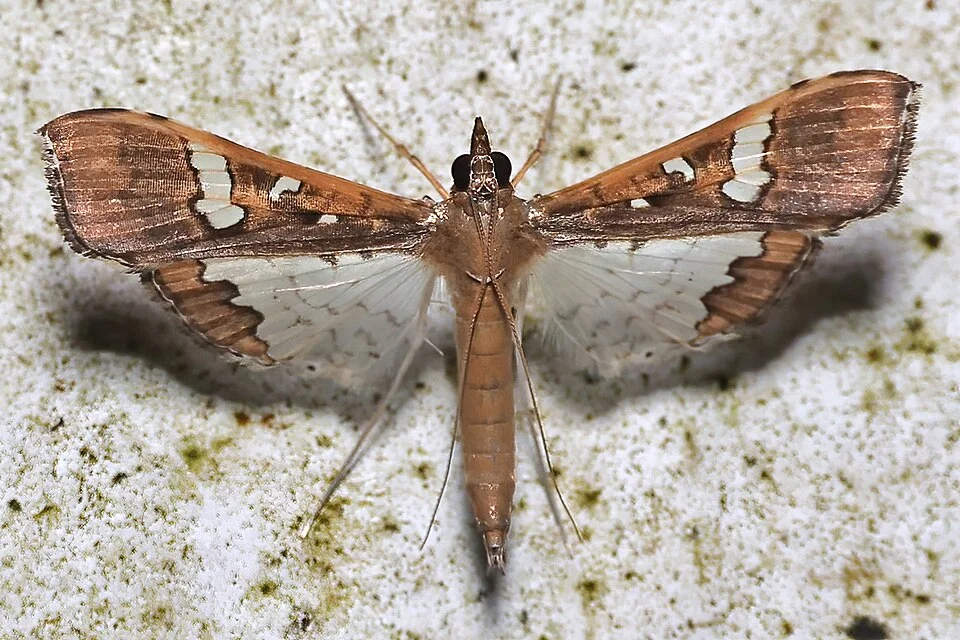
Photo: Charles J. Sharp · CC BY-SA 4.0
The legume pod borer (Maruca vitrata) is a small, night-flying moth whose caterpillars attack grain legumes — cowpea, pigeonpea, common bean and soybean — at the flowers and pods, the very parts you harvest. The young caterpillar spins silk to web flower buds and young pods into a bundle, hides inside, eats the developing seeds, then bores from one pod to the next. It strikes during flowering and pod-fill and thrives in warm, humid weather when the crop flowers over a long, staggered period. It is one of the most damaging pests of cowpea across sub-Saharan Africa.
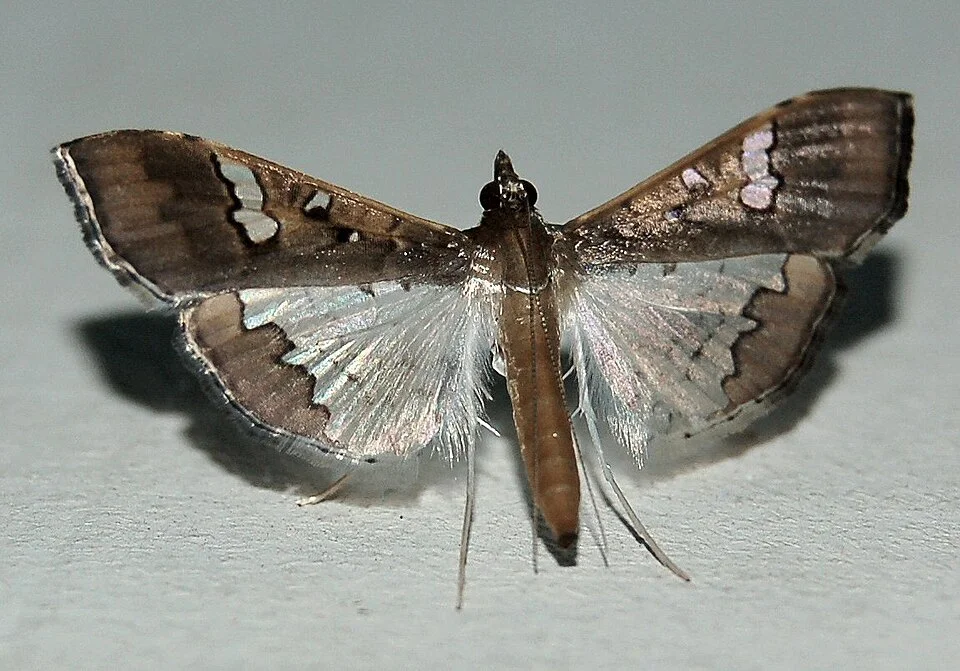
Ravi Vaidyanathan · CC BY 3.0 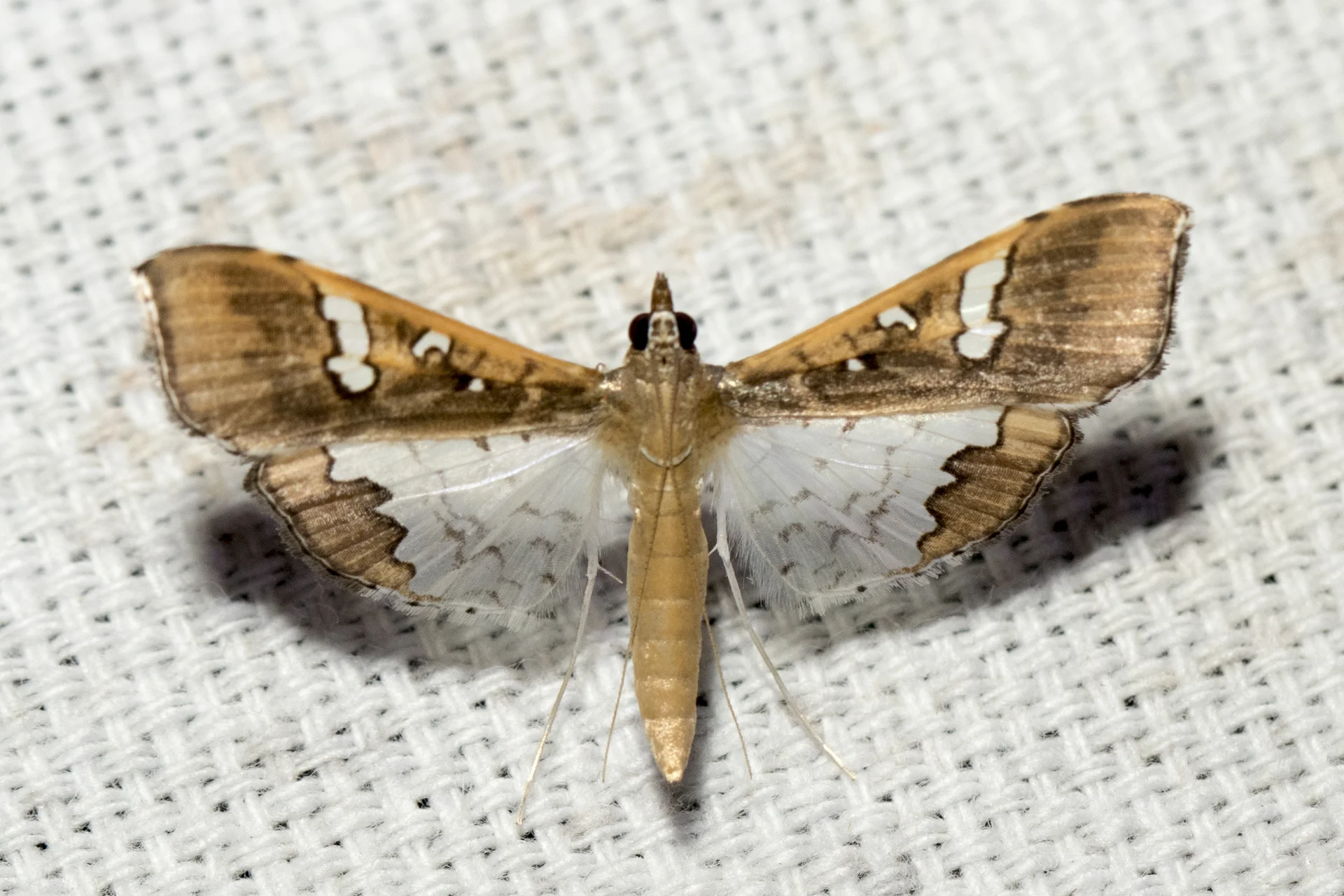
Ashokjbp · CC BY 4.0
Why it matters
This pest goes straight for the parts you actually harvest — the flowers and the seeds inside the pods — so a heavy attack can cost you up to 70% of your grain, more than two-thirds of the crop gone. The trouble is that the caterpillar hides inside a bundle of webbed-together flowers, or deep inside a pod, where no spray can reach it. Once it has bored in, it is almost impossible to kill — so the whole fight is won or lost in the short window while the crop is flowering, before the young caterpillars get inside.
When to act
larvae or webbing on flowers, or damage on about 1 in 10 flowering racemes at the onset of flowering
This guidance is general, compiled from published agronomic references including FAO and CABI. Thresholds and timing shift with your crop, your variety and the season.
In much of the region a spray is simply called mushonga — medicine. But a chemical group you cannot name is one you cannot rotate, and a product you did not write down has no pre-harvest interval you can observe. Mushonga, and other farming words →
The full legume pod borer field guide
Identify it
The first thing you'll see
is flower buds and young pods stuck together in a bundle by fine silk webbing, often with brown, sawdust-like droppings (called frass) caught in the web. Pull a webbed bundle apart and you'll find it eaten hollow inside. A little later, look for small round holes bored into the pods, with half-eaten seeds and frass packed in behind them.
Flowers and buds suddenly drop
A plant that was covered in flowers can go bare almost overnight, because the borer destroys the flowers before they can set pods. This flower drop is an early warning — you can spot it even before you open a single pod.
The caterpillar
is the one doing the damage. It grows to about the length of the top joint of your little finger (up to ~1.5 cm), is creamy-white to pale green, and carries rows of dark brown-to-black spots down its back — a pair of spots on each segment — above a dark head. You'll almost always find it curled up inside the webbed flowers or inside a pod, never sitting out in the open.
The moth
(the adult) flies at night. It is small — wings spread about 2 cm, roughly a thumbnail's width — with dark brown front wings marked with clear white patches and pearly-white back wings edged in brown. Knock the plants at dusk and you may see one flit out and settle again a short way off.
Don't confuse it
with the African bollworm (Helicoverpa), which chews one clean hole in a pod and feeds with its body hanging outside, leaving no webbing at all. The legume pod borer's signature is the silk that ties flowers and pods together — if the flowers are webbed into a bundle, it is this pest.
Scout for it
Start the day you see the first flower buds open
, and scout twice a week right through flowering and pod-fill — the mid- to late-season window when this borer does its damage. Once the pods are full and hardening, the danger has passed.
Walk a big "W" shape across the field so you cover all four corners and the middle — not just the edge nearest the path. Make about 10 stops along the way.
At each stop, check the flower clusters (the 'racemes' — the flower-bearing stalks) and the young pods on a few plants. Gently open any webbed-up flowers and split open a few pods, and look inside for silk webbing, brown frass, and the spotted caterpillars.
1 in 10 is your action number
As soon as about one flower cluster in every ten shows webbing, frass or a caterpillar — right from the onset of flowering — it is time to act, while the young caterpillars are still out in the open and easy to hit before they web up and bore in.
To see the wave coming, hang a pheromone trap (a small scented lure that draws in male moths) at flowering. A rising nightly catch warns you that egg-laying — and a fresh batch of young caterpillars — is on the way, so scout harder and get ready to spray.
Control it
Prevent — plant early and all at once
Sow early and at the same time as your neighbours, and pick short-duration (quick-maturing) varieties, so the whole crop flowers together in one short window and finishes before borer numbers build up. A long, drawn-out flowering period is exactly what feeds this pest.
Break up the crop and keep it clean
Intercrop your legume with a cereal such as maize or sorghum — a mixed stand is harder for the moths to find. As you scout, pick off and destroy (burn or bury) every webbed flower bundle and bored pod you find; each one you remove is a batch of caterpillars that never reaches your other pods. After harvest, clear the crop trash and pull out wild legume weeds nearby that shelter the pest between seasons.
Protect the helpers
Tiny parasitic wasps and other natural enemies attack the borer's eggs and young caterpillars for free. Don't blanket-spray harsh poisons that wipe them out — spray only when your scouting has actually reached the threshold.
Act early with a Bt spray
The moment you hit the threshold at early flowering, spray Bt (Bacillus thuringiensis, a natural caterpillar-killing bacterium) onto the flowers and buds. Bt only kills small caterpillars that are still feeding in the open, so hitting them at early flowering — before they web up and bore into the pods — is everything. It is safe for you, for bees and for your natural enemies. Spray it in the cool of the evening, once the bees have stopped working the flowers.
Only if it keeps spreading, reach for an insecticide — and treat it as a last resort
If webbing and damage keep climbing despite the steps above, use a recommended insecticide, timed to flowering (spray at bud, then again at peak flower) and aimed straight at the flowers where the caterpillars sit, before they bore into the pods. Because this pest lives on flowers that bees visit, spray only in the late evening once bees have stopped foraging, keep well away from hives, and choose a bee-safer product where you can. Safety: cover your skin, eyes, nose and mouth, spray with the wind at your back in the cool of the day, and keep the spray off food, drinking water, children and animals. Afterwards, wait the full pre-harvest interval — the number of days the label tells you to leave between your last spray and picking — before you harvest and eat the pods, and wash yourself and your clothes.
Don't let the pest get used to the spray
Every time you have to spray, rotate to a different chemical group — change the type of active ingredient, not just the brand name — so the borer never builds resistance (the ability to survive a poison that used to kill it). Never hit it with the same product season after season.
If it keeps spreading, or you caught it late →
once the caterpillars are sealed inside webbed flowers and pods, no spray can reach them, and spraying then only wastes money and kills your helpers. Keep pulling off and burning the worst webbed clusters and bored pods, then harvest as soon as the pods are mature to save the seed that's left before more is eaten. Afterwards, break the cycle for next season: plough in the trash, clear the wild legume weeds, rotate that plot to a non-legume such as maize or sorghum, and go back to early, uniform planting with a short-duration variety.
Catch legume pod borer before it costs you the harvest
This guide is the general answer. Divisi works out yours — the week to scout your own field for legume pod borer, and what to do the day you find it.


Crops it affects
Plan the crops it attacks
-
 When to plant Cowpea in Bangui-Rapides
 -
 When to plant Green gram in Ika
 -
 When to plant Pigeon pea in Buganda
 -
 When to plant Soybean in Dola
All planting calendars, country by country
Get Insights by email
A short digest of new Divisi articles. No email on quiet weeks.
Frequently asked questions
How do I identify legume pod borer?
The first thing you'll see. is flower buds and young pods stuck together in a bundle by fine silk webbing, often with brown, sawdust-like droppings (called frass) caught in the web. Pull a webbed bundle apart and you'll find it eaten hollow inside. A little later, look for small round holes bored into the pods, with half-eaten seeds and frass packed in behind them.
When should I take action against legume pod borer?
larvae or webbing on flowers, or damage on about 1 in 10 flowering racemes at the onset of flowering
How do I control legume pod borer?
Prevent — plant early and all at once. Sow early and at the same time as your neighbours, and pick short-duration (quick-maturing) varieties, so the whole crop flowers together in one short window and finishes before borer numbers build up. A long, drawn-out flowering period is exactly what feeds this pest.
Which crops are attacked by legume pod borer?
Among the crops covered here: Cowpea, Green gram, Pigeon pea, Soybean.