 Divisi
Red spider mite
Tetranychus urticae · Mite
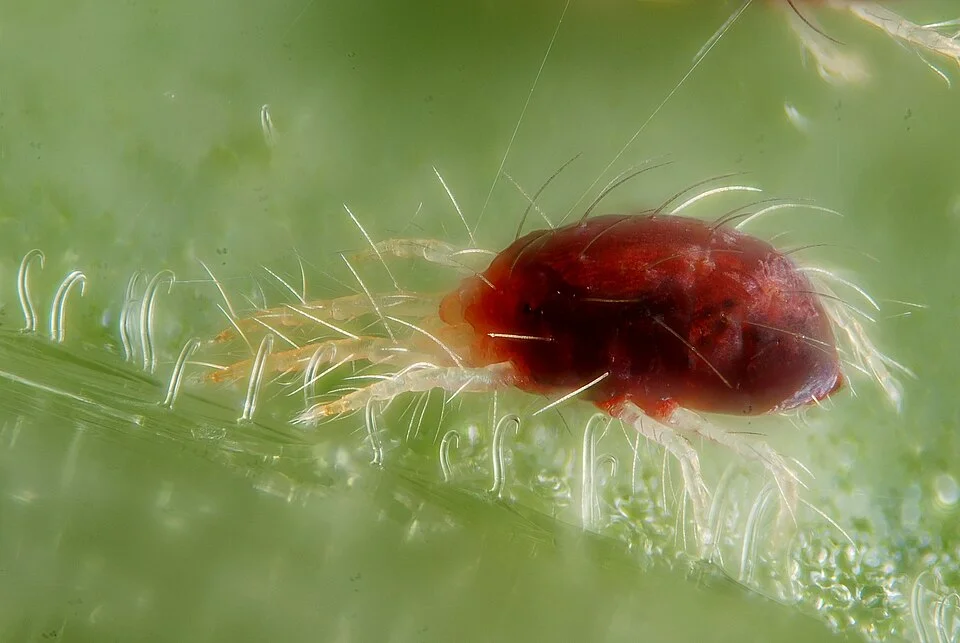
Photo: Gilles San Martin · CC BY-SA 2.0
Red spider mite (Tetranychus urticae) is a sap-sucking mite — barely the size of a speck of ground pepper — that lives in colonies on the underside of leaves. It stabs the leaf cells and drinks them dry, so the leaf loses its green, turns dull and bronzed, then yellows and drops early. It breeds fastest in hot, dry, dusty weather (about 25–35°C), when a colony can multiply in a few days and spin fine silk webbing over the leaves and growing tips. It hits a wide range of crops — tomato, beans, cassava, cotton and eggplant among them.
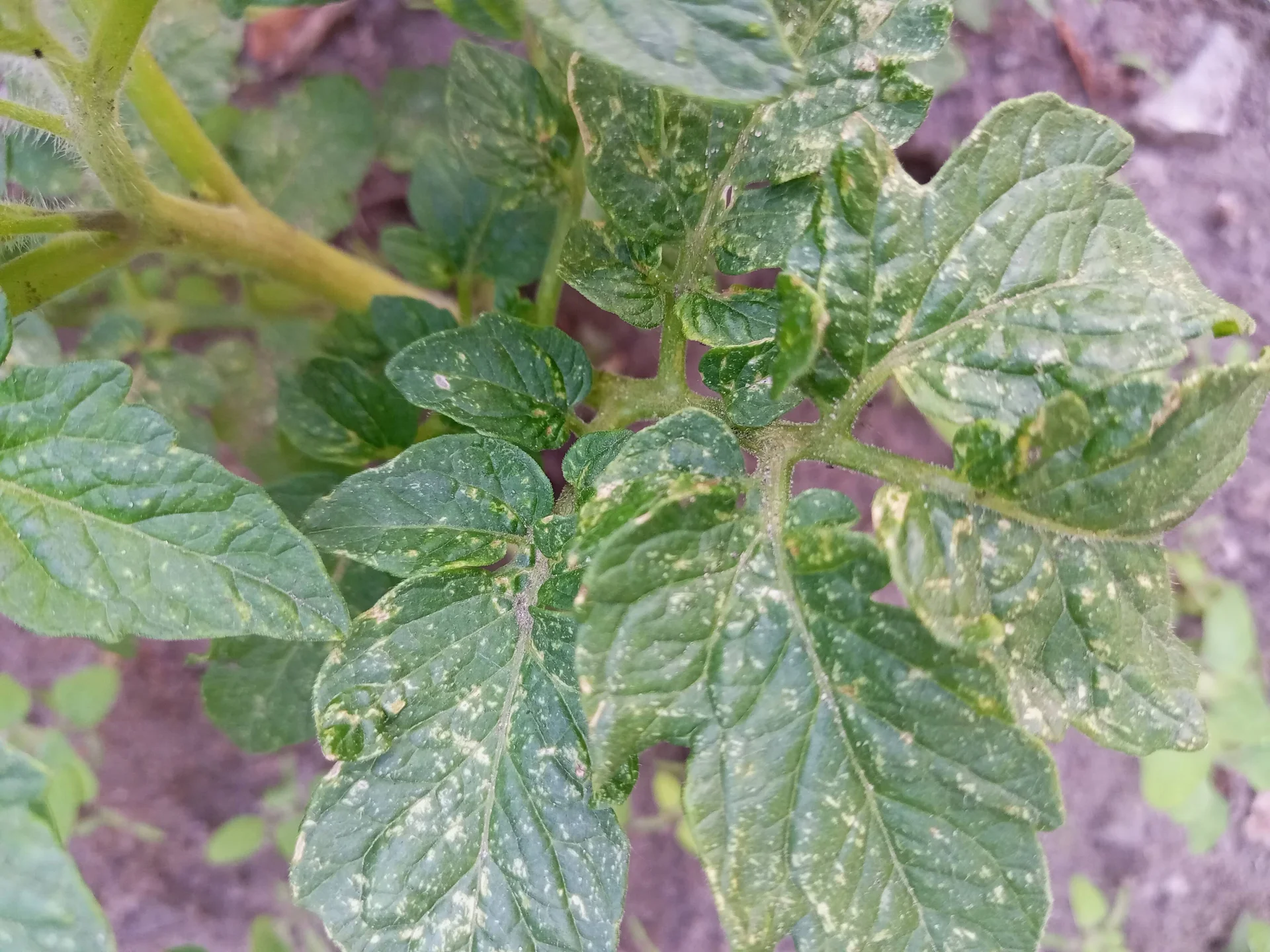
Natalka Ukraine (baby-bear.org) · CC BY 4.0 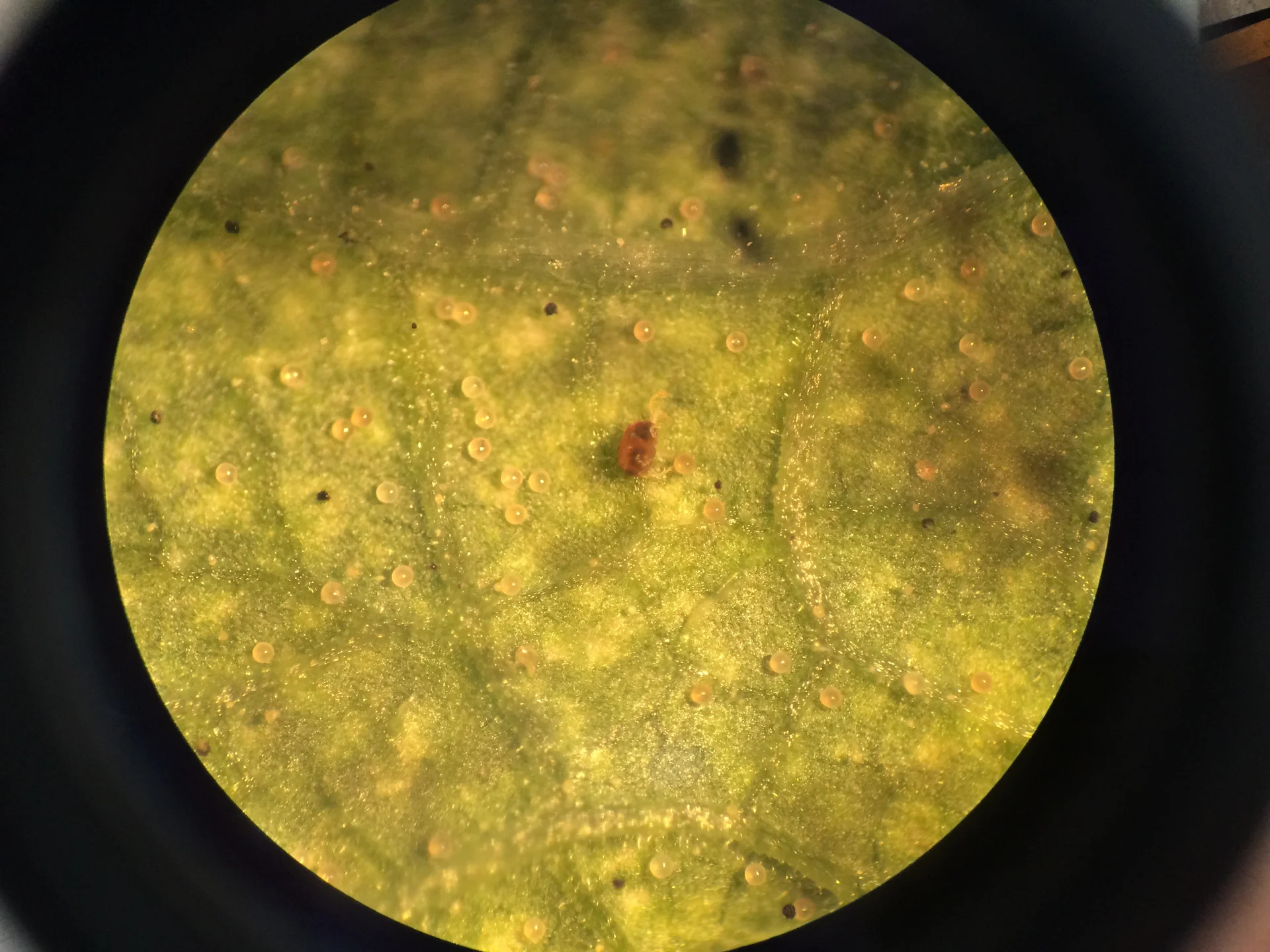
Excellens25 · CC BY 4.0
Why it matters
Red spider mites are tiny, but they can strip the life out of a crop: a bad, unchecked attack can cost you up to 60% of your harvest — more than half of what you were counting on. They breed fastest in hot, dry weather, so a few mites on a couple of leaves can explode into a webbed, dying patch in a week or two. Once the colony is big and spinning silk over the leaves, sprays struggle to wet the mites hiding underneath, and the mites quickly stop responding to the same chemical — so the only cheap win is catching them early, while they are still a small, spreading patch.
When to act
Fine stippling and mites visible on the underside of leaves on a spreading patch of plants, before webbing becomes general
This guidance is general, compiled from published agronomic references including FAO and CABI. Thresholds and timing shift with your crop, your variety and the season.
In much of the region a spray is simply called mushonga — medicine. But a chemical group you cannot name is one you cannot rotate, and a product you did not write down has no pre-harvest interval you can observe. Mushonga, and other farming words →
The full Red spider mite field guide
Identify it
The first thing you notice is the leaves losing their colour
A fine sprinkle of pale, silvery-white or yellow dots — called stippling, as if the leaf was dusted with tiny pin-pricks — shows up on the upper side of the leaves. As it worsens the whole leaf goes dull and bronzed or rusty, then yellows, dries at the tips and edges, and falls early. It almost always starts on the older, lower leaves and along the hot, dusty edge of the field.
The mite itself is almost too small to see
— about the size of a speck of ground pepper, or the full-stop at the end of this sentence. Turn a stippled leaf over and look underneath, if you can with a hand lens (a magnifying glass): you'll find slow-moving oval mites, pale green to yellow with two dark spots on the back (they turn orange-red in the hottest, driest weather), sitting beside clear round eggs like tiny glass beads. In a heavy attack you'll also see fine silk webbing — like a thin, dusty cobweb — over the leaf undersides, in the leaf joints and over the growing tips, with mites crawling inside it.
Tell it apart from look-alikes
Drought or hunger (a plant short of water or feed) also yellows the leaves, but leaves no dots and no mites. Thrips scratch silvery patches too, but they leave tiny black specks of dung and no webbing. Real spiders spin coarse, open webs and are your friends — mite webbing is fine, lies flat on the leaf, and is full of moving specks. When you are unsure, tap a leaf over a sheet of white paper: mites fall as 'dust' that then crawls — real dust just lies still.
Scout for it
Check hardest in hot, dry spells
Start scouting once the crop is growing well (the development stage) and keep it up through flowering, fruiting and pod-fill, right into the late, drying-down season — mites do the most harm in the hot, dry middle and end of the season, and on plants that are short of water or standing in dust. Look at least once a week, and twice a week during a hot, dry run.
Walk a big "W" across the field
so you cover the four corners and the middle — not just the row beside the path. Make about 10 stops. Begin at the hot, dusty edges and the driest corners: that is where the mites arrive first.
At each stop, pick a plant and check the older, lower leaves first. Hold a leaf up so the light shines through and look at the top for pale stippling; then turn it over and look underneath for the mites and any fine webbing. Tap the leaf over white paper or your palm — moving specks confirm the mites are alive and feeding.
Act as soon as 2–3 plants in every 10 show live mites and stippling and the patch is spreading to its neighbours
Don't wait for webbing to cover the leaves: once the webbing is general the colony is huge, sprays can no longer wet the mites hiding underneath, and the crop is already losing ground. The first patches, caught early, are your cheap win.
Control it
Prevent it — keep plants strong and cool
Mites explode on thirsty, dusty, over-fed plants. Water enough that the crop never wilts, and in the heat wash the dust off the leaves with plain water — a dusty leaf is a mite nursery. Go easy on nitrogen fertiliser, because soft, over-lush growth feeds mites. And pull out the weeds in and around the field, since they carry mites over from one crop to the next.
Don't spark an outbreak
The worst mite attacks come right after a broad-spectrum insecticide (a general bug-killer) that wipes out the mites' natural enemies. Avoid blanket insect sprays. Where you already see a few mites, pick off and destroy the worst-infested leaves to slow the spread before it takes hold.
Act early — let the good bugs win
Tiny predatory mites, ladybird beetles and lacewings hunt and eat spider mites for free. Protect them by not spraying broad poisons, and where you can buy them, release predatory mites onto the first infested patches. A firm spray of plain water onto the leaf undersides knocks the mites and their webbing off and raises the humidity that mites hate — a cheap first strike on a small patch.
Chemical — the last resort
If a patch keeps spreading despite all the above, use a proper acaricide (a spray made specially to kill mites) — never an ordinary insecticide, which kills the mites' enemies and makes things worse. The mites hide underneath, so drench the underside of the leaves until they are wet; the spray only kills the mites its droplets actually touch. Safety: cover your skin, eyes, nose and mouth; spray in the cool of the morning or evening with the wind at your back; keep it off food, water, animals, children and bees; wait the full number of days on the label between spraying and picking (the pre-harvest interval); and wash yourself and your clothes afterwards.
Stop the mites out-smarting the spray, and know when to cut your losses
Spider mites build resistance fast — they survive a chemical used too often until it no longer kills them — so change to a different group of acaricide each time and never spray the same one twice in a row. If it keeps spreading after two rotated sprays, or webbing has already blanketed the plants, that block is beyond saving: cut and burn or bury the worst plants to protect the rest, keep the healthy crop well-watered, and start clean next season with weed-free, well-watered fields so the mites cannot carry over.
Catch Red spider mite before it costs you the harvest
This guide is the general answer. Divisi works out yours — the week to scout your own field for Red spider mite, and what to do the day you find it.


Crops it affects
Plan the crops it attacks
-
 When to plant Cassava in Banalia
 -
 When to plant Common bean in Dilolo
 -
 When to plant Cotton in Kalemie
 -
 When to plant Eggplant in Kiuaba-N'Zoji (Cuaba Nzogo)
 -
 When to plant Tomato in Goma
All planting calendars, country by country
Get Insights by email
A short digest of new Divisi articles. No email on quiet weeks.
Frequently asked questions
How do I identify Red spider mite?
The first thing you notice is the leaves losing their colour. A fine sprinkle of pale, silvery-white or yellow dots — called stippling, as if the leaf was dusted with tiny pin-pricks — shows up on the upper side of the leaves. As it worsens the whole leaf goes dull and bronzed or rusty, then yellows, dries at the tips and edges, and falls early. It almost always starts on the older, lower leaves and along the hot, dusty edge of the field.
When should I take action against Red spider mite?
Fine stippling and mites visible on the underside of leaves on a spreading patch of plants, before webbing becomes general
How do I control Red spider mite?
Prevent it — keep plants strong and cool. Mites explode on thirsty, dusty, over-fed plants. Water enough that the crop never wilts, and in the heat wash the dust off the leaves with plain water — a dusty leaf is a mite nursery. Go easy on nitrogen fertiliser, because soft, over-lush growth feeds mites. And pull out the weeds in and around the field, since they carry mites over from one crop to the next.
Which crops are attacked by Red spider mite?
Among the crops covered here: Cassava, Common bean, Cotton, Eggplant, Tomato.