 Divisi
Root-knot nematode
Meloidogyne incognita · Nematode
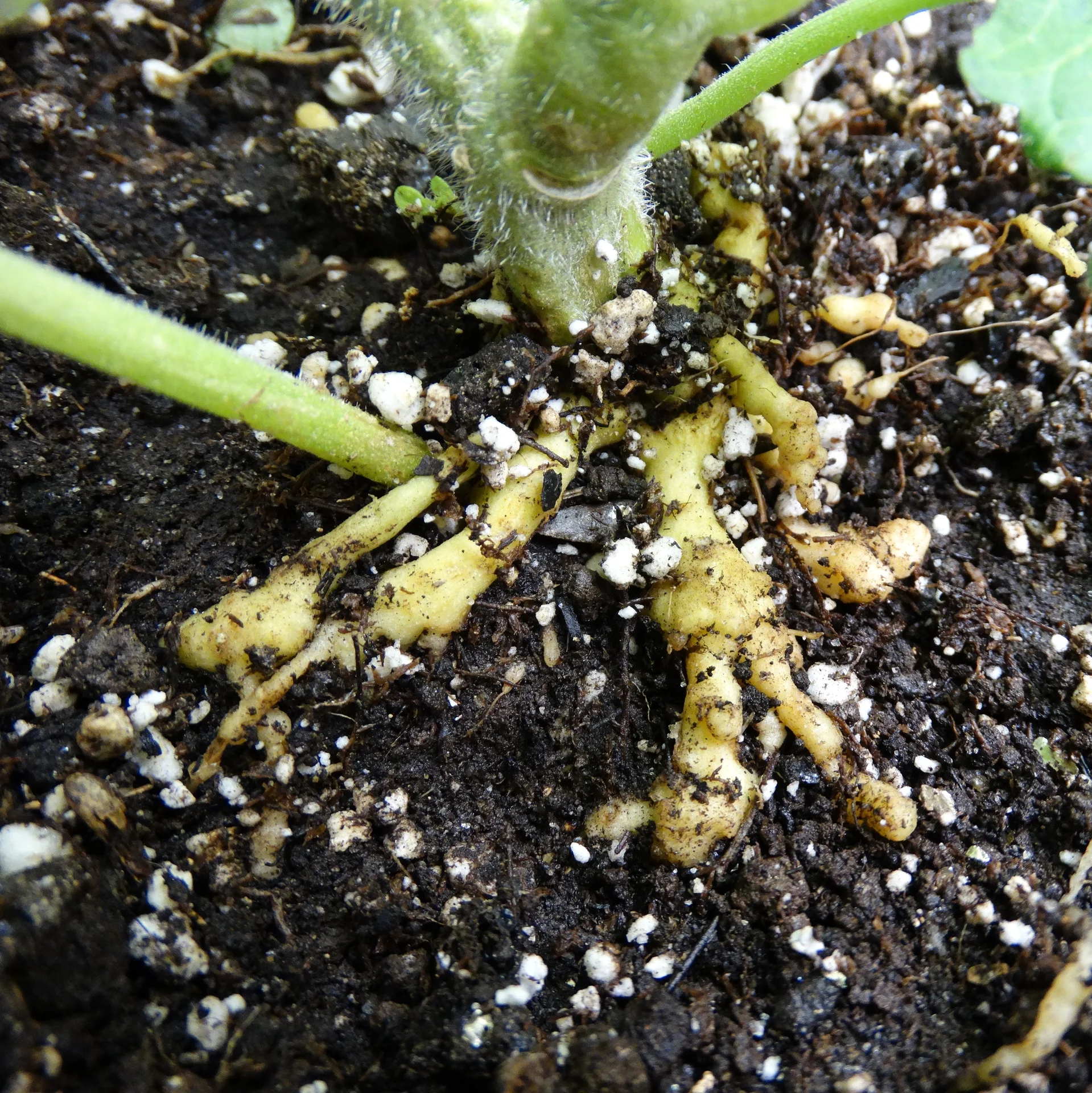
Photo: Plant pests and diseases · CC0
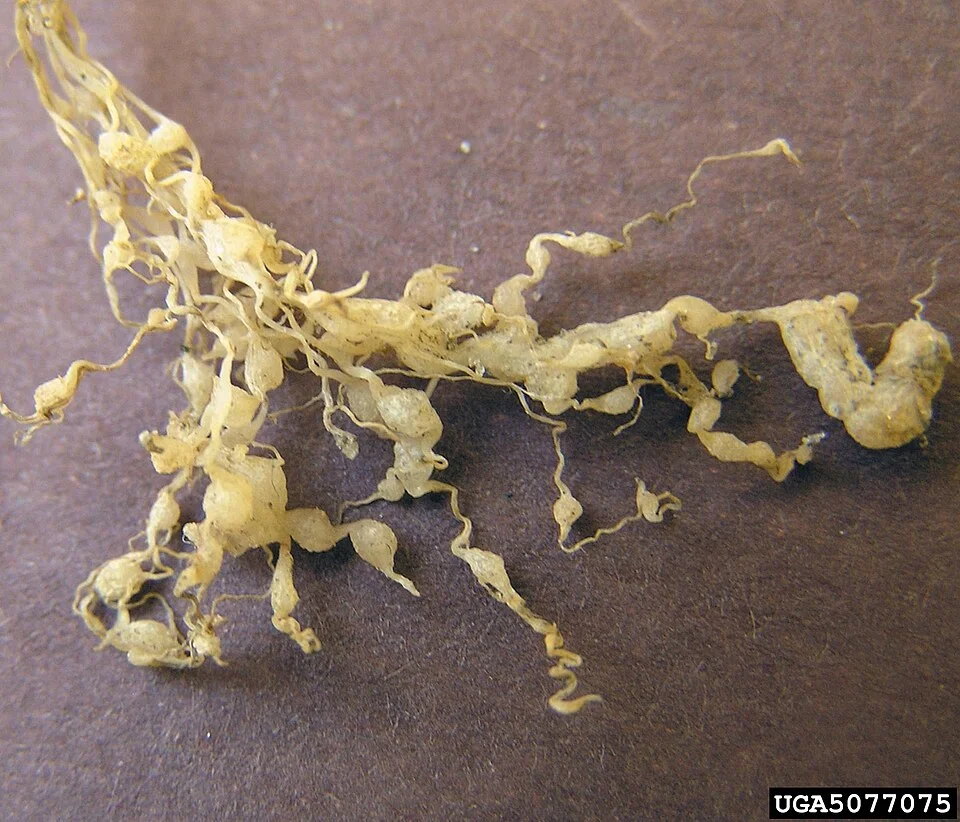
Root-knot nematode (Meloidogyne incognita) is a microscopic, worm-like animal that lives in the soil, far too small to see with your eyes. Its young burrow into plant roots and make them swell into knobbly knots or 'galls', so the roots can no longer draw up water and food, and the plants above go stunted, yellow and wilt. It breeds fastest in warm, light sandy soils and can survive in the ground for years, spreading on infested soil, water and seedlings.
David B. Langston, University of Georgia, Bugwood.org · CC BY 3.0 us 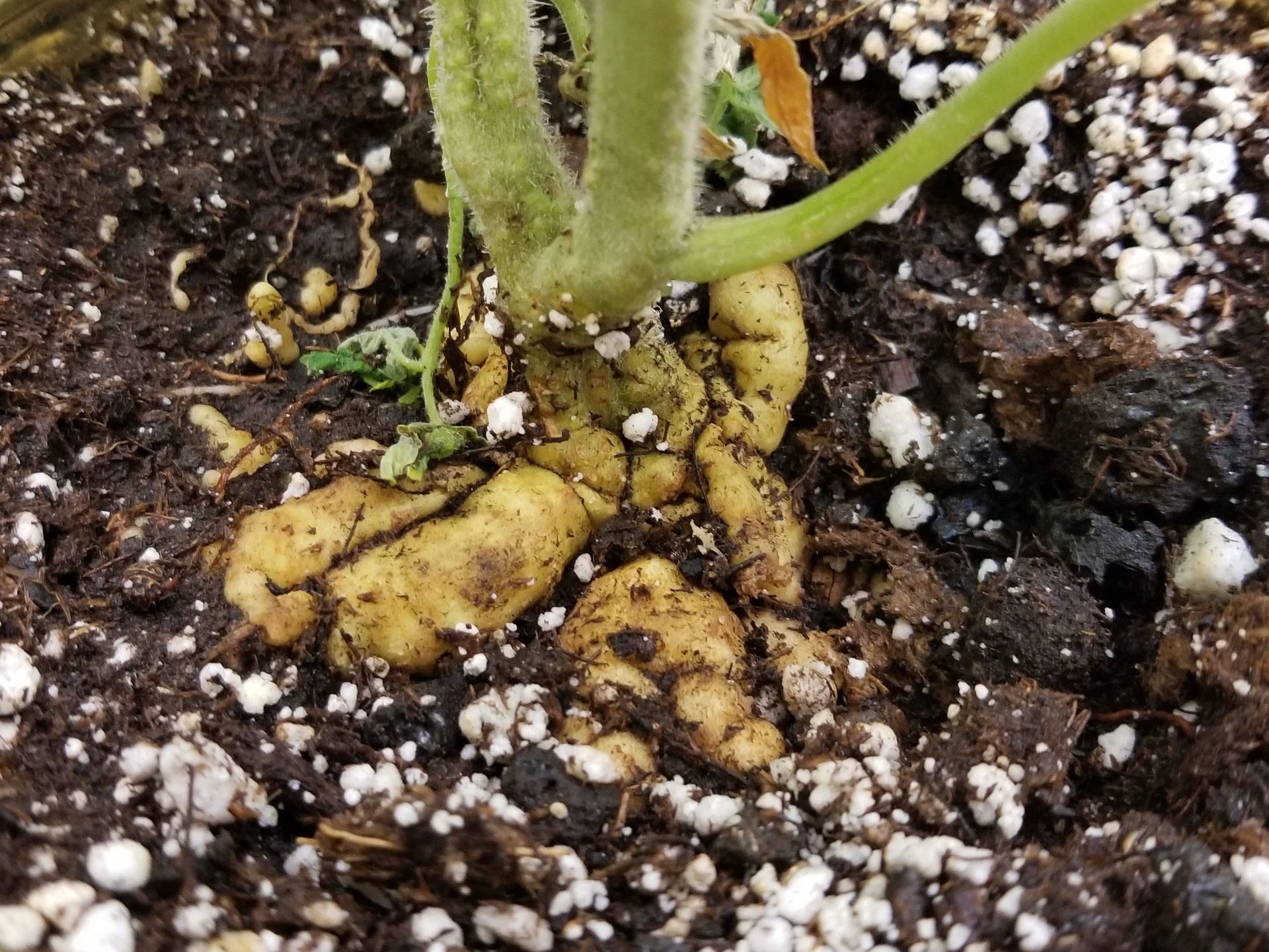
Plant pests and diseases · CC0
Why it matters
Root-knot nematode is a hidden root pest that can take up to 60% — more than half — of your crop of tomato, pepper, okra, carrot, cucumber, potato or beans. You rarely see it coming: it works underground, choking the roots, so by the time the plants are stunted and wilting the damage is already done. Worst of all, once it is in your soil it stays there for years and rides from bed to bed on soil, water and seedlings — and there is no quick spray that can save the crop. Keeping it out, and starving it with rotation, is far easier than getting rid of it.
When to act
patches of stunted, wilting plants, or galls found on roots of sampled plants
This guidance is general, compiled from published agronomic references including FAO and CABI. Thresholds and timing shift with your crop, your variety and the season.
In much of the region a spray is simply called mushonga — medicine. But a chemical group you cannot name is one you cannot rotate, and a product you did not write down has no pre-harvest interval you can observe. Mushonga, and other farming words →
The full Root-knot nematode field guide
Identify it
The first thing you see (above ground)
a patch of plants that are stunted and yellow and wilt in the midday heat even though the soil is wet and you have watered — then perk up again in the cool of evening. The patch is uneven — sick plants sitting right next to healthy ones, not the whole field failing evenly.
The real proof (below ground)
gently lift a sick plant and knock off the soil. Nematode roots carry knobbly swellings and knots — the 'galls' — strung along them like beads or tiny potatoes, from pinhead-size up to a marble. The root is swollen into the lump. The roots are short, forked and stunted, and older ones may already be rotting. (A gall, or knot, is a swelling the nematode makes inside the root.)
You will never see the worm itself
— it is smaller than a pinhead, thinner than a hair, and hidden inside the root and the soil. You judge this pest only by the galls on the roots, never by spotting an animal.
Don't confuse the galls with bean 'nodules'
Beans and cowpeas carry helpful round nitrogen nodules on their roots — but those sit on the outside on a little stalk, rub off easily and leave the root smooth, and are pink or red inside when you split one open. Nematode galls are part of the root itself, cannot be rubbed off, are knobbly and irregular, and are not pink inside.
Don't confuse the wilting with plain hunger or drought
Poor soil or dry weather yellows the whole field evenly, and the plants recover once you feed or water them. Nematode plants stay stunted, wilt in a patch even though you have watered, and — the giveaway — carry galls on the roots. When you are unsure, always pull a plant and look at the roots.
Scout for it
When to look
from soon after transplanting or emergence right through the fast-growing and flowering weeks — the earlier you find it, the more you can still do. Watch hardest in warm weather and light, sandy ground, where the pest breeds fastest. Also dig and look when you clear an old crop and before you plant a new one in that bed.
Look in the heat of the day
, when the wilting sign shows most, and go straight to any patch of stunted, midday-wilting or yellow plants — that patch is where the nematodes are worst.
How to walk it
cross the field in a big 'W' so you cover the middle and all four corners, not just the edge by the path. Make about 5 stops, and at each stop lift 1–2 plants — around 10 plants in all — including a few from the healthy areas so you have something to compare against.
What to check
you cannot scout this pest from above — you must dig or gently pull plants and wash the soil off the roots. Sample plants at the edge of a bad patch (still sick but not yet dead) — a fully dead plant's roots have already rotted and won't show clear galls. Run your eye down every root looking for the beaded knots.
When to act (the number)
if you find galls on the roots of even 1–2 plants out of the 10 you lift — or you can already see a clear patch of stunted, midday-wilting plants — the nematode is established and confirmed. The roots already galled cannot be saved, so act now to protect the rest of this crop and, above all, the next crop you grow in that ground.
Control it
Prevent
-
best of all, plant a resistant variety
Where you can get them, grow nematode-resistant varieties or grafted rootstocks (for example Mi-gene resistant tomatoes — a type of the same crop bred to shrug the pest off). This is the single most powerful thing you can do; it stops most of the attack before it even starts.
-
starve it with rotation
Do not grow the same susceptible crop (tomato, pepper, okra, cucumber, carrot, potato or bean) in the same bed season after season — the nematodes just build up in that soil. Rotate to a 'non-host' — a crop the nematode cannot feed and breed on, such as maize, sorghum, millet or other grasses — for a season or two. Even better, grow a block of marigold and dig it into the soil: its roots poison the pest.
-
clean soil, clean start
Rest the bed bare (fallow) or solarise it — cover moist soil with a clear plastic sheet in the hot sun for 4–6 weeks to cook the top layer and kill nematodes (to 'solarise' just means to heat the soil under plastic). Dig in plenty of compost or manure to feed the tiny soil fungi and bacteria that naturally eat nematodes. And start only with clean, gall-free seedlings from a trusted nursery.
-
stop the spread
The nematode travels on soil, water and seedlings. Knock the soil off your tools, boots and wheelbarrow before you move from a sick bed to a clean one; don't let irrigation or rain run off an infested patch onto clean ground; and after harvest pull up and burn or bury the old infested roots so they cannot carry the pest into next season.
Act — a living (biological) treatment
Where you can buy one, work a bionematicide into the planting hole and root zone — a living fungus or bacterium (such as Paecilomyces lilacinus or Bacillus firmus) that attacks nematodes and their eggs in the soil. Apply it to moist soil and follow the label. Because it is alive, handle it with care: avoid breathing the powder when you mix it, cover your skin, nose and eyes, keep it cool and out of the sun, keep it moist, wash your hands after, and keep it off food and away from children. It works best stacked on top of rotation and clean soil — not on its own.
Chemical is a last resort — and the strong poisons are not for you
Be clear-eyed: there is no safe spray you can put on to kill nematodes already around a growing crop. The powerful soil poisons (fumigants — chemicals that gas the whole soil) are dangerous, costly and not meant for smallholder use — leave them aside. Your real strength here is prevention, not a cure. And because there is no chemical to rotate, your 'anti-resistance' plan is simply to stack several methods together — resistant variety plus rotation plus clean soil plus the biological — so the pest never gets on top of any single one.
If it keeps spreading, or it's too late
pull out and destroy — burn or bury far away — the worst plants together with their roots so they don't seed the soil with even more nematodes. Do not replant a susceptible vegetable in that bed. Switch the ground to a non-host grass or cereal, or marigold, for a season or two to starve the nematodes right down, keep feeding it compost, then begin your next susceptible crop with a resistant variety and clean seedlings. Accept this crop's loss and protect the land for next time — that is how you win against this pest.
Catch Root-knot nematode before it costs you the harvest
This guide is the general answer. Divisi works out yours — the week to scout your own field for Root-knot nematode, and what to do the day you find it.


Crops it affects
Plan the crops it attacks
-
 When to plant Carrot in Plahn Nyarn
 -
 When to plant Cucumber in Jorquelleh
 -
 When to plant Okra in Kouroussa
 -
 When to plant Tomato in Goma
All planting calendars, country by country
Get Insights by email
A short digest of new Divisi articles. No email on quiet weeks.
Frequently asked questions
How do I identify Root-knot nematode?
The first thing you see (above ground). a patch of plants that are stunted and yellow and wilt in the midday heat even though the soil is wet and you have watered — then perk up again in the cool of evening. The patch is uneven — sick plants sitting right next to healthy ones, not the whole field failing evenly.
When should I take action against Root-knot nematode?
patches of stunted, wilting plants, or galls found on roots of sampled plants
How do I control Root-knot nematode?
Prevent — best of all, plant a resistant variety. Where you can get them, grow nematode-resistant varieties or grafted rootstocks (for example Mi-gene resistant tomatoes — a type of the same crop bred to shrug the pest off). This is the single most powerful thing you can do; it stops most of the attack before it even starts.
Which crops are attacked by Root-knot nematode?
Among the crops covered here: Carrot, Cucumber, Okra, Tomato.