 Divisi
Cereal stem borers
· Insect
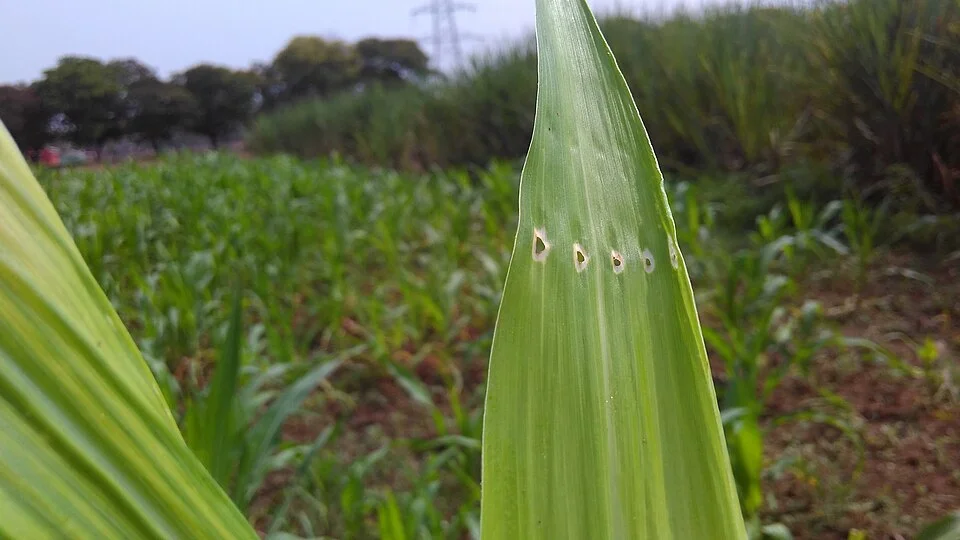
Photo: சிகி பாரதி · CC BY-SA 4.0
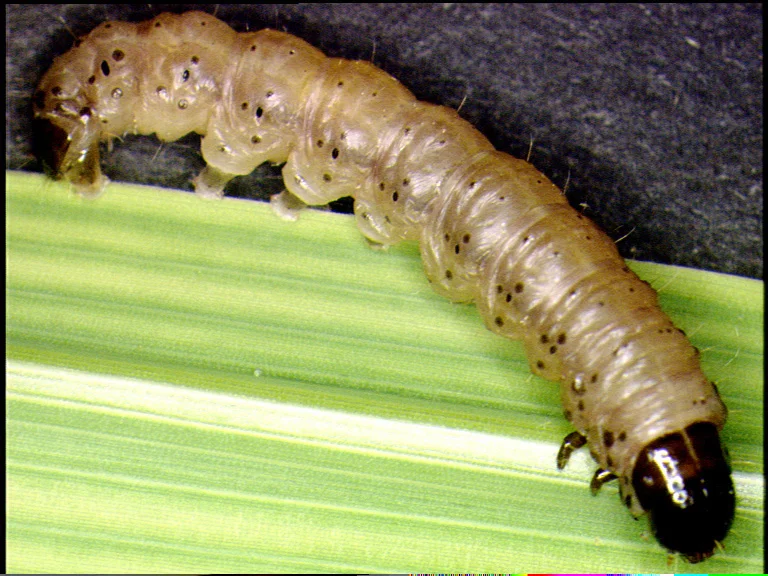
Cereal stem borers are the caterpillars (grubs) of several dull, brown, night-flying moths — the spotted stem borer, the African maize stalk borer and the pink borer among them — that attack maize, sorghum, millet, rice and sugarcane. The young grubs hatch on the leaves and feed hidden inside the whorl (the funnel of new leaves at the plant's centre), cutting the neat rows of holes you later see marching across the opened leaf; then they tunnel down into the stem, choking off the plant's water and food, killing the growing point and hollowing out the stalk until it snaps. They ride out the dry season as grubs sealed inside old stalks and stubble, so a field left uncleaned after harvest quietly plants next year's attack.
Paul-andre Calatayud · CC BY-SA 3.0 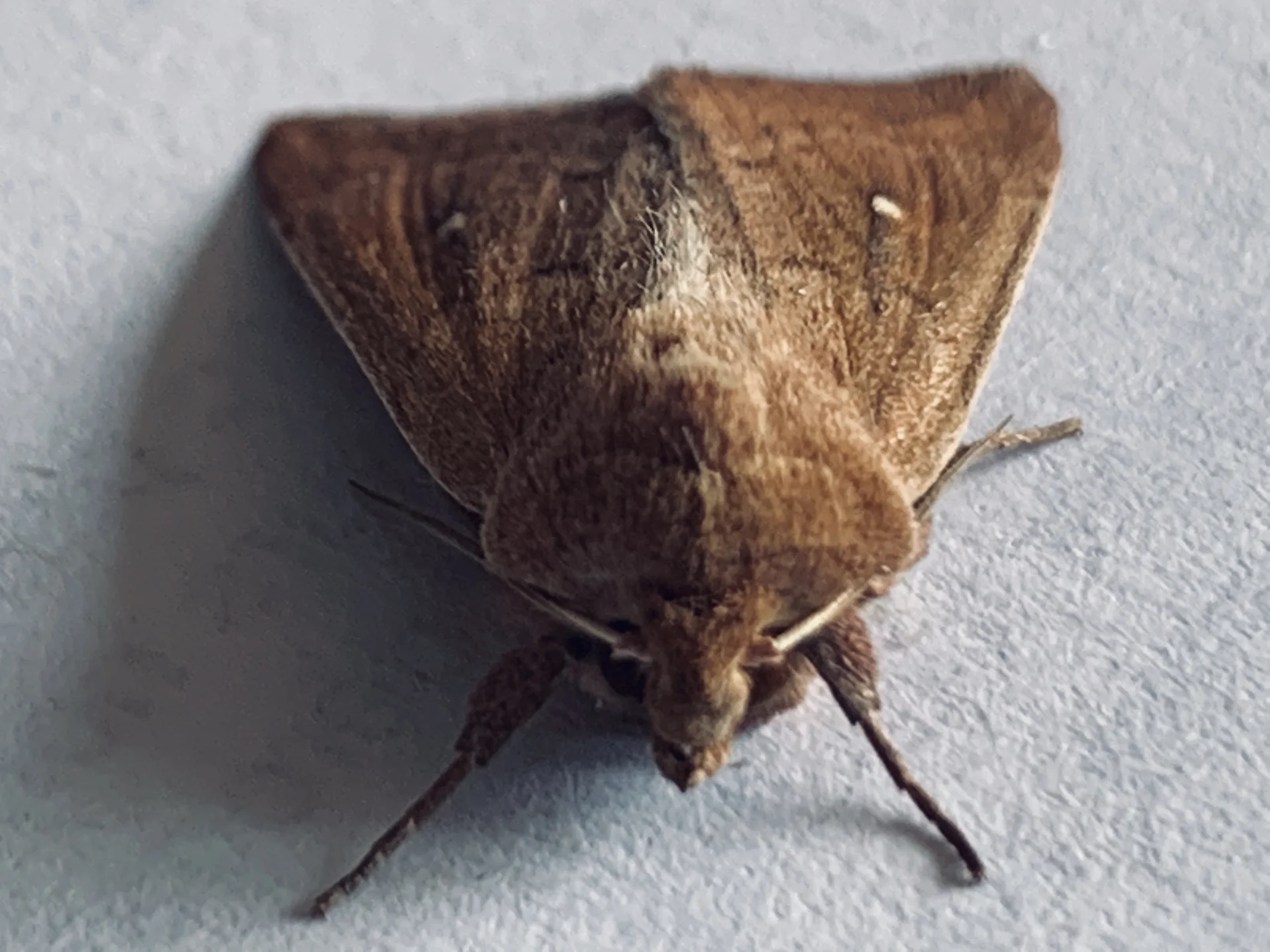
LEMAUX Yves · CC BY-SA 4.0
Why it matters
In a bad year, stem borers can take up to half your grain (50%). Once a grub tunnels deep inside the stem, no spray can follow it, and when it kills the plant's growing point — leaving a dead centre shoot called a dead-heart — that plant will never make a cob. Worse, the grubs survive the dry season hidden inside old stalks and stubble, so if you leave last season's residue lying in the field they come back stronger the next year. That is why catching them early and cleaning up after harvest beat any spray.
When to act
Around 5 to 10 percent of plants showing fresh leaf shot-holes or early dead-hearts; scout weekly during vegetative growth.
This guidance is general, compiled from published agronomic references including FAO and CABI. Thresholds and timing shift with your crop, your variety and the season.
In much of the region a spray is simply called mushonga — medicine. But a chemical group you cannot name is one you cannot rotate, and a product you did not write down has no pre-harvest interval you can observe. Mushonga, and other farming words →
The full Cereal stem borers field guide
Identify it
The first sign — neat rows of little holes
While the grub feeds on the tightly-rolled young leaves down inside the whorl (the funnel of new leaves at the plant's centre), it punches through all the folds at once. When that leaf later opens out, you see a tidy, straight row of small holes — shot-holes — marching across the leaf, as if someone pushed a pin through folded paper. Neat rows, not ragged tears, are the giveaway.
The dead-heart
The grub bores into the base of the central shoot and kills it, so the newest middle leaves turn yellow, then brown and dry out while the outer leaves stay green. Tug those central leaves — they slide out easily and often smell rotten. A plant with this dead centre shoot (a dead-heart) is finished in the middle and will never grow a cob.
Boreholes, sawdust and toppling stalks
As the grub tunnels down the stem you find small round holes on the stalk with fresh sawdust-like droppings (frass) piled at the leaf joints. The hollowed stalk turns weak and snaps or topples over in the wind — this is called lodging. Split an affected stalk open lengthwise and you find the tunnel, and often the grub still inside. Late in the season borers can bore into the cob too.
The borer itself
Open the whorl or split a stem to find it: a smooth, hairless caterpillar about 2–3 cm long — roughly the top joint of your thumb — creamy-white to dull pink, usually with rows of dark spots down its back and a hard, dark reddish-brown head. You will almost never see the adult — a dull straw-brown moth that hides low in the crop by day and flies only at night.
Don't mix it up with fall armyworm
Fall armyworm makes ragged, torn holes with messy wet droppings and sits curled up in the whorl — look for its four dark spots in a square near the tail and a pale, upside-down 'Y' on a dark head. Stem borer damage is neater — straight rows of holes — and its true signatures are the dead-heart and the tunnel bored into the stalk, which armyworm hardly ever does.
Scout for it
When: from knee-high right through flowering
Begin once the crop is in active growth, about knee-high (the development stage), and keep checking through tasselling and cob-fill (mid-season). Borer numbers build up steadily across the season — unlike armyworm, which mostly strikes tiny seedlings — so walk the crop once every week; don't check once and forget it.
Walk a big 'W'
Cross the field in the shape of a 'W' so you cover all four corners and the middle, not just the row beside the path where your eye always lands. Make about 10 stops along the way.
At each stop, check 10 plants — about 100 plants in all
Peer into the whorl for fresh rows of shot-holes, look at the central shoot for a yellowing dead-heart, and run your eye down the stalk for boreholes with fresh frass. Where you see fresh frass, split one stalk open to confirm a live grub is inside.
Fresh or old?
Moist, crumbly frass and soft new holes mean the grub is feeding right now. Dry old holes with no frass and no grub are a past attack that has already moved on — don't waste money spraying for that.
The number that means ACT: about 1 plant in every 10 to 20
If roughly 1 in every 10 to 20 plants (5–10%) shows fresh shot-holes or an early dead-heart, you are at threshold — act now, while the grubs are still small and feeding in the whorl and before they tunnel into the stem where nothing can reach them.
Control it
Prevent
-
plant early and all together
Sow early and at the same time as your neighbours so the whole area grows past the tender stage before borer moths build up; the late or lonely field is the one they hammer. Keep the crop well-fed and weed-free so it grows fast and can shrug off light damage.
-
clean up after harvest (the single most important step)
Because the grubs survive the dry season sealed inside old stalks and stubble, you must destroy that residue: shred it, plough it in, burn it, or feed the stalks to your animals, and slash back the grassy field edges that also shelter them. A clean field starves next season's borers before they can hatch.
-
try push-pull and tougher varieties
In push-pull you plant a smelly repellent legume (such as desmodium) between the rows to push the moths away, and a trap grass (such as Napier) around the border to pull them out of your crop — the border grass also feeds the wasps that kill borers. Where you can get the seed, grow borer-tolerant varieties bred with firmer stems and tighter husks.
Act early — let the natural enemies work, and cut out dead-hearts
Tiny parasitic wasps — Cotesia and Trichogramma — are harmless to you but deadly to borers: they lay their own eggs inside the borer's eggs and grubs. Push-pull and avoiding broad poisons let these helpers build up. Any plant already showing a dead-heart will not recover and still holds the live grub — pull it out and destroy it (burn it or feed it to livestock) so that borer can't spread or carry over to next year.
Last resort — a registered insecticide, and only in time
If you hit threshold while the grubs are still small in the whorl, you may use a registered insecticide (one approved and sold for your crop) — granules dropped into the whorl, or a spray aimed straight down into the whorl — to catch them before they tunnel into the stalk. Timing is everything: once they are sealed inside the stem, no spray or granule can reach them — a contact poison (one that only kills what it lands on) must touch the grub itself, and even a systemic one (one taken up inside the plant's sap) cannot bring back a dead growing point — so spraying grown borers is wasted money. Safety: cover your skin, eyes, nose and mouth; spray in the cool of early morning or evening with the wind at your back; keep it well away from food, drinking water, children, animals and bees; wash yourself and your clothes straight after; and respect the pre-harvest interval — the number of days the label tells you to wait between your last spray and harvest — so no poison is left on the grain you eat or sell. And rotate — switch to a different chemical group each time you spray so the borers never get used to one poison and become resistant (no longer killed by it).
If it keeps spreading — or it's already too late
If most of the damage is now deep boreholes, tunnels and toppled stalks, spraying will not help — cut your losses on those plants. Harvest what you can, then do the one thing that truly breaks the cycle: destroy every stalk and stubble after harvest so no grub survives the dry season, plant early next season, and rotate that land to a non-cereal — a legume such as beans or groundnuts — for a season so the borers have nothing to feed on and starve out. That clean start guards next year's crop better than any chemical.
Catch Cereal stem borers before it costs you the harvest
This guide is the general answer. Divisi works out yours — the week to scout your own field for Cereal stem borers, and what to do the day you find it.


Crops it affects
Plan the crops it attacks
-
 When to plant Maize in Mougalaba
 -
 When to plant Pearl millet in Kono
 -
 When to plant Rice in Mbama
 -
 When to plant Sorghum in Maracha
 -
 When to plant Sugarcane in Douigni
All planting calendars, country by country
Get Insights by email
A short digest of new Divisi articles. No email on quiet weeks.
Frequently asked questions
How do I identify Cereal stem borers?
The first sign — neat rows of little holes. While the grub feeds on the tightly-rolled young leaves down inside the whorl (the funnel of new leaves at the plant's centre), it punches through all the folds at once. When that leaf later opens out, you see a tidy, straight row of small holes — shot-holes — marching across the leaf, as if someone pushed a pin through folded paper. Neat rows, not ragged tears, are the giveaway.
When should I take action against Cereal stem borers?
Around 5 to 10 percent of plants showing fresh leaf shot-holes or early dead-hearts; scout weekly during vegetative growth.
How do I control Cereal stem borers?
Prevent — plant early and all together. Sow early and at the same time as your neighbours so the whole area grows past the tender stage before borer moths build up; the late or lonely field is the one they hammer. Keep the crop well-fed and weed-free so it grows fast and can shrug off light damage.
Which crops are attacked by Cereal stem borers?
Among the crops covered here: Maize, Pearl millet, Rice, Sorghum, Sugarcane.