 Divisi
Whitefly
Bemisia tabaci · Insect
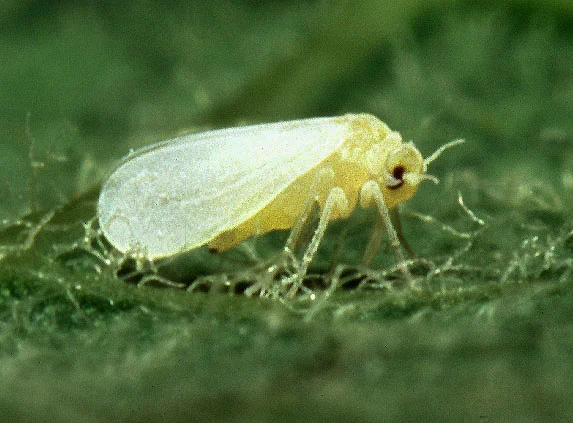
The whitefly (Bemisia tabaci) is a tiny, sap-sucking insect no bigger than a grain of sugar. Its white, moth-like adults and flat, scale-like young crowd the underside of leaves, where they drain the plant's sap, coat it in sticky honeydew that blackens with sooty mould, and — most dangerous of all — carry plant viruses such as cassava mosaic and tomato leaf curl from one plant to the next.
Why it matters
A whitefly attack can cost you more than half your crop — up to 60%. But the worst harm isn't the sap they drink: whitefly is a vector — a carrier that moves plant viruses (like cassava mosaic and tomato leaf curl) from sick plants into healthy ones. Once a plant catches the virus there is no cure — you can kill every last fly and the sick plants stay sick and stunted. And whitefly is stubborn: it breeds very fast in warm, dry weather, hides under the leaves where sprays miss it, and quickly stops dying to a spray you lean on too often. That is why you must act early, while numbers are still low — before the virus gets a foothold in your field.
When to act
Clouds of tiny white flies rise when plants are disturbed, or several adults or nymphs per leaf on young plants; act early where the crop is virus-susceptible.
This guidance is general, compiled from published agronomic references including FAO and CABI. Thresholds and timing shift with your crop, your variety and the season.
In much of the region a spray is simply called mushonga — medicine. But a chemical group you cannot name is one you cannot rotate, and a product you did not write down has no pre-harvest interval you can observe. Mushonga, and other farming words →
The full whitefly field guide
Identify it
The first thing you notice is the mess they leave
Leaves turn sticky and shiny, as if sprinkled with sugar-water — that is honeydew, the sweet waste the flies drip. A black, sooty mould then grows on the stickiness, blackening leaves and fruit, while the leaves themselves yellow, curl and wilt and the plant looks tired and stunted.
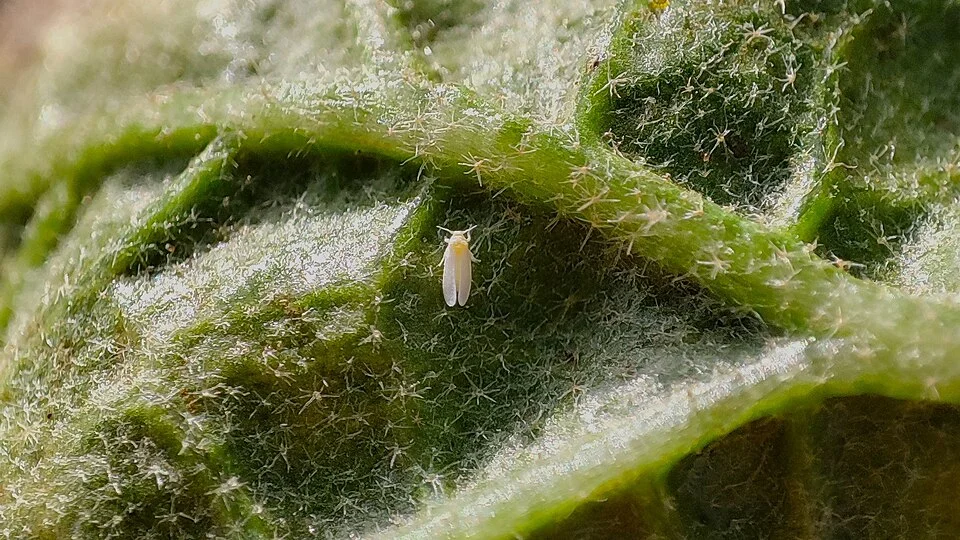
Brush or shake a plant and a cloud of tiny white flies puffs up
like fine ash or smoke, then quickly settles back under the leaves. Up close each one is pure white and about the size of a grain of sugar (roughly 1 mm) — like a minute white moth holding its wings roof-like over its back.
Turn a leaf over — especially the young top leaves
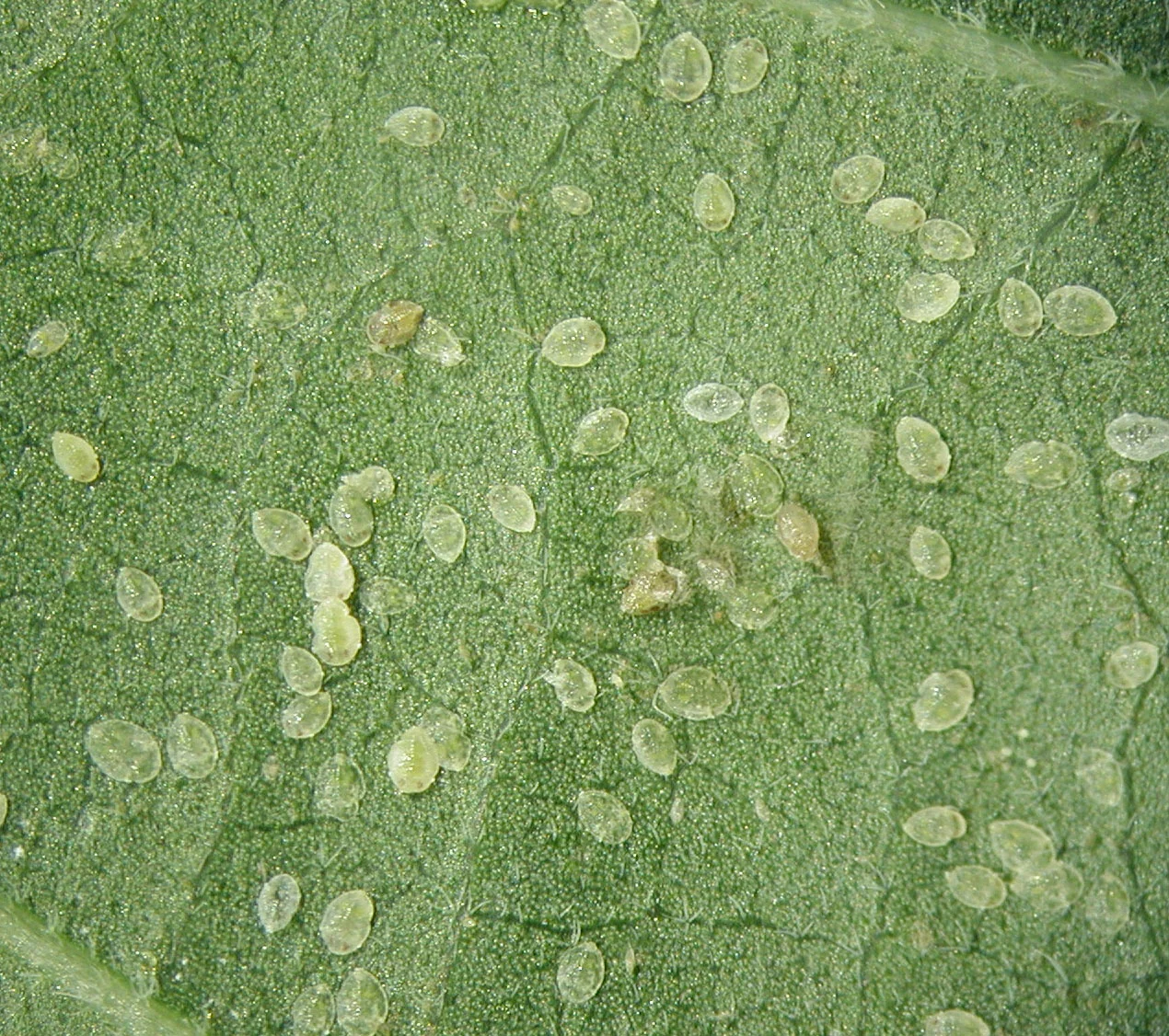
Stuck to the underside you'll find the young (called nymphs): tiny, flat, oval scales, pale yellow-green and see-through, glued in place and not moving — so still they look like part of the leaf. Adults rest and lay their eggs here too, which is why sprays aimed at the top of the leaf miss.
Watch for the virus signs that follow the flies
On cassava, leaves show a yellow-and-green mosaic mottle and become crumpled and small; on tomato and beans, the top leaves curl upward, cup and stunt. These virus diseases are the real killers — the flies bring them in.
Don't confuse whitefly
with aphids (small, pear-shaped, mostly wingless lice — green, black or grey — that cluster on soft shoots and stems and do NOT fly up when disturbed) or with mealybugs (bigger, cottony-white fluffy blobs that sit still in one spot). Only whitefly rises as a white cloud when you touch the plant.
Scout for it
Check from the moment the crop is growing strongly (the development stage) right through mid-season
— that is when whitefly builds up and does the most harm. Look more often during warm, dry spells (about 20–32°C), the weather whitefly loves best.
Twice a week, walk a big "W" across the field so you pass through all four corners and the middle — not just the row nearest the path. Whitefly starts at the field edges and in warm, sheltered spots, so spread your checks out. Make about 10 stops.
At each stop, gently shake or brush the top of a plant and watch: does a cloud of white flies rise? Then turn over two or three of the youngest top leaves and look for adults resting there and the flat, pale scales (the young) stuck underneath. Check in the cool of early morning, when the flies are slow and easier to catch before they scatter.
Hang a few yellow sticky traps just above the crop — a yellow board or sheet smeared with grease or oil. Whitefly is strongly drawn to yellow and gets stuck, so the traps show you when numbers are climbing and which edge they are coming from.
Act now if a cloud of white flies rises when you disturb the plants, or you find about 5 or more adults or young on a single leaf
on young plants. On virus-catching crops — cassava, tomato, beans, cotton — do NOT wait for a cloud: act at the very first few flies, because it takes only a handful to spread the virus.
Control it
Start clean — this is your strongest defence
Plant only clean, virus-free seedlings and cuttings: for cassava, take cuttings only from healthy-looking mother plants; for tomato and beans use fresh, healthy seedlings. One infected plant carries the virus straight into your field, so never plant material taken from sick-looking plants.
Starve the flies between crops
As soon as you harvest, pull out and burn or bury the old crop remains, and keep the weeds around the field cleared — whitefly lives on both and crosses to your next crop. Don't plant a new susceptible crop right beside an old, infested one (for example tomato after tomato, or cassava next to cotton), so the flies have no green bridge to walk across.
Confuse them with reflective mulch, and protect their natural enemies
Spreading silver or white plastic mulch (shiny side up) on the ground bounces light upward and makes it hard for whitefly to find and settle on your plants. And never spray broad poisons that kill every insect — that wipes out the flies' natural enemies (below) and whitefly, which breeds faster, roars back worse than before.
Protect and use the natural enemies — your free workforce
Tiny helpful wasps called parasitoids (harmless insects that lay their eggs inside the whitefly young and kill them from within), such as Encarsia and Eretmocerus, together with ladybirds and lacewings, quietly hold whitefly down at no cost. Keep them alive by avoiding broad poisons. For the young stages, spray insecticidal soap or neem (an extract from the neem tree) in the cool of the day, aiming the spray up under the leaves where the flies actually live.
Reach for insecticide only as a last resort, and only at threshold
If flies keep rising past the threshold on a virus-prone crop, use a selective insecticide (one chosen to spare natural enemies) and direct it under the leaves where whitefly hides. Safety, every time: cover your skin, eyes, nose and mouth; spray in the cool of morning or evening with the wind at your back; keep it away from food, drinking water, children and bees; obey the pre-harvest interval (the set number of days you must wait between spraying and picking, so no poison is left on the crop); and wash yourself and your clothes afterwards. To stop the flies becoming immune, rotate — change to a different chemical group each spray rather than using the same one over and over, because whitefly builds resistance very quickly.
If it keeps spreading
immediately pull out and destroy the worst virus-sick plants (mosaic, curled leaves) — one bad plant keeps feeding both the flies and the virus to the rest. When a field is heavily virus-struck, cut your losses: harvest what you can, clear and burn the crop remains, then leave a break with no host crop to starve the flies before you replant with clean, virus-free material. Chasing a virus-riddled field with more and more spray only wastes your money.
Catch whitefly before it costs you the harvest
This guide is the general answer. Divisi works out yours — the week to scout your own field for whitefly, and what to do the day you find it.


Crops it affects
Plan the crops it attacks
-
 When to plant Cassava in Banalia
 -
 When to plant Cotton in Kalemie
 -
 When to plant Sweet potato in Bailundo
 -
 When to plant Tomato in Goma
 -
 When to plant Cabbage in Les Eucalyptus
All planting calendars, country by country
Get Insights by email
A short digest of new Divisi articles. No email on quiet weeks.
Frequently asked questions
How do I identify whitefly?
The first thing you notice is the mess they leave. Leaves turn sticky and shiny, as if sprinkled with sugar-water — that is honeydew, the sweet waste the flies drip. A black, sooty mould then grows on the stickiness, blackening leaves and fruit, while the leaves themselves yellow, curl and wilt and the plant looks tired and stunted.
When should I take action against whitefly?
Clouds of tiny white flies rise when plants are disturbed, or several adults or nymphs per leaf on young plants; act early where the crop is virus-susceptible.
How do I control whitefly?
Start clean — this is your strongest defence. Plant only clean, virus-free seedlings and cuttings: for cassava, take cuttings only from healthy-looking mother plants; for tomato and beans use fresh, healthy seedlings. One infected plant carries the virus straight into your field, so never plant material taken from sick-looking plants.
Which crops are attacked by whitefly?
Among the crops covered here: Cabbage, Cassava, Cotton, Sweet potato, Tomato.