 Divisi
How to grow pineapple
Ananas comosus · Bromeliaceae
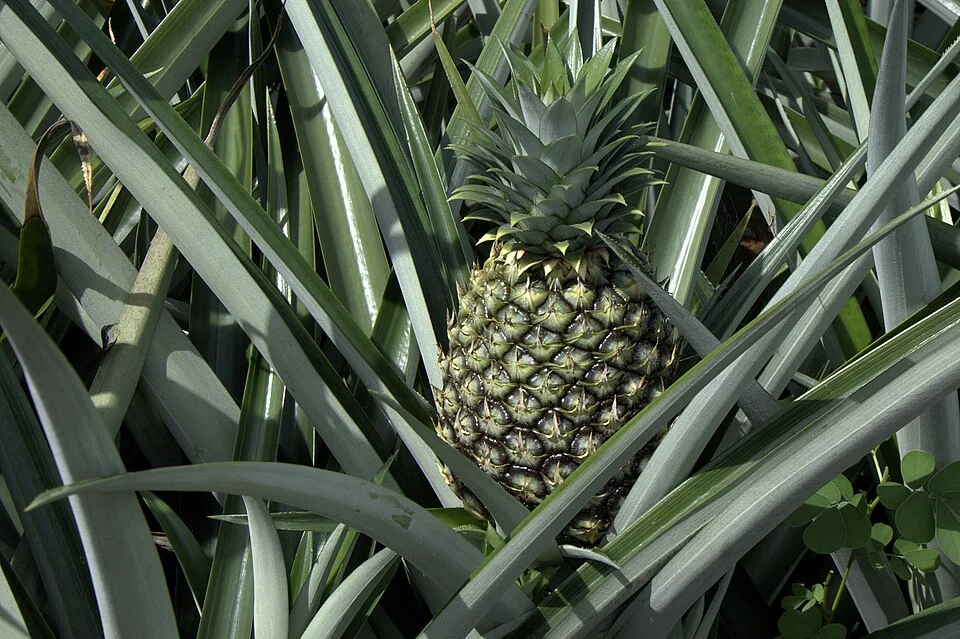
Photo: Markus Leupold-Löwenthal · CC BY-SA 3.0
Pineapple is a tough, low-growing plant — a rosette (a circle of stiff, spiny leaves growing out from one central point) about waist-high, carrying one sweet fruit in its heart. It is a perennial: it lives for years and gives you more than one harvest. It drinks very little — its leaves do their breathing at night, so it needs only about a fifth of the water an ordinary crop wants — and it loves sour (acid), sandy, well-drained soil and full sun. Its one true enemy is wet feet. You never plant a seed: you plant a sucker, slip or crown taken from another pineapple. And because a wild pineapple flowers whenever it likes, you deliberately force the whole field to flower together, so all the fruit ripens at once. From planting to your first fruit is a long road — about 15 to 24 months — but after that, one sucker left on the old plant gives you a second crop for far less work.
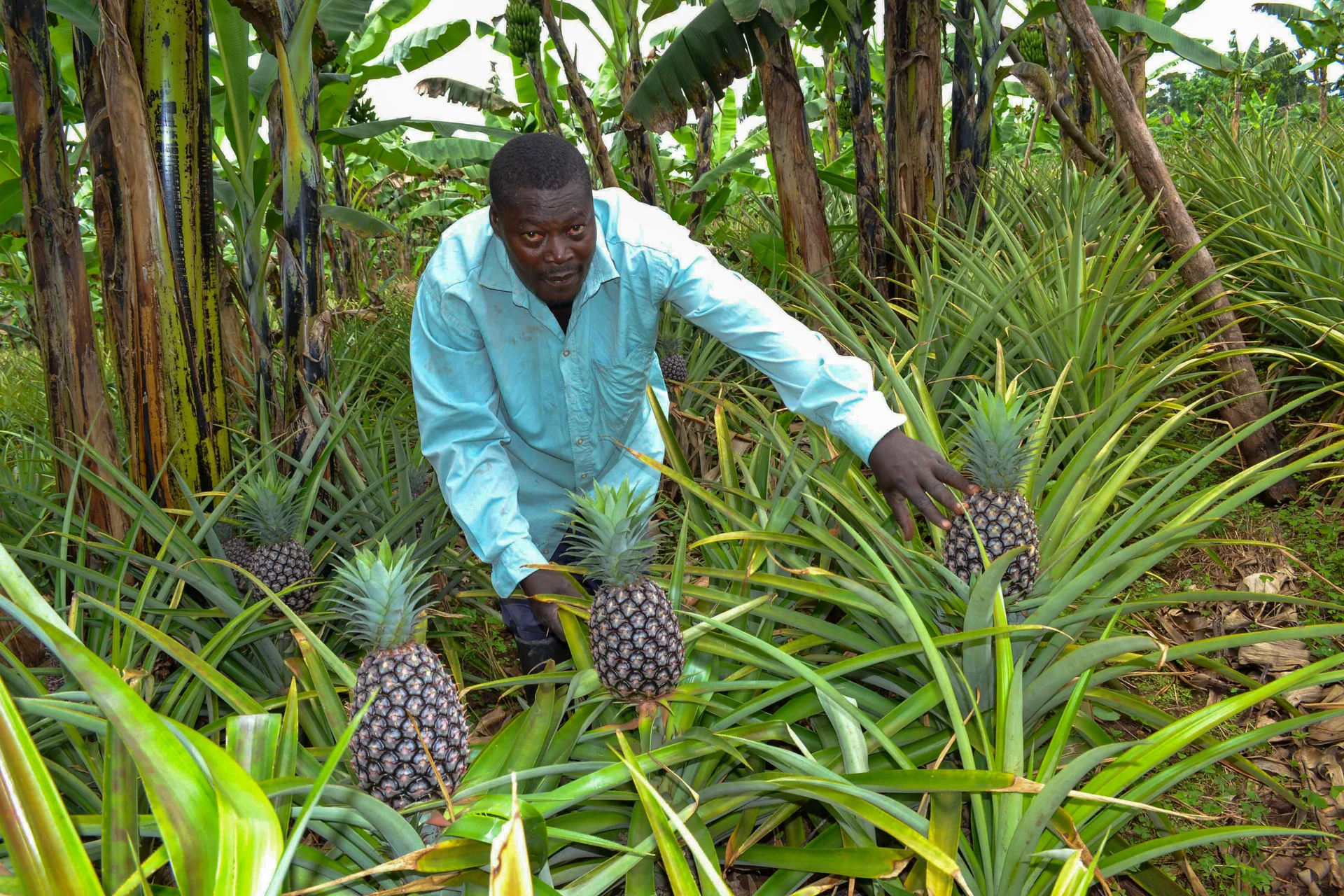
Emmanuel Ssekaggo · CC BY-SA 4.0 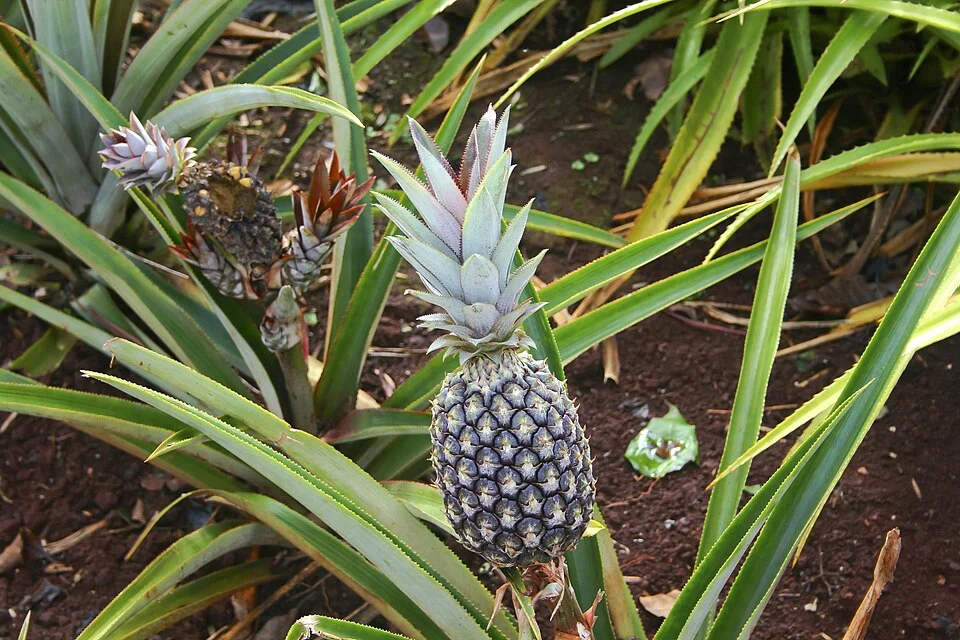
Diego Delso · CC BY-SA 3.0
- Days to maturity
- 450–730 days
- Sowing depth
- 7–15 cm
These are general figures for the crop, compiled from published agronomic references including FAO and CABI. The right choice for your field depends on your soil, rainfall and the yield you are aiming for.
Will pineapple actually do well on your field? Check your own field against every crop in the catalogue — no signup. Run the crop check →
Also known as
- Afrikaans
- pynappel
- Amharic
- አናናስ (ananas)
- French
- ananas
- Portuguese
- ananás, abacaxi
- Shona
- nanazi, mananasi
- Swahili
- nanasi, mananasi
- Zulu
- iphayinaphu
Working in buckets, bags or paces? The farming glossary turns the measures growers actually use into kilograms and hectares — what a 20 litre bucket of each crop really weighs, and how to size a field by walking it — alongside the Shona, Swahili, Ndebele and Yoruba words used in the field. Open the glossary →
Growing pineapple, stage by stage
Your pineapple crop from start to finish — picking an acid, well-drained, sunny site and clean planting shoots, the long months of growing a big leaf rosette, forcing the whole field to flower on one day, shading and ripening the fruit, and raising a second (ratoon) crop from a sucker left on the old plant.
Choose your site and your planting shoots
Almost everything about a pineapple crop is decided before you plant. Pick a sunny, well-drained, sour (acid) soil so the plant never sits in water, and clean, healthy planting shoots — all one kind and one size — so the whole field grows and flowers together. Get this right in the weeks before planting; a mistake here follows you for the full two-year crop.
Choose an acid, well-drained, sunny site Critical
Pineapple has shallow roots and hates wet feet. In soil that holds water, the heart of the plant rots (heart rot) and it dies — and heart rot cannot be cured. Pineapple also needs sour (acid) soil and full sun to feed well and sweeten its fruit. You live with the site you pick now for the whole two-year crop, so choose carefully.
Pick full-sun, gently sloping ground where water never stands. Pineapple roots are shallow and rot in wet soil, so keep away from low spots, hard clay pans, and anywhere puddles sit after rain.
Choose sour (acid) soil, about pH 4.5 to 5.5 — a sourness most crops dislike but pineapple loves. Sandy, sour soil is ideal; sweet or heavy soils give weak, sickly plants. Never add lime to pineapple ground — sweetening the soil starves the plant of iron and zinc and invites disease.
Make sure water drains away fast. If your only land is flat or heavy, plan now to plant on ridges or raised beds (see the next tasks) so the roots sit above standing water.
Keep the block well away from old, diseased pineapple and from big ant nests — both carry the mealybug and rot that ruin a young crop.
- Tip:
Mixing planting-shoot types or sizes in one block — suckers, slips and crowns reach flowering age at different times, so a mixed block never ripens together.
- Do:
Plant on ridges or raised beds wherever water might stand — heart rot kills waterlogged plants and cannot be cured.
- Watch out:
Do not lime pineapple ground to 'improve' it — pineapple needs sour soil, and sweetening it starves and sickens the crop.
Select & grade clean planting material Critical
The shoot you plant becomes your plant. A clean, well-grown one of the right kind roots fast and fruits on time; a weak or pest-carrying one brings mealybug and rot into your field and flowers late or not at all. Sorting by size now means the whole block reaches flowering size together — one harvest instead of a trickle.
Choose one type of shoot for the whole block. Suckers (shoots from the base and stem of an old plant) fruit fastest, in about 14–17 months. Slips (shoots from just below a fruit) are in between. Crowns (the leafy top cut off a fruit) are slowest, about 22–28 months. Pick one type only, so they all reach flowering size at the same time.
Grade by size. Sort the shoots into big, medium and small, and plant each size in its own block or row. Mixed sizes flower at different times and split one harvest into several.
Throw out sick shoots. Reject any shoot with white, cottony patches (that is mealybug — a small waxy insect), a soft or rotten base, or one that came from a wilting, reddish plant. A single infested shoot can seed the whole field with pests.
Cure the base before planting. Strip a few of the lowest leaves, then lay the shoots in the shade, base upward, for a few days up to two weeks, until the cut base dries and heals over. 'Curing' just means letting the wound dry hard. A healed base resists butt rot — where the base goes soft and black and the shoot never roots.
- Do:
Cure (dry-heal) the cut bases in shade before planting — a healed base fights off the rot that kills freshly set shoots.
- Tip:
Planting a shoot with white cottony mealybug on it — you carry the pest and its incurable wilt disease straight into a clean field.
- Watch out:
Suckers fruit almost a year sooner than crowns — know which you have so you plan the right time to force flowering.
Form ridges/beds for drainage Recommended
Raised ridges or beds lift the shallow roots above standing water, so heavy rain drains away instead of rotting the heart of the plant. On flat or heavy ground, this is the difference between a healthy block and one lost to heart rot.
On flat or heavy soil, hoe up ridges or raised beds — about knee-high (45 cm) on wet ground, lower where the soil is sandy and already drains well — so water runs off and away.
Run the ridges across the slope, not up-and-down, so they shed rain without washing the soil away.
Shape the beds for double (twin) rows of plants, with a clear path between each pair of rows to walk, weed and harvest.
Loosen the topsoil to a fine, crumbly tilth — pineapple's shallow roots spread sideways and need soft soil, not clods.
- Do:
Raise the beds higher on heavy or flat land, lower on sandy, free-draining ground where water already runs off.
- Watch out:
Leave a real walking path between the twin rows — a grown pineapple block is spiny and very hard to push through.
Plant the shoots and get the roots going
Now you set the shoots into the beds — deep enough to stand firm, close together in double rows to fill the land. For the first three months the plant is putting down roots and cannot defend itself, so keep it weed-free and watch for ants and mealybug from day one. The ants carry the mealybug, and the mealybug spreads a wilt disease that has no cure.
Plant suckers/slips/crowns Critical
How you set the shoots decides whether they root fast and stand firm or rot and topple. Right depth, firmed in, in close double rows, gives you a full, even block — and you cannot add plants later, so the stand you get now is the ceiling on your whole crop.
Plant your cured shoots two to three finger-joints deep (7–15 cm) — deep enough that each shoot stands on its own and will not rock in the wind, but not so deep that soil tips into the central heart.
Set the plants in double (twin) rows, close together — about a hand-span (20 cm) between plants in the row — with a clear path between each pair of rows. Pineapple is a crowded crop: aim for around 55,000 plants per hectare, far more than a grain field.
Firm the soil around each base so the shoot sits snug and its roots meet moist earth.
Keep the central cup — the funnel of young leaves at the plant's heart — clear and upright. Do not bury it, and do not let soil or water settle in it, or the heart rots.
- Do:
Firm each shoot in well — a loose shoot rocks, roots poorly, and rots at the base.
- Tip:
Planting so deep that soil falls into the central heart — a buried heart rots and the plant dies.
- Watch out:
Plant all one type and one size in a block, so the whole field reaches flowering size together.
Scout (mealybug + ants, heart rot) Critical
In these first months the young plant is defenceless. Mealybug — spread by ants — carries a wilt disease with no cure, and heart rot can kill a plant in days. Ten minutes walking the rows each month lets you stop the first few before they run down the whole block.
Once a month, from planting through the first three months, walk the whole block in a big loop — all four corners and the middle, not just the edge by the path.
Mealybug: look in the leaf-bases and hearts for white, cottony, waxy clusters, like tiny blobs of cotton wool. Follow any ant trails — ants farm and carry the mealybug, so ants running up the plants are your earliest warning.
Heart rot: gently tug the centre leaves. If they pull out easily and the base is soft, brown and foul-smelling, that plant has heart rot — pull the whole plant and carry it out of the block.
Butt rot: check newly set shoots — any whose base has gone soft and black and that have not rooted are rotting; lift them and replace them.
Yellowing: note any plant whose young centre leaves are pale or yellow instead of deep green — that is hunger you will feed later.
Act on the first mealybug clusters and ant trails before they spread. If they are taking hold, open the mealybug guide.
- Watch out:
Ant trails up the plants are your first mealybug warning — deal with the ants and you cut off the mealybug's carriers.
- Do:
Pull and carry off any heart-rotted plant straight away — a rotting heart spreads to its neighbours in wet weather.
Weed Recommended
A young pineapple grows slowly and leaves the ground wide open to weeds. Weeds steal the water, light and food the little plant needs to root, and they hide the ants and pests you are trying to catch. The first three months must be kept clean.
Weed every month or so through the first three months, while the plants are small and slow.
Hoe shallowly — pineapple roots run just under the surface and spread sideways, so deep hoeing near the plants cuts them.
Pull weeds close to the plants by hand, to avoid wounding the roots or the base.
Lay the pulled weeds or dry grass between the rows as mulch — it smothers new weeds and holds moisture for the shallow roots.
- Do:
Mulch between the rows with dry grass or the pulled weeds — it keeps the soil moist and slows the next flush of weeds.
- Tip:
Deep hoeing near the base — the shallow roots are easily cut, which sets the plant back just as it is trying to establish.
Grow a big, strong rosette
This is the long haul — many months while the plant builds a big rosette (circle) of leaves. It can only be forced to flower once it is big enough — about 30–40 leaves — so everything now is about growing leaf and root. Feed it (pineapple is very hungry for potassium and nitrogen), keep it weed-free, and keep watching for mealybug, wilt and yellowing.
Scout (mealybug/ants, nematodes, chlorosis) Critical
Through the growing year the big dangers are mealybug wilt (an incurable disease spread by ants and mealybug), nematodes (tiny soil worms that rot the roots), and hunger showing as pale leaves. Each shows early if you look — catching it keeps the plant growing toward flowering size.
Once a month, from about three months after planting until the plant is roughly a year old, walk the whole block and check plants in every part, not just the edge.
Mealybug wilt: look for plants whose leaves turn reddish or pink, with tips that dry back and curl inward, and the whole plant slowly wilting — dig one up and the roots have collapsed. Keep checking, too, for the white cottony mealybug and the ant trails that spread it.
Nematodes (soil worms too small to see): look for patches of stunted, pale plants that never pick up. Dig one — roots that are stubby, knotted or rotten instead of white and branching point to nematodes.
Yellowing (zinc or iron hunger): young centre leaves that are pale, yellow, or crooked and twisted — common where the soil is not sour enough. Note it and fix it with a leaf feed (see the feeding task).
Act on the first mealybug and ants before wilt spreads down the row. If it is taking hold, open the mealybug guide.
- Watch out:
Reddening, inward-curling leaves that spread from plant to plant along an ant trail are mealybug wilt — there is no cure, so stopping the ants and mealybug is your only defence.
- Do:
Pull and carry off badly wilted plants so they do not seed the rest of the block.
Foliar N-K feeding Recommended
Pineapple feeds partly through its leaves, and it is exceptionally hungry for potassium (K) — the nutrient that builds a big, sweet fruit — plus nitrogen (N) for leaf. Its roots are shallow and weak, so a light feed sprayed onto the leaves reaches the plant better than fertiliser on the ground. Feeding steadily now grows the rosette to forcing size.
About once a month through the growing year, mix a weak solution of nitrogen (urea) and potassium fertiliser in water. Your recommendation gives the exact amount and mix for your block.
Spray or splash it over the leaves and into the leaf-bases, which catch and hold it. This is foliar feeding — feeding through the leaves. Keep the mix weak; a strong mix scorches the leaves.
Where you saw pale or crooked young leaves, add a zinc (and iron) leaf feed. On soil that is not sour enough the plant cannot pull these from the ground, so the leaves take them straight.
Feed in the cool of the day, not in hot sun, so the drops do not burn the leaf as they dry. Stand so any breeze carries the spray away from your face.
- Do:
Keep the solution weak and feed little-and-often — pineapple leaves burn if the mix is too strong.
- Tip:
Feeding in the heat of the day — the drops dry fast and scorch the leaf. Feed early or late.
- Watch out:
Cover your skin and eyes while you spray, wash your hands after mixing and spraying, and keep the fertiliser away from your drinking water, your food, and children.
Weed Recommended
Until the rosette is big enough to shade the ground, weeds keep stealing water and food and give pests a place to hide. A clean block through the growing months lets the plant put everything into leaf and root.
Weed every month or so through the growing year, whenever a new flush of weeds comes up.
Keep hoeing shallow — the roots are still near the surface and spread wide between the rows.
Top up the mulch between the rows with dry grass, to smother weeds and hold moisture.
Once neighbouring plants' leaves touch and shade the ground, weeds struggle on their own and you can ease off.
- Do:
Let the closing canopy help you — once the spiny leaves meet, they shade out most weeds.
- Tip:
Hoeing deep near the base — you cut the shallow feeding roots and slow the plant just when it needs to bulk up.
Force the whole field to flower
Left alone, pineapples flower whenever they feel like it, so a field would ripen a few at a time over months. Instead you force the whole block to flower together on one day, once the plants are big enough (about 30–40 leaves). This sets a single harvest you can plan for. A red flower bud appears in the heart about 4–6 weeks later.
Force flowering Critical
Forcing is the switch that starts your fruit — and doing the whole block on one day is what gives you a single, plan-able harvest instead of a trickle. It is worth 20–50% of your crop's value: force too early on small plants and the fruit come out tiny and uneven; skip it and the field ripens in dribs and drabs.
Wait until the plants have about 30–40 leaves — big, robust rosettes. Count the leaves on a few plants first; small plants respond poorly and flower unevenly, so do not rush. Plants usually reach this size many months after planting, not before.
Do the whole block within a day or two, in the cool of the morning or evening — forcing works best when it is not hot — so every plant flowers together.
The simple smallholder method: dissolve a pea-sized lump of calcium carbide (about 2–5 g) in about half a litre of water (a large mug), and pour a splash into each plant's central cup — the funnel of leaves at the heart. (Shops may instead sell ethephon or ethylene, used the same way — follow the label.)
Repeat once, about two days (48 hours) later, so every plant takes.
Then watch for the red flower bud in the heart in 4–6 weeks — that is your sign it worked.
- Tip:
Forcing undersized plants — they respond poorly, flower unevenly, and give small fruit. Wait for 30–40 leaves.
- Watch out:
Calcium carbide gives off a flammable, choking gas and burns skin — keep it dry until you use it, well away from any flame or cigarette, do not breathe the fumes, and keep it off your skin and out of your eyes.
- Do:
Force the whole block on the same day, so it flowers — and later ripens — together.
Scout for the flower bud Recommended
The red bud is your proof that forcing worked. Knowing which plants took — and when — lets you count forward to harvest and spot any stragglers you may need to force again.
Starting about 3–4 weeks after you force, check the hearts of the plants for a small reddish flower bud rising from the centre.
By 4–6 weeks after forcing, most plants should show one — this bud becomes the fruit.
Mark any plant that did not take, so you can re-force the odd straggler and keep the block even.
From the day the bud shows, count forward: the ripe fruit follows in about 5–6 months. Write the date down — the whole run to harvest is counted from flowering, not from planting.
If it fails → if barely any buds show 6 weeks after forcing (usually because you forced in hot weather, or on plants still too small), force those plants again in the cool of the day and check once more in 4–6 weeks.
- Do:
Write down the date the bud appears — the whole run to harvest is counted from flowering, not from planting.
Grow and protect the fruit
Now a single fruit swells in the heart of each plant over about 5–6 months. The big danger is the sun: a fruit that leans over and bares its shoulder to hot sun gets sunburned — a pale patch that turns brown, sunken and rotten, and cannot be saved. Cover exposed fruit and keep watching for rot.
Cover fruit against sun Recommended
A ripening pineapple often leans and bares one shoulder to the sun. In strong sun that shoulder cooks — it goes pale, then brown and sunken, then rots — and a sunburned fruit is a total loss you cannot recover. A simple cover saves it.
From about a month after the flower bud appears, check for fruit that lean over and bare a shoulder to the afternoon sun.
Shade each exposed fruit: bend one of the plant's own long leaves over it, or lay dried grass, a handful of straw, paper, or a scrap of net over the sun-facing side.
Re-check every month or so as the fruit grows and shifts — a cover that slips leaves the shoulder bare again.
Shade, do not seal — let air move around the fruit so it does not sweat and rot under the cover.
- Do:
Use the plant's own leaves first — bending a leaf over the fruit is free, quick, and moves with the fruit.
- Watch out:
The afternoon-sun (west-facing) shoulder burns worst — check those fruit first on hot, clear days.
- Tip:
Wrapping the fruit tight in plastic — it traps heat and damp and rots the fruit. Shade it loosely instead.
Scout (fruit collapse, core rot) Recommended
Late on, the danger moves to the fruit itself — fruitlet core rot browns the inside, and soft, collapsing or sunburned fruit spoil before you can sell them. Spotting trouble early lets you cut and use an affected fruit rather than lose it whole.
From flowering through fruit growth, once a month, walk the block and look over the swelling fruit.
Fruitlet core rot: look for individual eyes on the fruit (each 'eye' is one of the little segments that make up the skin) that have gone brown or dark with a soft spot — the rot is inside those eyes. Badly affected fruit are best cut and used early.
Collapse or sunburn: look for fruit that are soft, weeping, or have a brown sunken shoulder — cut these out so they do not spread rot to their neighbours.
Check your sun covers are still in place as you go.
If rot is spreading, harvest the affected fruit early rather than lose them.
- Watch out:
A soft, fermenting smell or oozing at the base of a fruit means rot inside — take that fruit out of the block.
Cut the ripe fruit
The long wait is over — about 15 to 24 months from planting to your first fruit. Pineapple does not ripen or sweeten after you cut it (it is 'non-climacteric'), so you must pick it near-ripe and judge ripeness on the plant. Cut it — never pull it.
Hand-cut ripe fruit Critical
Pick at the right moment. Because pineapple will not sweeten off the plant, a fruit cut too early stays sour forever, while one left too long turns soft and rots or sunburns. Read the ripeness signs and cut cleanly to sell a sweet, whole fruit.
About 5–7 months after the flower bud showed, start checking ripeness. Look for the shell turning from green to golden-yellow, starting at the base and rising up the fruit.
Check the other signs together: the eyes flatten and the little bracts (the dry leaf-tips between the eyes) brown, the fruit gives off a sweet smell, and it sounds dull and solid — not hollow — when you tap it.
Cut the ripe fruit off with a sharp knife, leaving a short piece of stalk on the fruit. Do not pull or twist it off, which bruises it.
Pick in the cool of the morning, handle each fruit gently, and lay them in the shade — never drop or stack them hard.
Selling nearby? Let the fruit colour up a little more. Sending it far? Cut a touch earlier, while it is still firm and only just turning.
- Tip:
Picking under-ripe to beat the market — a pineapple cut green never sweetens, so it stays sour and sells poorly.
- Do:
Leave a short stalk on each fruit and carry them gently — a bruised pineapple rots fast.
- Watch out:
A hollow sound when tapped, and a fruit gone soft or leaking, means over-ripe — use those first; they will not travel.
Handle the fruit and raise a ratoon
Two jobs after the cut. First, the fruit is perishable and bruises easily — handle it gently and get it cool and sold fast. Second, do not dig up the plant: leave one strong sucker on it to grow your ratoon — a second crop from the same plant, ready in about 12–15 months.
Handle gently & cool promptly Recommended
A pineapple is at its best the day it is cut and goes downhill fast — bruised, warm fruit rot within days and fetch a poor price. Gentle handling and quick cooling are what turn a good harvest into money.
Keep the fruit in the shade from the moment you cut — never leave them heaped in the sun.
Handle them gently: do not drop, throw or over-stack them. Every knock becomes a soft, rotten spot within a day or two.
Get them cool as soon as you can — a shaded, airy store — and move them to market quickly; they do not keep long.
Keep them cool but not cold — not below about 7°C. Too cold gives 'chilling injury' — the inside browns and the fruit spoils — so never put pineapples in a very cold fridge or cold-room.
- Do:
Sell or move the fruit quickly — pineapple is perishable, and every warm day costs you quality and price.
- Tip:
Chilling the fruit below about 7°C — cold browns the inside. Keep it cool, not cold.
- Watch out:
Stacking fruit too high — the ones underneath bruise under the weight and rot first.
Select one ratoon sucker Optional
The old plant can give you a second crop almost for free. A ratoon grows from a sucker left on the mother plant and fruits in about 12–15 months — far faster than starting new plants. But only one sucker should carry it, or the plant splits its strength and every fruit comes out small.
In the few weeks after harvest, look at the suckers (side-shoots) growing from the base and stem of the cut plant.
Choose one strong, well-placed, low sucker to keep — this becomes your ratoon crop.
Snap or cut off the other suckers, so the plant pours all its strength into the one you kept.
Grow the ratoon on as before — feed, weed and watch for pests — and force it to flower once it too reaches about 30–40 leaves. Expect its fruit about 12–15 months on, a little smaller than the first.
- Do:
Keep just one strong sucker — a single ratoon gives a decent fruit, while several give a cluster of small ones.
- Watch out:
After a couple of ratoon crops the fruit get smaller and pests build up — that is the time to start a fresh block from clean suckers.
Pests and diseases that attack pineapple
-
 Black shank
 -
 Fruitlet core rot
 -
 Mealybug wilt of pineapple
 -
 Phytophthora root rot
 -
 Pineapple base rot
 -
 Plant-parasitic nematodes
Where to sell pineapple
Markets that trade this crop — what each one sells it by, when supply peaks there, and the currency used.

Grow pineapple with a plan, not a guess
This guide is the general answer. Divisi works out yours — the week to plant pineapple on your soil and your rainfall, and each job dated for your field.


When to plant pineapple, country by country
- When to plant pineapple in Algeria
- When to plant pineapple in Angola
- When to plant pineapple in Benin
- When to plant pineapple in Botswana
- When to plant pineapple in Burkina Faso
- When to plant pineapple in Burundi
- When to plant pineapple in Cabo Verde
- When to plant pineapple in Cameroon
- When to plant pineapple in Comores
- When to plant pineapple in Congo
- When to plant pineapple in Côte d'Ivoire
- When to plant pineapple in Egypt
- When to plant pineapple in Eritrea
- When to plant pineapple in Eswatini
- When to plant pineapple in Ethiopia
- When to plant pineapple in Gabon
- When to plant pineapple in Gambia
- When to plant pineapple in Ghana
- When to plant pineapple in Guinea Ecuatorial
- When to plant pineapple in Guinea-Bissau
- When to plant pineapple in Guinée
- When to plant pineapple in Kenya
- When to plant pineapple in Liberia
- When to plant pineapple in Madagascar
- When to plant pineapple in Malawi
- When to plant pineapple in Mali
- When to plant pineapple in Mauritanie
- When to plant pineapple in Mauritius
- When to plant pineapple in Morocco
- When to plant pineapple in Moçambique
- When to plant pineapple in Namibia
- When to plant pineapple in Niger
- When to plant pineapple in Nigeria
- When to plant pineapple in Rwanda
- When to plant pineapple in République centrafricaine
- When to plant pineapple in République démocratique du Congo
- When to plant pineapple in Sao Tome and Principe
- When to plant pineapple in Seychelles
- When to plant pineapple in Sierra Leone
- When to plant pineapple in Somalia
- When to plant pineapple in South Africa
- When to plant pineapple in South Sudan
- When to plant pineapple in Sudan
- When to plant pineapple in Sénégal
- When to plant pineapple in Tchad
- When to plant pineapple in Togo
- When to plant pineapple in Uganda
- When to plant pineapple in United Republic of Tanzania
- When to plant pineapple in Zambia
- When to plant pineapple in Zimbabwe
Where pineapple scores best
Districts where Divisi's engine currently rates this crop highest, ranked by fit.
-
 Bukoba
 -
 Mougoutsi
 -
 Jinja
Jinja -
 Sanquin Dist #3
 -
 Makabana
 -
 Tarkwa Nsuaem
 -
 Shabunda
 -
 Mananjary
 -
 Bungo
Bungo -
 Ntega
Ntega -
 Bugesera
 -
 Kipkelion West
Get Insights by email
A short digest of new Divisi articles. No email on quiet weeks.
Frequently asked questions
How do I grow pineapple?
How to grow pineapple: 450–730 days to maturity, 7–15 cm deep. Also called pynappel, አናናስ (ananas), ananas, ananás, nanazi, nanasi, iphayinaphu.
What is pynappel in English?
Pynappel is the Afrikaans name for pineapple.
What is አናናስ (ananas) in English?
አናናስ (ananas) is the Amharic name for pineapple.
What is ananas in English?
Ananas is the French name for pineapple.
What is ananás in English?
Ananás (also abacaxi) is the Portuguese name for pineapple.
What is nanazi in English?
Nanazi (also mananasi) is the Shona name for pineapple.
What is nanasi in English?
Nanasi (also mananasi) is the Swahili name for pineapple.
What is iphayinaphu in English?
Iphayinaphu is the Zulu name for pineapple.
How long does pineapple take to grow?
Pineapple takes about 450–730 days from sowing to maturity, though the exact length varies with variety, temperature and how the season runs.
How deep should pineapple be planted?
Sow pineapple at about 7–15 cm deep. Shallower risks drying out; deeper wastes seed energy before the shoot reaches light.
What pests and diseases attack pineapple?
The ones covered in this guide are Black shank, Fruitlet core rot, Mealybug wilt of pineapple. Each has its own page explaining how to identify, check for and control it.