 Divisi
Aphids
Aphididae · Insect
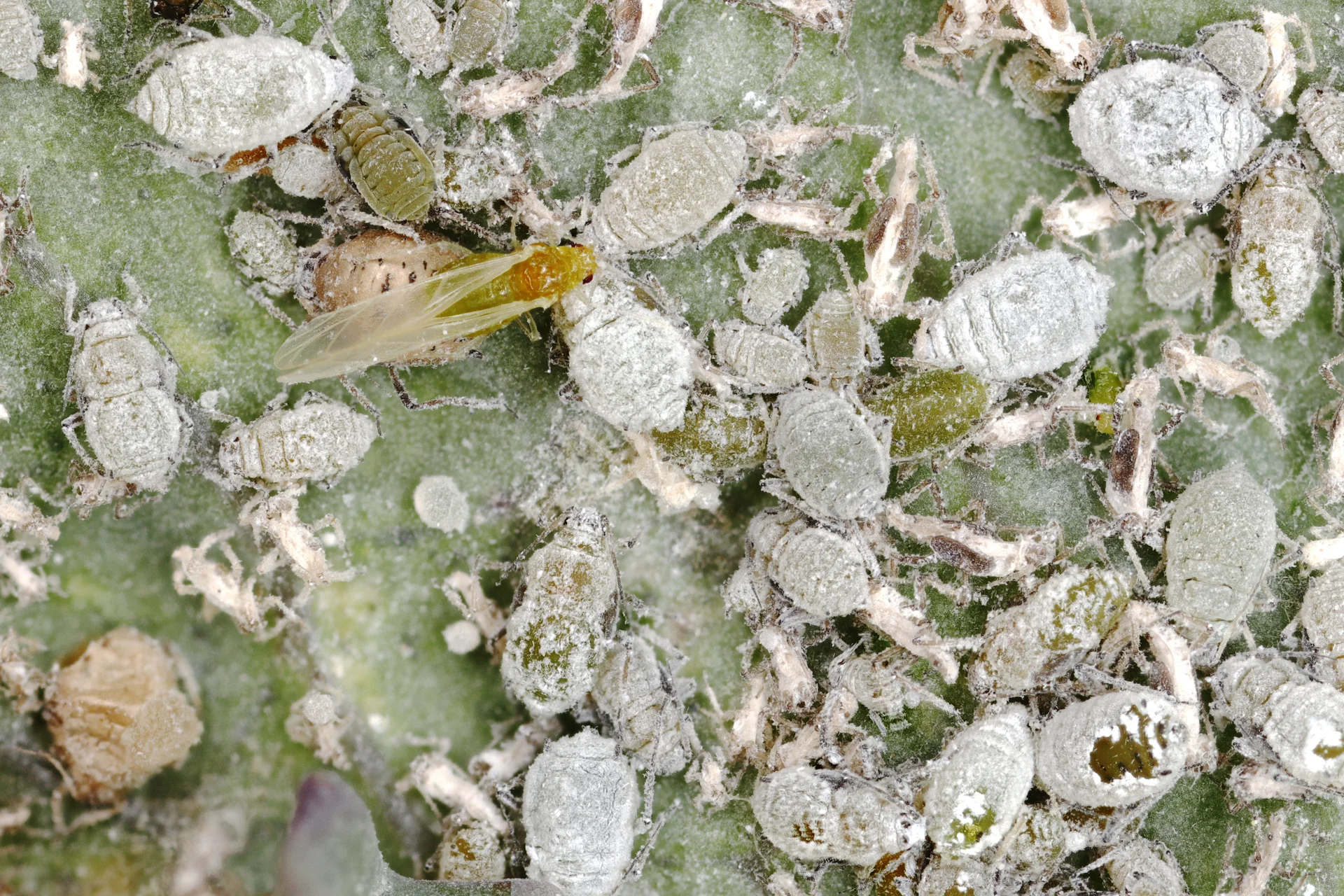
Photo: Sanjay Acharya · CC BY-SA 4.0
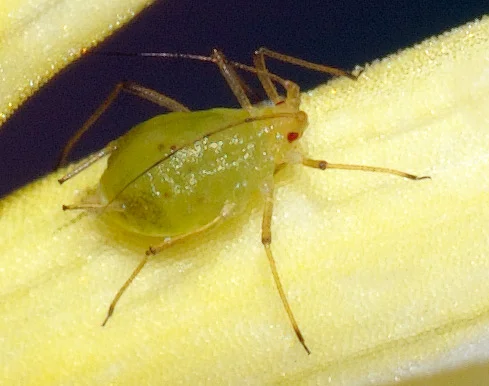
Aphids are tiny, soft, pear-shaped sap-sucking insects — green, black, grey or waxy-white, each no bigger than a pinhead — that gather in dense clusters on the tender growing tips, flower buds and leaf undersides of many crops, from beans, cowpea and cabbage to tomato, pepper, potato, cotton, citrus and wheat. They multiply explosively in warm, dry weather, curling and stunting new growth, coating leaves in sticky honeydew that blackens with sooty mould, and — most damaging of all — carrying plant viruses from field to field.
André Karwath aka Aka · CC BY-SA 2.5 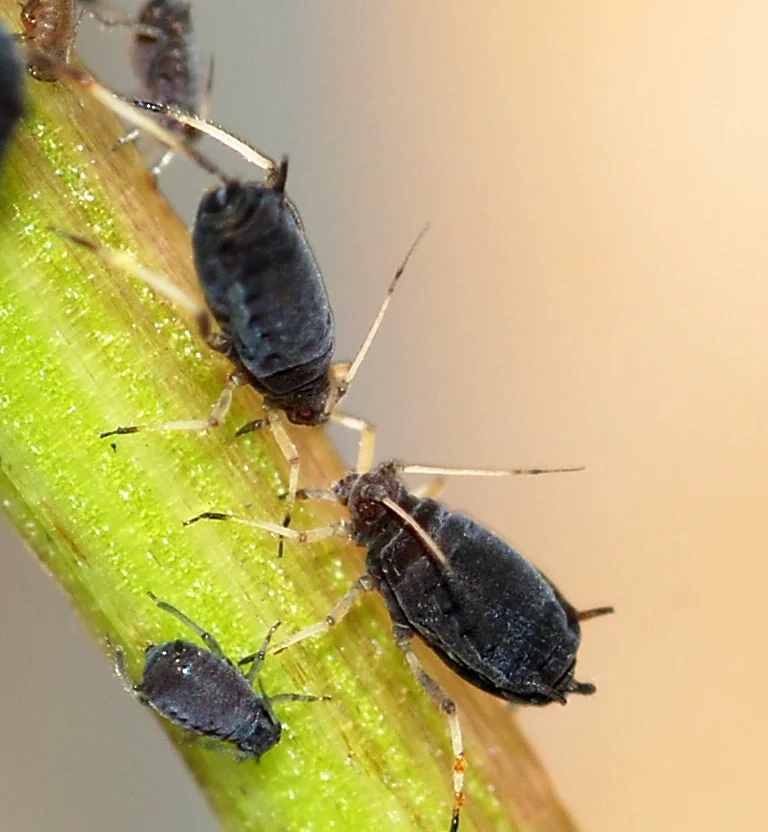
Alvesgaspar · CC BY-SA 3.0
Why it matters
Aphids are tiny sap-suckers that can quietly cost you up to half your crop (50%). They drain the tender growing tips so leaves curl and plants stunt, they coat everything in sticky honeydew that turns black with sooty mould and dirties your produce, and worst of all many of them carry plant viruses — a disease no spray can cure. They are hard to stop once they settle, because a few aphids become thousands in a few days (the females give birth to live young without even mating) and they hide under curled leaves and leaf undersides where sprays miss them — so the whole game is catching them early, while the colonies are still small.
When to act
Act when colonies build on growing tips of many plants, when honeydew and curling appear, or on virus-sensitive crops even at low numbers.
This guidance is general, compiled from published agronomic references including FAO and CABI. Thresholds and timing shift with your crop, your variety and the season.
In much of the region a spray is simply called mushonga — medicine. But a chemical group you cannot name is one you cannot rotate, and a product you did not write down has no pre-harvest interval you can observe. Mushonga, and other farming words →
The full Aphids field guide
Identify it
The first thing you see is the damage, not the insect
the newest leaves and growing tips curl, pucker and twist, growth turns stunted and yellowish, and leaves get a shiny, sticky coating (honeydew) that soon turns black and sooty — a mould that grows on the sugar. Ants running up and down the stems are a giveaway: they farm the aphids for that honeydew and guard them.
The insect itself
turn a curled leaf or growing tip over and you'll find dense clusters of tiny, soft, pear-shaped insects, each about the size of a pinhead (1–3 mm). They may be green, black, grey or waxy-white depending on the crop, they move slowly and stay put in a mass, and the sure mark — if you look closely — is two tiny 'exhaust pipes' at the tail end (called cornicles). They pack onto the growing tips, flower buds and undersides of the youngest leaves — the soft, sappy parts.
Don't confuse them
with whiteflies (tiny white specks that fly up in a little cloud when you disturb the leaf — aphids stay put and don't fly off) or leafhoppers (wedge-shaped, and they hop or run sideways fast). Aphids are the ones that sit still in soft clusters on the tender growth, with those two little tailpipes at the back. The pale white flecks stuck in the honeydew are just their shed skins — harmless, but a sign the colony has been feeding there a while.
Watch for virus signs too
even after the aphids have moved on, plants they fed on may show mottled light-and-dark green patches (mosaic), yellowing, rolled or crinkled leaves, or stunting that no amount of feeding or water fixes. That is a virus the aphids carried in — a warning to protect the rest of the field before it spreads.
Scout for it
When
aphids hit hardest from seedlings, right through leafy growth, to flowering and fruiting — so check from the moment plants emerge, and step it up during warm, dry spells (that is exactly the weather they explode in). Walk the field twice a week, in the cool of the morning.
How
walk a big "W" across the field so you cover all four corners and the middle — not just the row beside the path. Make about 10 stops, and check a few plants at each stop.
What to check
turn over the youngest leaves and look closely at the growing tips, flower buds and stems — the soft new parts, where colonies start. Look for clusters of aphids, curling, shiny honeydew, black sooty mould and ant trails. Hang a few yellow sticky traps (yellow cards smeared with grease or oil) to catch the winged aphids flying in — these are the ones that carry viruses from other fields.
When to act
act once you find growing-tip colonies on about 2 in every 10 plants (20%), OR as soon as you see leaf-curling with sticky honeydew anywhere in the field. On virus-sensitive crops — potato, tomato, pepper, citrus — don't wait for the numbers: act the moment you find even a few aphids, because it takes only a small number to spread virus.
Control it
Prevent it — don't grow the soft, sappy shoots aphids love:
feed balanced nutrients and go easy on nitrogen (too much — like heavy urea — flushes out tender growth that aphids breed on fastest). Clear the weeds in and around the field, because they shelter aphids and viruses between crops. Keep a new planting away from old, infested or virus-sick crops.
Shield the young plants
spread a reflective or pale mulch (silvery plastic, or even light dry grass or straw) between the rows. The glare confuses the winged aphids looking for somewhere to land, so fewer settle on your seedlings — this is especially worth doing on virus-sensitive crops.
Let the natural enemies do the work — this is your strongest tool:
ladybirds and their alligator-shaped larvae, lacewings, hoverfly maggots and tiny parasitic wasps eat huge numbers of aphids. A sign they're winning is when some aphids swell into bronze, papery 'mummies' — that is a wasp that killed the aphid from inside. If you see plenty of ladybirds or mummies, don't spray — let them finish the job. Avoid harsh, broad poisons that kill these helpers, or the aphids come back worse than before.
Act early by hand on small plots
knock the colonies off with a strong jet of water, or wipe and squash them by hand, and cut off and destroy the worst-infested tips and shoots. Deal with the ants too — a band of wood ash or sticky grease around the stem stops them, because ants drive off the ladybirds and wasps to protect their aphids.
Spray only as a last resort — and only a soft one:
if colonies keep building past the threshold and few natural enemies are about, use a soft insecticide — an insecticidal soap, a neem product, or a selective aphid spray. 'Soft' means it is gentle on bees and natural enemies; do NOT reach for a harsh broad poison. Spot-spray only the infested plants, and wet the leaf undersides and curled tips well — these are contact sprays that only kill the aphids they actually touch. Safety: cover your skin, eyes, nose and mouth; spray in the cool of the day with the wind at your back; keep it off food, water sources, children and bees (spray in the late evening when bees have stopped foraging); respect the pre-harvest interval — the wait between spraying and when the crop is safe to eat or sell, which matters most on leafy and fruiting vegetables you eat soon; and wash yourself and your clothes afterwards. Resistance: aphids breed so fast they beat a poison quickly, so rotate to a different chemical group each time and never spray the same one over and over (resistance means the spray simply stops killing them).
If it keeps spreading
after two soft-spray rounds with no let-up, switch to a different group of soft insecticide and cut out and burn the worst shoots. If plants already show virus (mosaic, yellowing, rolled leaves, stunting), no spray can cure it — pull out and destroy the sick plants so they can't feed virus to the rest, and protect the healthy young ones. When a crop is badly virused, cut your losses: rogue out the infected plants, harvest what is still healthy, and next season start with clean, virus-free seed or planting material, planted away from old crops and under a reflective mulch.
Catch Aphids before it costs you the harvest
This guide is the general answer. Divisi works out yours — the week to scout your own field for Aphids, and what to do the day you find it.


Crops it affects
Plan the crops it attacks
-
 When to plant Common bean in Dilolo
 -
 When to plant Cotton in Kalemie
 -
 When to plant Cowpea in Bangui-Rapides
 -
 When to plant Tomato in Goma
 -
 When to plant Wheat in Hammedi
 -
 When to plant Cabbage in Les Eucalyptus
All planting calendars, country by country
Get Insights by email
A short digest of new Divisi articles. No email on quiet weeks.
Frequently asked questions
How do I identify Aphids?
The first thing you see is the damage, not the insect. the newest leaves and growing tips curl, pucker and twist, growth turns stunted and yellowish, and leaves get a shiny, sticky coating (honeydew) that soon turns black and sooty — a mould that grows on the sugar. Ants running up and down the stems are a giveaway: they farm the aphids for that honeydew and guard them.
When should I take action against Aphids?
Act when colonies build on growing tips of many plants, when honeydew and curling appear, or on virus-sensitive crops even at low numbers.
How do I control Aphids?
Prevent it — don't grow the soft, sappy shoots aphids love:. feed balanced nutrients and go easy on nitrogen (too much — like heavy urea — flushes out tender growth that aphids breed on fastest). Clear the weeds in and around the field, because they shelter aphids and viruses between crops. Keep a new planting away from old, infested or virus-sick crops.
Which crops are attacked by Aphids?
Among the crops covered here: Cabbage, Common bean, Cotton, Cowpea, Tomato, Wheat.