 Divisi
Bollworm complex
· Insect
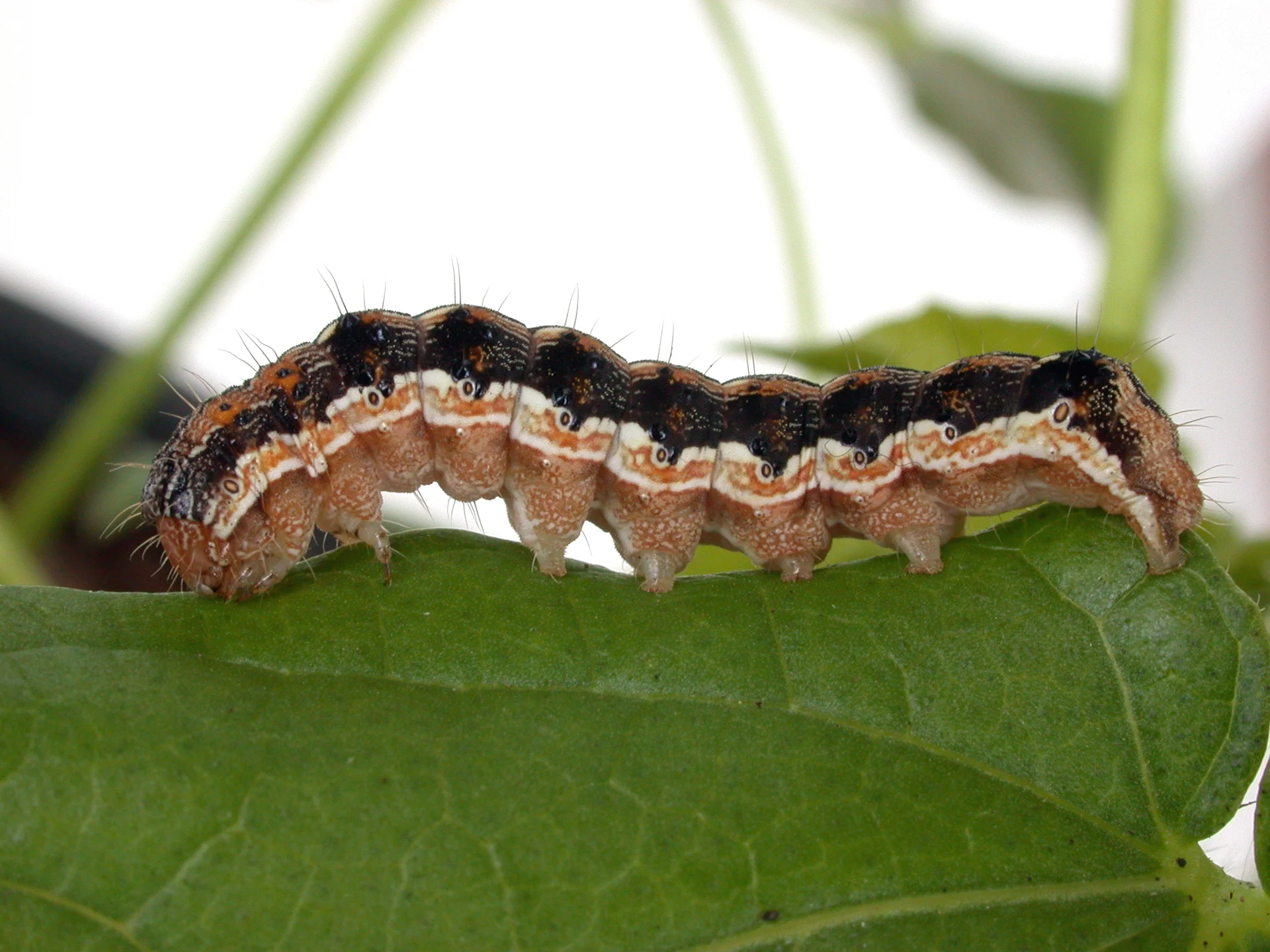
Photo: David McClenaghan, CSIRO · CC BY 3.0
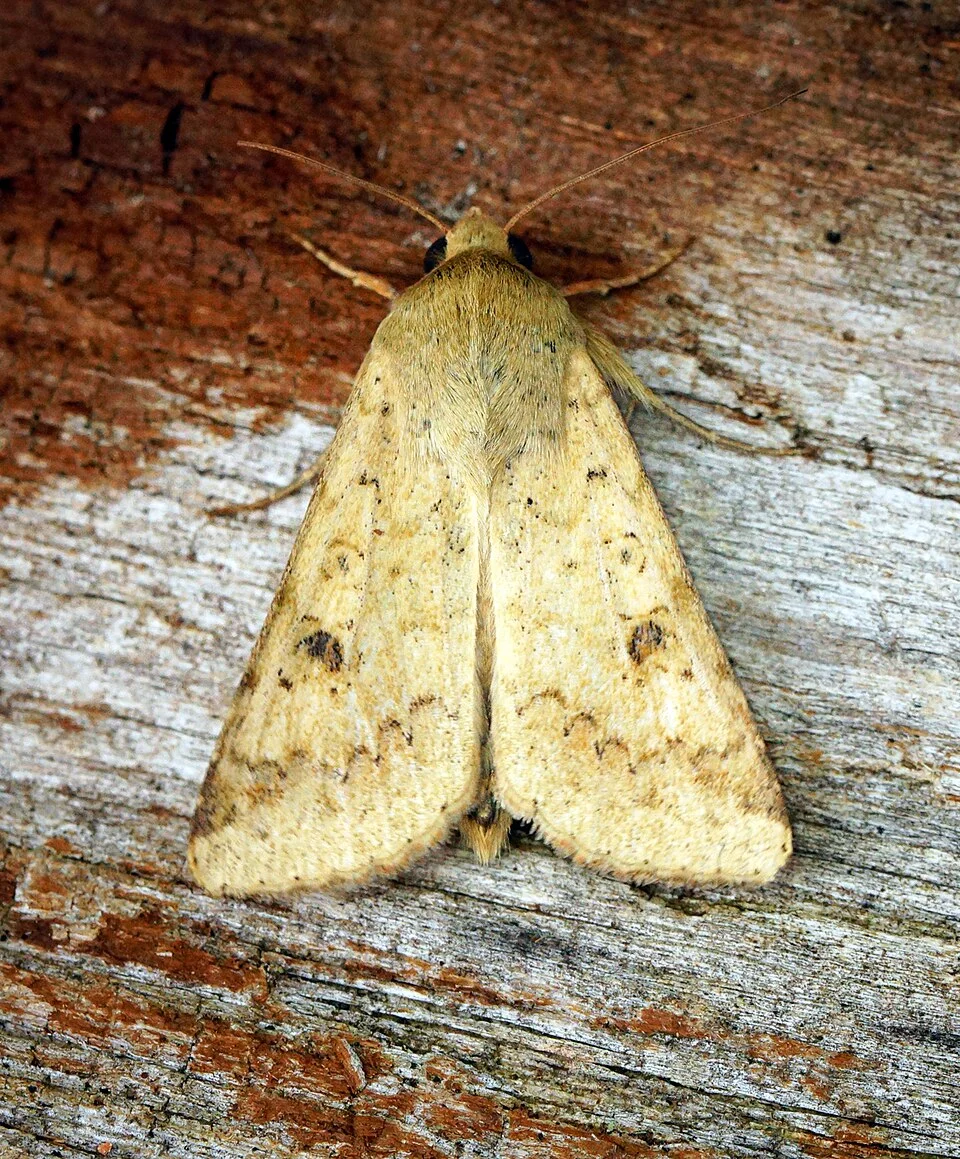
Bollworms are a group of caterpillars that attack the fruiting parts of the crop rather than the leaves. The main one is the African bollworm (Helicoverpa armigera), joined by the spiny bollworm (Earias species) and the pink bollworm (Pectinophora gossypiella). Dull, night-flying moths lay their eggs on flowers, growing tips and young fruit; the caterpillars then bore into the cotton bolls, or into the pods and fruit of beans, cowpeas, pigeon peas, chickpeas, soybeans, tomatoes, peppers and okra — eating the seed and lint you were going to sell.
Ben Sale from UK · CC BY 2.0 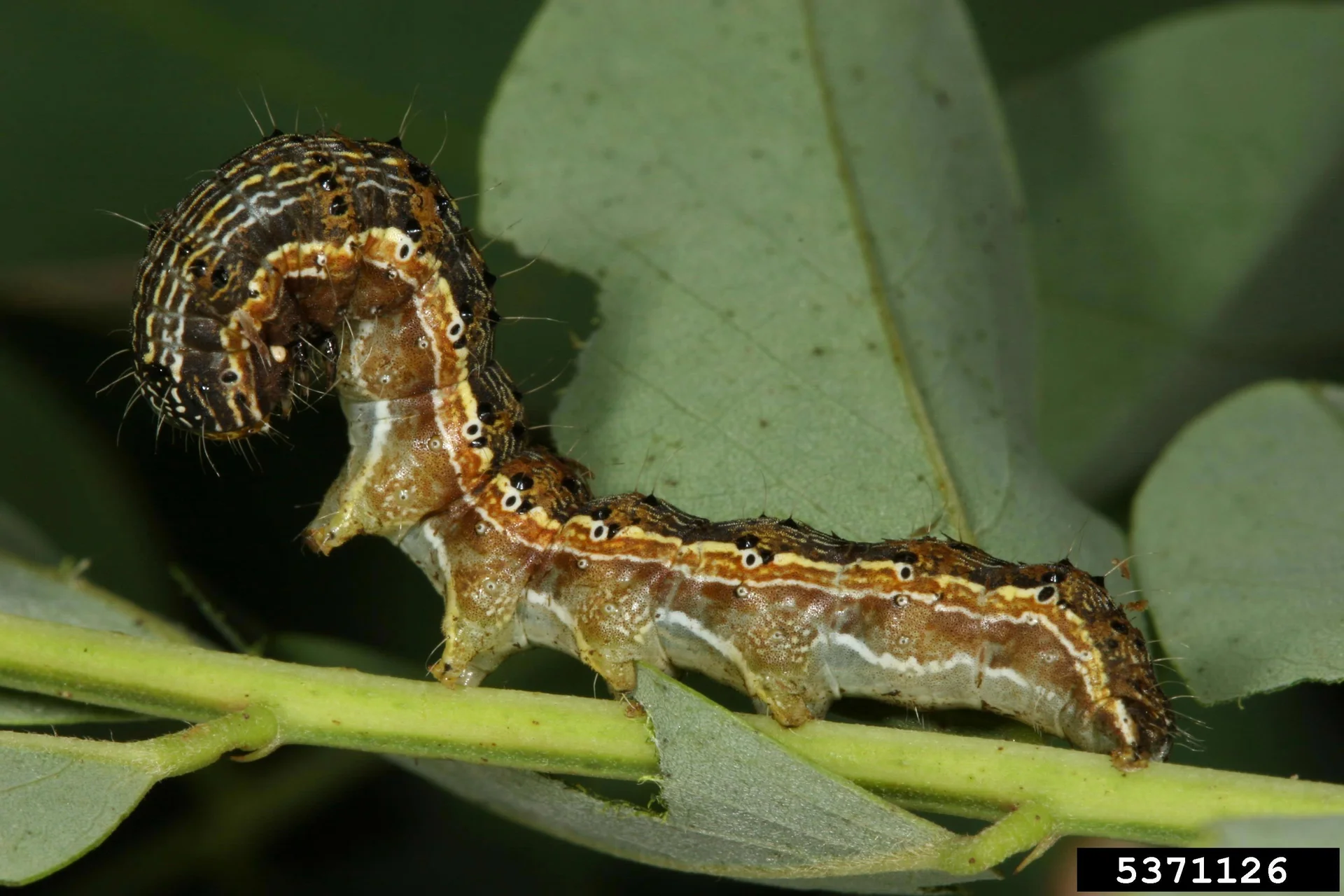
Gyorgy Csoka, Hungary Forest Research Institute, Bugwood.org · CC BY 3.0 us
Why it matters
Bollworms go straight for the part you sell — the bolls on cotton, and the pods and fruit on beans, cowpeas, pigeon peas, tomatoes, peppers and okra. A bad attack can eat up to 60% of your harvest — well over half. And one caterpillar does not stop at one fruit: it bores from pod to pod, fruit to fruit, and once it is tucked inside, no spray can reach it and the rot is already done. That is why you must catch it early — as eggs and tiny caterpillars on the outside, before it bores in.
When to act
Spray when about 1 in 4 plants carries eggs or young larvae, or when 5-10% of squares/bolls show fresh boreholes.
This guidance is general, compiled from published agronomic references including FAO and CABI. Thresholds and timing shift with your crop, your variety and the season.
In much of the region a spray is simply called mushonga — medicine. But a chemical group you cannot name is one you cannot rotate, and a product you did not write down has no pre-harvest interval you can observe. Mushonga, and other farming words →
The full Bollworm complex field guide
Identify it
Look at the fruit, not the leaves
The first sign is round bore-holes in the cotton bolls (the pods that hold the lint and seed), or in the pods and fruit of beans, cowpeas, tomatoes, peppers and okra — usually with wet, crumbly droppings (frass) pushed out at the hole. Buds, squares (the flower buds) and young bolls or pods drop off the plant, and if you cut one open the inside is hollow, stained or rotten.
The classic giveaway
a caterpillar feeding with its head buried inside the boll, pod or fruit and its back half sticking out. No other pest sits like that. One worm will leave a trail of several bored, ruined fruits as it moves along.
The African bollworm itself
(the main one): up to 3-4 cm long — about the length of your thumb from the tip to the first knuckle. Its colour varies a LOT (green, yellow, pink, brown, even almost black), but it always has pale wavy stripes running along the sides with a darker line down the back, and rough, bristly skin that feels like fine sandpaper if you run a finger along it. The head is dark.
The eggs
are laid one at a time — NOT in a fuzzy mass. Each is tiny, round and dome-shaped like a miniature helmet, white at first and turning brown, stuck on flowers, growing tips and young fruit. Finding single eggs like this is your earliest warning.
The other two bollworms
the spiny bollworm bores into the growing tip first, so the shoot wilts and droops like a bent candle before you ever see fruit damage. The pink bollworm is small and hides inside the boll, twisting the flower into a bunched "rosette" that never opens properly — cut a suspect boll open to find it.
Do not confuse it with leaf-eaters
Armyworms and loopers chew the leaves; bollworm goes for the fruit and pods and bores in. A looper arches its back into a loop as it walks — bollworm crawls flat. If the caterpillar is eating leaves and not boring into fruit, it is not bollworm.
Scout for it
Start the moment the crop begins squaring, budding and flowering
— that is when the moths arrive to lay. Keep checking twice a week right through flowering and boll/pod-fill, because that whole fruiting stretch is the window the worms attack. There is no need to scout for it at the seedling stage.
Walk a big "W" across the field
so you cover all four corners and the middle — not just the edge by the path. Stop at about 5 points, and at each stop check 4-5 plants (about 20-25 plants in all).
On each plant check three places
the growing tips (for the drooping "candle" shoot and eggs), the squares, buds and open flowers (open a flower and look inside), and the young bolls, pods and fruit. Look for single dome-shaped eggs, tiny caterpillars, and fresh boreholes with frass. Also glance at the ground for shed buds and pods.
The number that means ACT NOW
treat when about 1 in every 4 plants (roughly 2-3 in every 10) is carrying eggs or young caterpillars, OR when about 5 to 10 out of every 100 fruiting bodies — that is 1 in every 10 to 1 in every 20 squares, bolls or pods — shows a fresh borehole. Below that, keep watching; do not spray.
Tell fresh from old
A fresh, moist hole with soft frass means a worm is still working — act on it. An old, dry hole with no worm inside is past damage — do not spend a spray on it.
Hang a pheromone trap if you can get one
— a small lure trap that gives off the female moth's scent and catches the male moths. A sudden jump in the nightly catch warns you that egg-laying is about to start, so you know to scout harder and to time any spray to hit the new eggs and young worms.
Control it
Prevent first
-
grow a resistant variety
On cotton, plant Bt cotton where it is available: a variety that carries a natural protein from the soil germ Bacillus thuringiensis (Bt) which kills the young worm as soon as it bites. Always keep a refuge — a strip of ordinary non-Bt cotton nearby — so the few surviving worms breed with normal ones and the pest does not turn resistant. On beans, peas and vegetables, choose any recommended tolerant variety your extension officer names.
-
plant early, all at once, and with your neighbours
Get the crop through squaring, flowering and boll/pod-fill before moth numbers build up. Never stagger your planting: a field that keeps pushing out fresh buds and fruit late in the season feeds the worms without a break.
-
clean up after harvest
Pull, burn or plough in the old stalks and crop residue, and deep-plough to turn up the resting pupae for the sun and the birds. Keep a host-free break (a close season) between crops so the pest starves, and rotate to a non-host crop such as a cereal next season.
Act early
-
protect the natural enemies
Tiny Trichogramma wasps (a natural egg-killer — the wasp lays inside the bollworm's egg so no worm ever hatches) and other predators do a lot of the work for free. Avoid broad poisons that wipe them out, and release Trichogramma where you can buy them.
-
handpick on small plots
On tomatoes, peppers, okra and beans, walk the rows twice a week and crush the eggs and caterpillars by hand, and pick up and bury or burn every bored or shed fruit and pod. Each one you destroy is a worm that will not move on to spoil the next fruit.
-
spray a natural product on the young worms
While the caterpillars are still small and on the outside, spray NPV (nucleopolyhedrovirus — a natural virus that only makes bollworms sick and is harmless to you, bees and helpful insects) or Bt (the same Bacillus thuringiensis germ, as a spray). Timing is everything: once the worm bores inside the fruit, no spray can reach it.
Last resort — a chemical spray (a pyrethroid)
Only if scouting reaches the threshold. A pyrethroid is a contact poison — it kills only the worm the spray actually touches, so aim it at the exposed eggs and young worms before they bore in. SAFETY: cover your skin, eyes, nose and mouth; spray in the cool of early morning or evening with the wind at your back; keep it off food, drinking water, children, animals and bees; respect the pre-harvest interval (the number of days the label says you must wait between the last spray and picking, so no poison is left on what you eat or sell); and wash yourself and the sprayer afterwards. RESISTANCE: bollworms quickly become immune to pyrethroids if you use them again and again — so spray only at threshold, rotate to a different chemical group each time, and never spray on a fixed calendar (that also kills the natural enemies and flares other pests like whitefly and mites).
If it keeps spreading → escalate, then cut your losses
If fresh boreholes keep climbing after you spray, the worms may be resistant to that pyrethroid — switch to a different chemical group and tighten your scouting so you hit each new batch of eggs early. But if most of the bolls, pods and fruit are already bored and rotting, stop spraying — that yield is gone and more spray only wastes money and poison. Harvest whatever is still clean, then destroy and plough in all the crop residue to kill the worms hiding inside, and rotate to a non-host crop so they cannot carry over to next season.
Catch Bollworm complex before it costs you the harvest
This guide is the general answer. Divisi works out yours — the week to scout your own field for Bollworm complex, and what to do the day you find it.


Crops it affects
Plan the crops it attacks
-
 When to plant Chickpea in Nyaribari Chache
 -
 When to plant Common bean in Dilolo
 -
 When to plant Cotton in Kalemie
 -
 When to plant Cowpea in Bangui-Rapides
 -
 When to plant Hot pepper in Dekese
 -
 When to plant Okra in Kouroussa
All planting calendars, country by country
Get Insights by email
A short digest of new Divisi articles. No email on quiet weeks.
Frequently asked questions
How do I identify Bollworm complex?
Look at the fruit, not the leaves. The first sign is round bore-holes in the cotton bolls (the pods that hold the lint and seed), or in the pods and fruit of beans, cowpeas, tomatoes, peppers and okra — usually with wet, crumbly droppings (frass) pushed out at the hole. Buds, squares (the flower buds) and young bolls or pods drop off the plant, and if you cut one open the inside is hollow, stained or rotten.
When should I take action against Bollworm complex?
Spray when about 1 in 4 plants carries eggs or young larvae, or when 5-10% of squares/bolls show fresh boreholes.
How do I control Bollworm complex?
Prevent first — grow a resistant variety. On cotton, plant Bt cotton where it is available: a variety that carries a natural protein from the soil germ Bacillus thuringiensis (Bt) which kills the young worm as soon as it bites. Always keep a refuge — a strip of ordinary non-Bt cotton nearby — so the few surviving worms breed with normal ones and the pest does not turn resistant. On beans, peas and vegetables, choose any recommended tolerant variety your extension officer names.
Which crops are attacked by Bollworm complex?
Among the crops covered here: Chickpea, Common bean, Cotton, Cowpea, Hot pepper, Okra, Pigeon pea, Soybean.